WUDANG TAIJIQUAN · 武当太极拳

Inward Hook Step (Koubu) and Outward Swing Step (Baibu) in Wudang Taijiquan: Hip-Crease (Kua) Rotation, Knee Protection, and Smooth Direction Changes 武当太极拳扣步与摆步要诀:松胯圆裆、分清虚实与护膝转身法

How to execute the Inward Hook Step (Koubu) and Outward Swing Step (Baibu) in Wudang Taijiquan—using complete weight separation (Fen Qing Xu Shi) and hip-crease (Kua) rotation to turn 90 to 180 degrees smoothly without twisting the supporting knee.


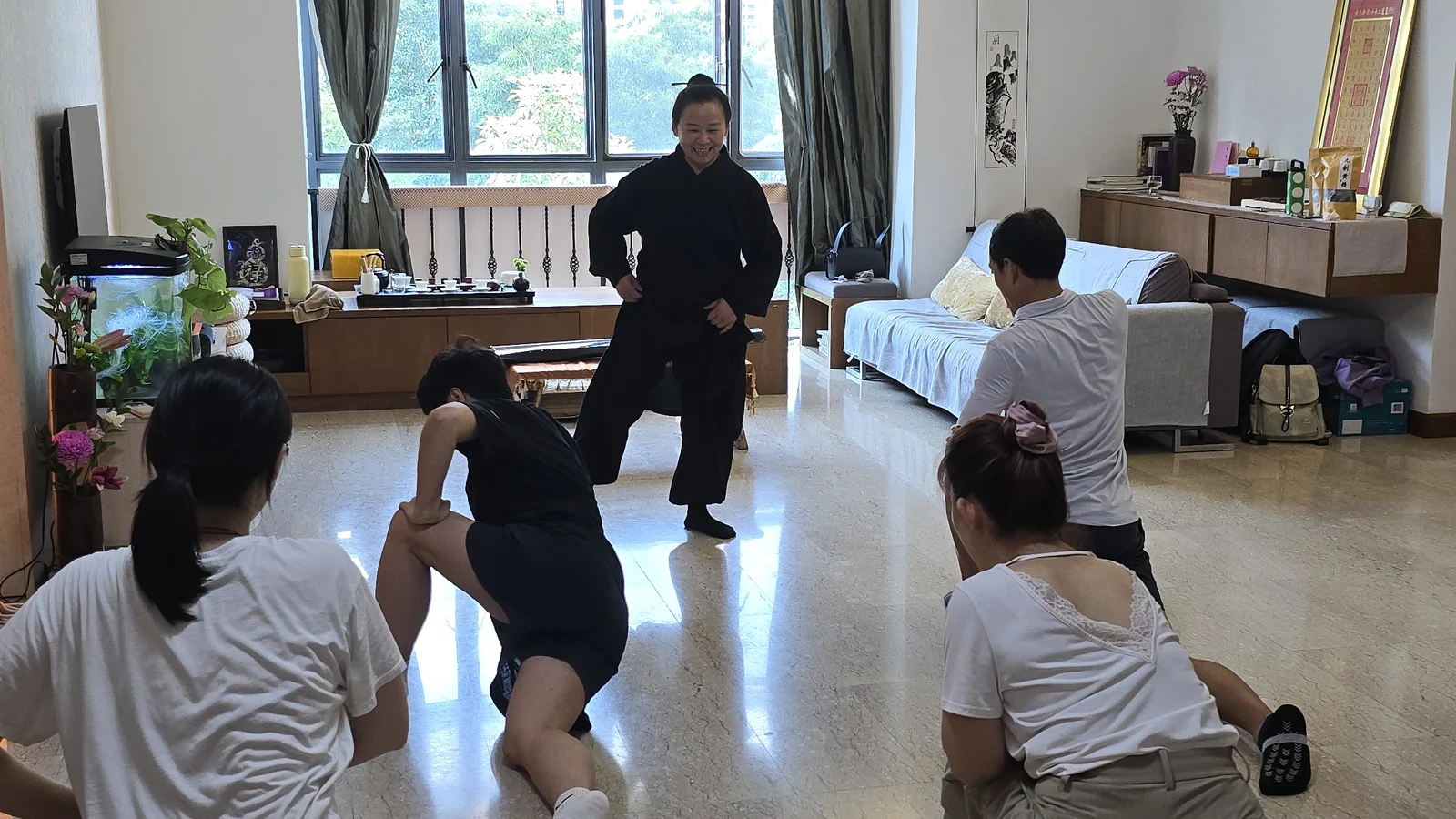
A Wudang taijiquan lesson in a sunlit room: students seen from behind kneel into deep lunges to open the hips while a teacher in black Taoist-style clothing stands in a wide stance, smiling, with an ink-painting scroll on the wall behind.

Why Direction Changes Reveal the Root: Seeking the Fault in the Waist and Legs

In Wang Zongyue's Taijiquan Lun (太极拳论), two classic lines diagnose why many practitioners lose balance when turning corners in a form: 'Stand like a balanced scale, turn like a cartwheel' (立如平准,活似车轮), and 'Whenever timing and advantage of position are not achieved, the body falls into disorder; the fault must be sought in the waist and legs' (有不得机得势处,身便散乱,其病必于腰腿求之). Forward and backward steps along a single line are relatively straightforward, but Wudang Taijiquan routines frequently turn 90, 135, or 180 degrees—such as transitioning from Single Whip (Danbian 单鞭) into Cloud Hands (Yunshou 云手), turning into Brush Knee (Louxi Aobu 搂膝拗步), or weaving through the Four Corners in Fair Lady Works at Shuttles (Yunü Chuansuo 玉女穿梭). Every one of these turns relies on two complementary footwork actions: the Inward Hook Step (Koubu 扣步) and the Outward Swing Step (Baibu 摆步).

The Golden Rule of Knee Safety: Unweighting Before Pivoting and Leading from the Kua

The single most common cause of medial knee strain in Taijiquan happens when a student leaves heavy body weight on a foot while trying to grind or twist that foot inward (Koubu) or outward (Baibu) on the floor. Anatomically, the human knee is a modified hinge joint designed primarily for flexion and extension, whereas rotational capacity belongs to the ball-and-socket hip joint (Kua 胯). Before turning either foot, you must apply Wu Yuxiang's rule of 'clearly distinguishing empty and full' (分清虚实): shift the majority of your weight off the pivoting foot—or release the unweighted heel/ball so friction drops—and initiate the turn by folding and rotating the inguinal crease (songkua 松胯). When the femur rotates inside the hip socket as one unit with the shin and foot, the knee cap and toes always point in the exact same direction.

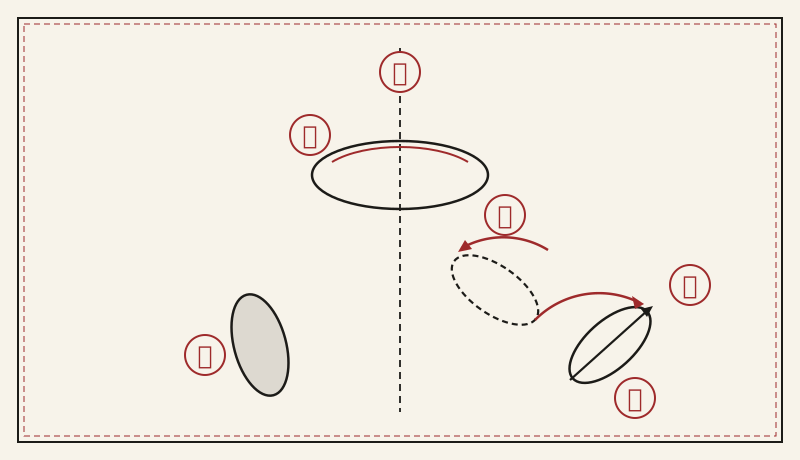
Classical Wudang ink-on-parchment diagram of Inward Hook Step (Koubu) and Outward Swing Step (Baibu) showing Weight Separation (①), Inguinal Kua Folding (②), Inward Hook Arc (③), Outward Swing Arc (④), Knee-Toe Alignment Axis (⑤), and Vertical Plumb Axis (⑥).

Key — ① Full Weight Separation (分清虚实, emptying the pivoting foot before turning); ② Inguinal Crease Folding (松胯圆裆, driving rotation from the hip socket rather than the knee); ③ Inward Hook Step (扣步, toes turning inward along a smooth arc to close the angle); ④ Outward Swing Step (摆步, toes opening outward to establish the new corner or line); ⑤ Knee-Over-Toe Safety Vector (膝与趾合, keeping the patella aligned with the second toe); ⑥ Vertical Plumb Line (立如平准,活似车轮).

Mechanics of Koubu (Inward Hook Step) and Baibu (Outward Swing Step)

An Inward Hook Step (Koubu 扣步) turns the toes of the front or stepping foot inward toward the centerline to close the pelvis and prepare a change of direction. To execute Koubu cleanly, sit back slightly into the rear hip crease to lighten the front foot, allow the front ankle to relax, and let the waist turn the whole front leg inward so the foot settles cleanly along the new angle without collapsing the inner arch. Conversely, an Outward Swing Step (Baibu 摆步) turns the toes of the lead or empty foot outward—typically 45 to 90 degrees—to open the hip gate before shifting weight forward into the next posture. In Baibu, the empty foot peels up lightly or glides like Wu Yuxiang's 'cat-walking step' (maobu 猫步, 迈步如猫行), touches down heel-first with the toes turned outward, and only receives weight after the new alignment between hip, knee, and toe is established.

A Five-Minute Corner-Turning Solo Drill for Courtyard or Small-Space Practice

You can refine Koubu and Baibu in a two-meter square without needing a full training hall. Begin in a left Bow Stance (Gongbu 弓步) with your hands resting lightly at the sides of your waist so you can feel pelvic alignment directly. First, sink into your rear (right) hip crease until the front (left) fore-foot feels light, then rotate your left hip socket inward to perform a 90-degree Koubu. Next, shift your weight smoothly onto the left leg while keeping the left knee aligned over the left toes, peel the right foot empty, and open the right hip crease outward for a 45-degree Baibu into a right Bow Stance. Repeat slowly in a four-corner square for five minutes. Safety note: Practice in flat, smooth-soled shoes on an even floor that allows clean pivoting without gripping, and reduce your stance length immediately if you feel any rotational tug at the inside of the knee.

Seeker’s Q&A · Frequently Asked Questions

What is the key structural alignment in Inward Hook Step (Koubu) and Outward Swing Step (Baibu) in Wudang Taijiquan?

How to execute the Inward Hook Step (Koubu) and Outward Swing Step (Baibu) in Wudang Taijiquan—using complete weight separation (Fen Qing Xu Shi) and hip-crease (Kua) rotation to turn 90 to 180 degrees smoothly without twisting the supporting knee.
