WUDANG TAIJIQUAN · 武当太极拳

The Four Corner Energies (Si Yu Jin): Pluck (Cai), Split (Lie), Elbow (Zhou), and Shoulder-Stroke (Kao) in Wudang Taijiquan 四隅手(采、挒、肘、靠):武当太极拳的八门劲路完备、远近三门转换与大捋要法

A comprehensive technical guide to Cai (采), Lie (挒), Zhou (肘), and Kao (靠)—the Four Corner Energies (四隅手) that pair with Peng, Lu, Ji, and An to complete the Eight Trigram methods of Wudang Taijiquan.


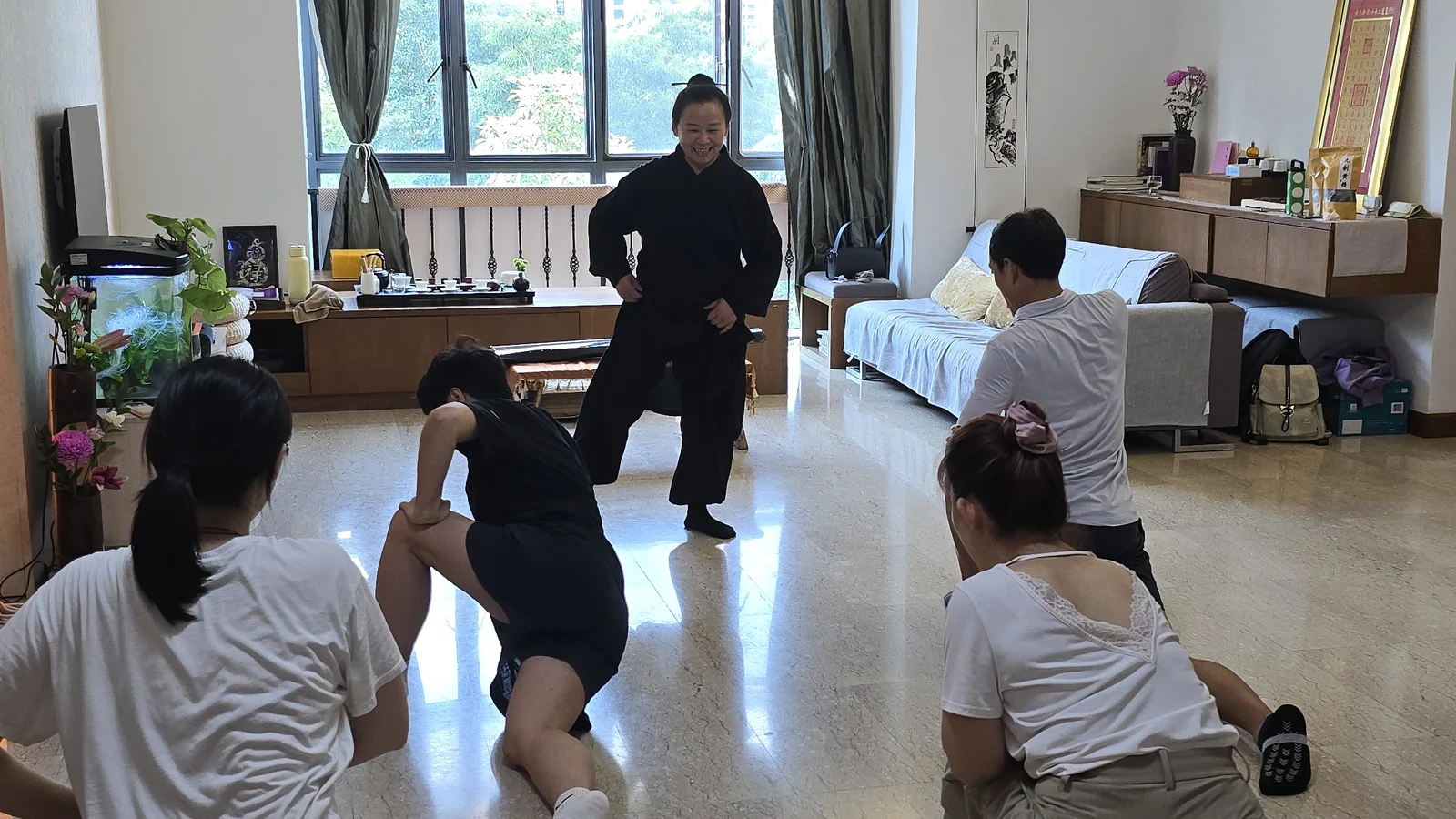
A Wudang taijiquan lesson in a sunlit room: students seen from behind kneel into deep lunges to open the hips while a teacher in black Taoist-style clothing stands in a wide stance, smiling, with an ink-painting scroll on the wall behind.

Completing the Eight Trigrams of the Thirteen Postures: Si Zheng and Si Yu

In classical Wudang Taijiquan and the foundational treatises preserved in our Taoist & Martial Classics overview, the eight martial energies of the Thirteen Postures (Shisanshi, 十三势) are divided into two complementary groups of four: the Four Cardinal Energies (Si Zheng, 四正—Peng, Lu, Ji, and An, examined in Grasping the Sparrow's Tail (Lanquewei)) and the Four Corner or Diagonal Energies (Si Yu, 四隅): Pluck (Cai, 采), Split (Lie, 挒), Elbow-Stroke (Zhou, 肘), and Shoulder/Body-Stroke (Kao, 靠). Mapped to the four corner trigrams of the Bagua—Xun (巽, Wind), Zhen (震, Thunder), Dui (兑, Lake), and Gen (艮, Mountain)—the Four Corner Energies come into play whenever the cardinal line is overextended, blocked, or breached at close quarters.

Cai (采, Pluck) and Lie (挒, Split): Lever Fulcrums and Spinning-Wheel Shear

How do Cai (采) and Lie (挒) differ from the cardinal Roll-Back (Lu, 捋)? Where Lu guides an incoming force along a long, smooth arc across the waist, Cai acts like a crisp, short-lever drop—traditionally compared to a steelyard weight balancing a heavy load (Qian Jin Cheng Chui, 千斤秤锤)—using a sudden sinking of the hip crease and wrist (as in the downward fold of Needle at Sea Bottom) to uproot an opponent's heel. Lie, by contrast, is rotational splitting energy compared to a rapidly spinning potter's wheel or waterwheel that flings off anything touching its rim: one hand draws inward while the other forearm or palm spirals diagonally outward across a fulcrum, shearing the opponent's structure along the diagonal corners practiced in Jade Maiden Works the Shuttles.

The Four Corner Energies (Si Yu Jin): Pluck (Cai), Split (Lie), Elbow (Zhou), and Shoulder-Stroke (Kao) in Wudang Taijiquan

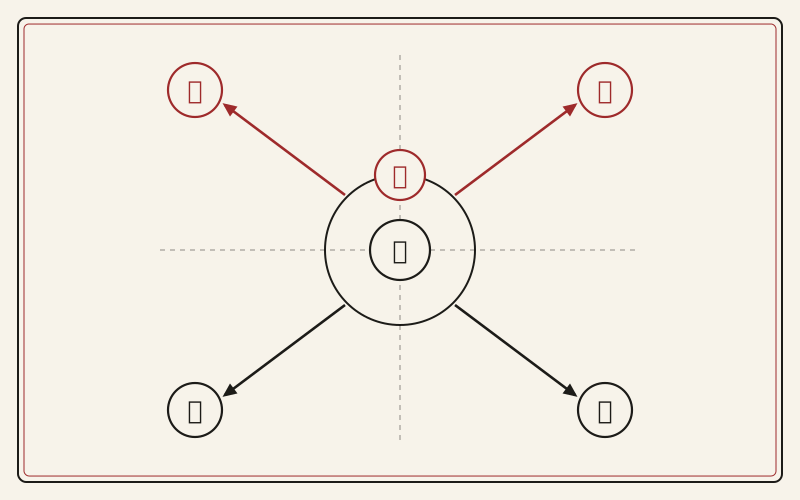
Biomechanical structure of the Four Corner Energies (Si Yu Jin — Cai, Lie, Zhou, Kao) completing the Eight Trigrams of Wudang Taijiquan: ① Central Cardinal Ring of Peng, Lu, Ji, and An (Si Zheng), ② Pluck (Cai / Xun Trigram —lever-like downward-diagonal fulcrum drop like a steelyard weight), ③ Split (Lie / Zhen Trigram — rotational two-way shear like a spinning wheel throwing off water), ④ Elbow-Stroke (Zhou / Dui Trigram — compact middle-gate folded-arm spiral supported by the waist), ⑤ Shoulder-and-Back Stroke (Kao / Gen Trigram — close-range mountain-like whole-torso wedge emission from the rear foot), and ⑥ Seamless transition between Cardinal (Si Zheng) and Corner (Si Yu) lines.

Zhou (肘, Elbow) and Kao (靠, Shoulder/Back): Middle and Close-Gate Reserve

Traditional Wudang manuals divide upper-limb range into three gates: the hand is the outer gate (Waimen, 外门), the elbow is the middle gate (Zhongmen, 中门), and the shoulder/torso is the inner gate (Neimen, 内门). When an opponent slips past the wrist, Zhou (肘) engages the folded forearm and elbow tip—never swinging the elbow in isolation from the shoulder, but sinking the scapula and driving the folded frame directly from the waist and rear leg. If the distance closes even further to chest-to-chest contact, Kao (靠—associated with the Gen / Mountain trigram) unites the shoulder, upper back, or hip into a single grounded wedge supported by a deep bow or horse stance, releasing short-range whole-body momentum without leaning off the central axis.

Integrating the Four Corners in Da Lu (大捋) and Solo Form Practice

In the courtyard practice of Wudang Mountain and our Start Here curriculum, the Four Corner Energies are trained both inside the solo form and in the four-corner two-person drill known as Da Lu (大捋, 'Large Roll-Back', see our Wudang Push Hands and Tingjin Guide). Whether executing Cai, Lie, Zhou, or Kao, the practitioner adheres to the third treasure of Tao Te Ching Chapter 67—'not daring to be first'—waiting for the partner's cardinal line to falter before answering along the diagonal.

Seeker’s Q&A · Frequently Asked Questions

What is the key structural alignment in The Four Corner Energies (Si Yu Jin)?

A comprehensive technical guide to Cai (采), Lie (挒), Zhou (肘), and Kao (靠)—the Four Corner Energies (四隅手) that pair with Peng, Lu, Ji, and An to complete the Eight Trigram methods of Wudang Taijiquan.
