
WUDANG TAIJIQUAN · 武当太极拳

Needle at Sea Bottom (Haidizhen) & Fan Through the Back (Shantongbei) in Wudang Taijiquan: Folding the Kua, Sinking to Gather & Expanding Through the Spine 武当太极拳“海底针”与“闪通背”详解:松胯折叠、下采沉劲与通背开合

How to dive downward in Haidizhen by folding the hip crease rather than hunching the back—and how to rebound immediately into Shantongbei so power flows through the upper spine into both arms.

A clear mountain stream running between mossy boulders through bamboo and forest in soft morning light.

Few transitions in Wudang Taijiquan display the interplay of Yin and Yang—gathering low to the earth and expanding high toward the sky—more vividly than the paired sequence “Needle at Sea Bottom” (海底针, Haidizhen) followed immediately by “Fan Through the Back” (闪通背, Shantongbei). In the first posture, you sink into a compact Empty Stance (Xubu) as your right fingertips point diagonally toward the floor like a diver searching for a needle on the ocean bed; in the very next breath, you rise, step forward into a broad Bow Stance, and open both arms from the upper back like a great fan unfolding.

1. Biomechanical Anatomy: Folding in Haidizhen & Unfolding in Shantongbei

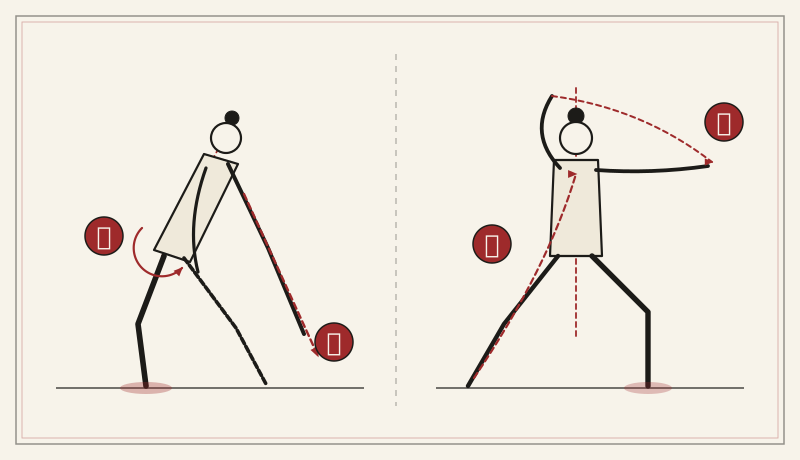
Classical ink-and-cinnabar diagram comparing Needle at Sea Bottom (Haidizhen) on the left with deep rear hip folding and diagonal downward hand vector, and Fan Through the Back (Shantongbei) on the right with spinal unfolding and overhead-and-forward split palms

Two-phase folding and unfolding mechanics of Needle at Sea Bottom and Fan Through the Back (海底针与闪通背 · 折胯下沉与拔背开展).

  1. Folding the Rear Inguinal Crease (松胯折叠 · 折胯不折腰): in Haidizhen, the forward inclination of the torso comes strictly from hinging deep in the rear hip socket (Kua 胯) while the spine from tailbone to crown remains one long, unbent line
  2. Diagonal Downward Piercing Vector (海底针 · 采挒下插): as the left hand brushes past the knee, the right wrist aligns with the shoulder and points 45 degrees downward ahead of the front toe without locking the elbow
  3. Unfolding From Heel Through Spine (蹬腿转腰 · 劲起于背): transitioning into Shantongbei, ground reaction travels up the rear leg through the waist to expand the upper back between the shoulder blades (Jiaji 夹脊)
  4. Fanning Through Both Arms (闪通背 · 上托下推,一身备五弓): the lead hand arcs above the temple while the opposite palm extends forward at chest height, connected through a single dorsal bow (Six Harmonies)

2. Why “Folding the Kua” (折叠松胯) Protects Both Your Lower Back and Your Balance

Beginners trying to reach closer to the floor in Needle at Sea Bottom almost always make the same mistake: they leave their hips stiff and bend their lumbar spine, dropping their head and collapsing their chest. In classical Taijiquan theory (Taijiquan Lun), rounding the lower back breaks the central equilibrium (Zhongding 中定) and allows an opponent who pulls slightly on your wrist to tip you onto your face.

  • Hinge at the hip crease, not the waist vertebrae: Imagine a crease at the groin of your rear supporting leg folding inward like a pocketknife while your tailbone draws backward to counterbalance your crown (Weilu Zhongzheng). Even if your torso inclines 30 degrees forward, your neck, thoracic spine, and lumbar spine stay spacious and elongated.
  • How deep should the fingertips reach? Height is determined by your hip mobility and leg strength—never by bending your neck. Pointing Toward the shin or ankle height with a clean, integrated spine is far superior to touching the floor with a hunched back.

3. What Does “Fan Through the Back” (闪通背) Mean?

Echoing Chapter 22 of the Tao Te Ching (Dao De Jing)—“Yield and remain whole; bend and become straight” (Qu ze Quan, Wang ze Zhi 曲则全,枉则直)—the deep fold of Haidizhen stores elastic potential across the hips and back. As you step forward into Shantongbei:

  • Shan (闪, “Flash / Evade”): Stepping slightly off the incoming line while raising the lead forearm above the temple to deflect high force (similar in upper-arm structure to Fair Lady Works at Shuttles, yet opening along a longer longitudinal arc).
  • Tongbei (通背, “Through the Back”): Rather than pushing from the isolated shoulder muscles, feel the space between your shoulder blades widen (Hanxiong Babei 含胸拔背) so that the upward-supporting arm and forward-pressing palm are driven as one continuous bow through the upper back.
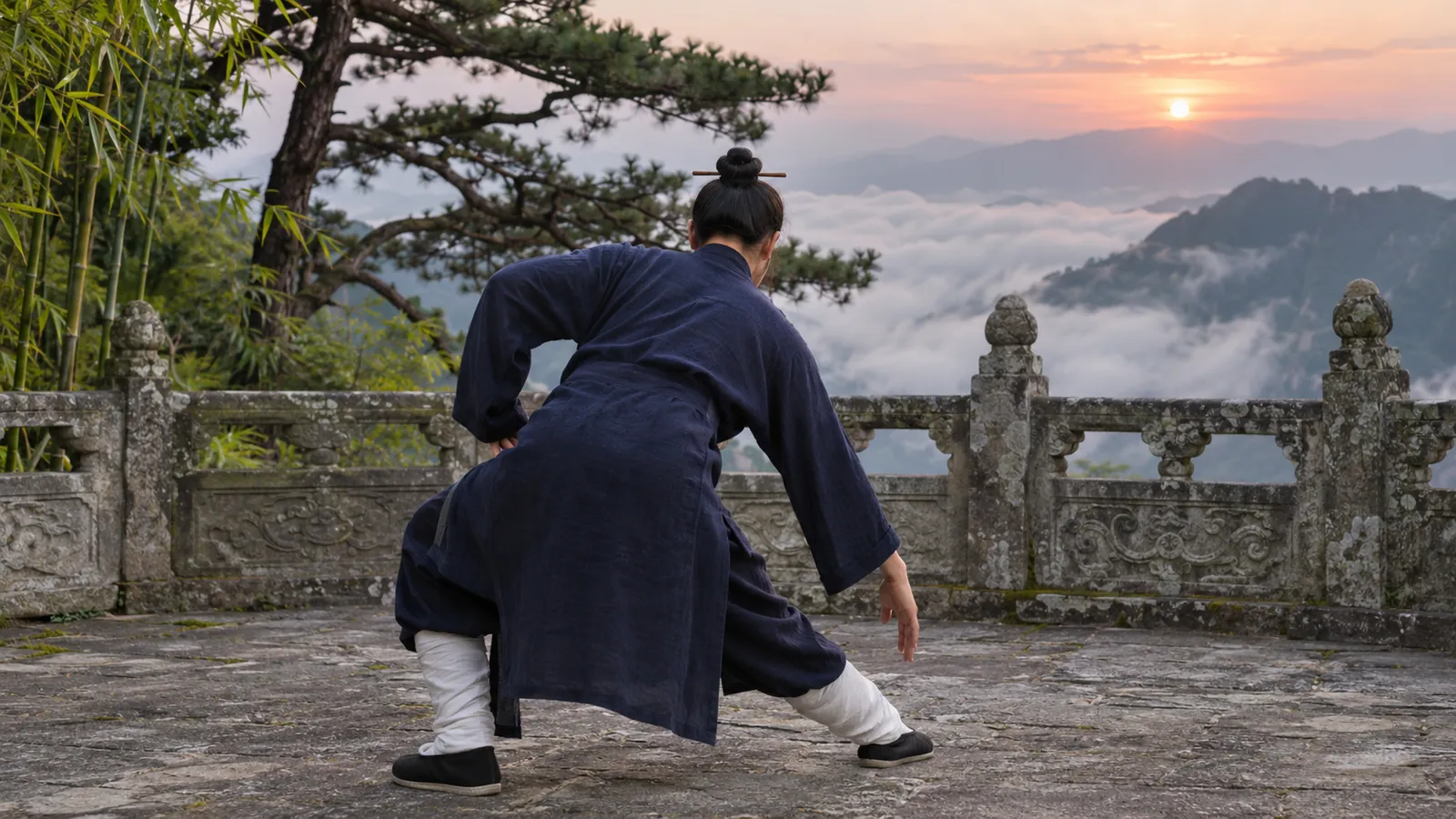
A practitioner in dark indigo Taoist robes and white cotton leg wraps seen from behind folding forward from the hips with one hand pointing down in Wudang Taijiquan’s Needle at Sea Bottom (Haidi Zhen) on a stone mountain terrace above morning clouds.

Needle at Sea Bottom (Haidi Zhen) at dawn: the weight sits back, the spine stays long as the torso folds from the hips, and the fingertips point down.

4. Training Folding and Expansion Between Wudang Mountain and Singapore

Connecting the living martial heritage near Wudang Mountain’s UNESCO World Heritage ancient Taoist temples with our regular classes in Singapore, Wudang.Org teaches students how to unite lower-body root with spinal elasticity. Start with Wudang Tai Chi for Beginners, visit Start Here, or join our Singapore Tai Chi Retreat Camp.

Safety note: In Haidizhen, keep 70–80% of your weight on the rear supporting leg with the rear knee aligned over the toes, and fold only as far as your hips allow with a straight spine; traditional martial training does not replace medical care.

Seeker’s Q&A · Frequently Asked Questions

Why should I never bend my lower back or drop my head in Needle at Sea Bottom (Haidizhen)?

Because rounding the spine breaks your central equilibrium and strains the lumbar vertebrae. Instead, fold deeply in the rear hip crease (Kua) so the entire spine from tailbone to crown inclines as one straight, elongated line.


What does “Tongbei” (通背, “Through the Back”) mean in Fan Through the Back (Shantongbei)?

It means that the two arms are connected across the upper back (Jiaji) like a single bow: power rises from the rear heel through the waist and spine, expanding between the shoulder blades to drive both the upper guarding hand and the forward palm simultaneously.

How is weight distributed between the two feet in Needle at Sea Bottom?

Needle at Sea Bottom uses a classic Empty Stance (Xubu): 70–80% of your weight sits solidly in the rear supporting leg, while the front foot touches the ground lightly with the ball or toes for balance.
