WUDANG TAIJIQUAN · 武当太极拳

High Pat on Horse (Gaotanma) in Wudang Taijiquan: High Empty Stance, Plucking-Drawing to the Hip & Threading Palm Along the Centerline 武当太极拳“高探马”详解:半步高虚步、回捋采挒与穿掌扑面要领

Why this poised posture rises slightly from Single Whip into a high Empty Stance like a rider looking out from horseback—uniting a downward plucking hand at the hip with a forward probing palm.

A sheer layered cliff face hung with ferns and pines above a misty gorge.

In the traditional Wudang Taijiquan form, right after the broad, low expansion of Single Whip (Danbian), the posture gathers inward and rises slightly into a poised, alert figure: “High Pat on Horse” (高探马, Gaotanma). Its lively name evokes a rider sitting tall in the saddle and reaching forward to pat the neck or bridle of a spirited horse while holding the reins near the waist with the other hand.

Yet this posture also carries a second warning hidden inside the word Tan (探, “to reach out / probe”): in beginner practice, reaching forward with the palm almost always tempts the student to lean their upper torso forward and shrug their shoulder—the classic error called “probing the shoulder and leaning the waist” (探肩弯腰). How do you reach far with the palm while keeping your spine as upright as the cicada-catcher’s rooted tree stump?

1. Structural Anatomy of High Pat on Horse (高探马)

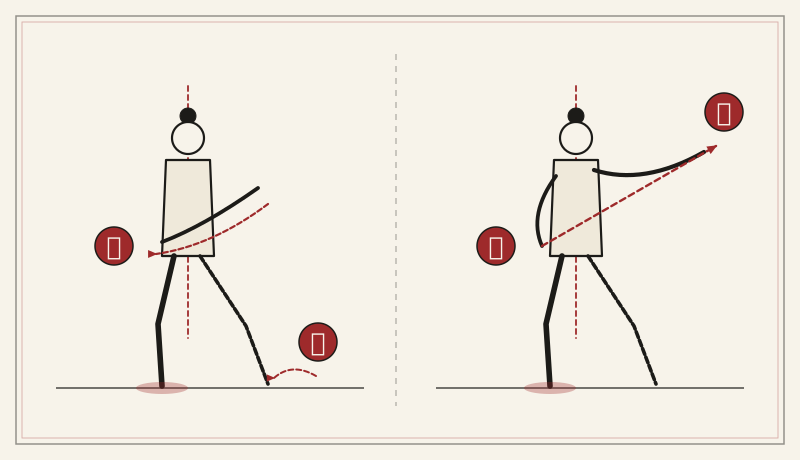
Classical ink-and-cinnabar diagram of Wudang Taijiquan High Pat on Horse (Gaotanma) showing the half-step gathering into a high Empty Stance and downward plucking hand on the left, and the forward threading palm counter-balanced by the rear hip and lower palm on the right

Four biomechanical keys of High Pat on Horse (武当太极拳“高探马”四维图解).

  1. Half-Step Gathering into High Empty Stance (跟步高虚步 · 坐胯虚点): the rear foot steps up half a step to take 70–80% of the weight while the front foot adjusts onto the ball/toes in a slightly higher Empty Stance (Xubu)
  2. Lower Plucking-Drawing Hand to the Hip (前手翻掌回捋 · 采挒引化): the front (left) hand turns palm-up and draws backward-and-downward to the left hip—neutralizing an opponent’s incoming arm along a downward spiral (Chansijin)
  3. Upper Threading-Probing Palm (后手顺臂上穿 · 扑面探掌): as the waist turns slightly left, the rear (right) palm threads smoothly over the left forearm and extends forward along the centerline at throat-to-forehead height
  4. Diagonal Two-Way Split (一捋一穿 · 沉肩不探身): every inch that the right palm reaches forward is counter-balanced by the left palm drawing back to the left waist and the rear hip sitting down (Six Harmonies)

2. Why “Drawing Back the Lower Hand” Gives Power to the Upper Palm

Echoing Chapter 36 of the Tao Te Ching (Dao De Jing)—“What is to be extended must first be gathered” (将欲张之,必固翕之)—Gaotanma is never a one-handed poke:

  • When an opponent reaches toward your chest or grabs your lead wrist, your lead (left) hand turns palm-up and draws their arm downward toward your left hip (combining Pluck Cai 采 and Roll-Back Lü 捋).
  • At the exact same instant, your rear (right) hand slides over the top of your left forearm like an arrow resting on a bow-hand, gliding straight toward their unguarded face or collarbone while your front foot remains light and ready to kick.

3. Three Checkpoints to Avoid Leaning Forward in “Gaotanma”

  • Send the palm forward by turning the waist and extending the scapula—not by tipping the spine: Your vertical plumb line from crown (Baihui) to perineum (Huiyin) stays perpendicular to the flagstones.
  • Keep the reaching shoulder sunken and the elbow heavy (Chenjian Zhuizhou): Even though the right fingertips reach eye-to-throat level, the right elbow points downward and the armpit stays hollow.
  • Maintain a true Empty Stance: Confirm that you can lift your front toes an inch off the floor without your torso wobbling forward.

4. Training Poised Centerline Control Between Wudang Mountain and Singapore

Connecting the living martial heritage near Wudang Mountain’s UNESCO World Heritage ancient Taoist temples with our regular classes in Singapore, Wudang.Org guides students through the complete traditional form. Begin with Wudang Tai Chi for Beginners, visit Start Here, or join our Singapore Tai Chi Retreat Camp.

Safety note: Keep the rear supporting knee aligned over the rear toes in the high Empty Stance and avoid hyper-extending the reaching elbow; traditional martial training does not replace medical care.

Seeker’s Q&A · Frequently Asked Questions

Why is the posture called “High Pat on Horse” (Gaotanma 高探马)?

“High” (Gao) refers to rising slightly from the low Single Whip into a poised high Empty Stance; “Pat on Horse” (Tanma) describes the one hand holding the reins at the waist while the other reaches out at head-to-throat height as if patting a horse’s neck.


How do I extend my palm forward in High Pat on Horse without leaning my torso or shrugging my shoulder?

Use the two-way counter-pull: for every inch your right palm threads forward, draw your left palm backward to your left hip and sink your rear hip socket—keeping your spine vertical and your right shoulder blade settled.

How do the two hands pass each other during the transition into Gaotanma?

As the left hand turns palm-up and draws back toward the left waist, the right palm threads smoothly forward directly over the top of the left forearm along the centerline.
