WUDANG TAIJIQUAN · 武当太极拳

Turn Body and Chop with Fist (Zhuanshen Piechui) and Fist Under Elbow (Zhoudi Kanchui) in Wudang Taijiquan 武当太极拳“转身撇身锤”与“肘底看锤”详解:转腰扣步螺旋撇打与虚步藏锤要领

Master the classical Wudang Taijiquan sequence of Turn Body and Chop with Fist (Zhuanshen Piechui) and Fist Under Elbow (Zhoudi Kanchui) — 180-degree heel-pivot stepping, waist-driven spiraling back-fist mechanics, inner-elbow palm guarding, and Empty-Stance vertical fist alignment.


A rolled scroll tied with cord, a small lit oil lamp and a vase with a pine sprig on a dark wooden table before open lattice windows, with misty pines at dusk outside.

1. Two of the Classic Five Fists (Wuchui): Pieshenchui and Zhoudi Kanchui

In the classical transmission of Wudang and traditional Taijiquan, while most postures employ the open palm (zhang 掌) to listen, adhere, and redirect, five specialized postures crystallize whole-body spiraling energy into a compact fist (Wuchui 五锤 — the Five Fists): Deflect, Parry, and Punch (Banlanchui), Turn Body and Chop with Fist (Zhuanshen Piechui 转身撇身锤, also called Pieshenchui 撇身捶), Fist Under Elbow (Zhoudi Kanchui 肘底看锤), Punch to the Groin/Lower Gate (Zhidangchui 指裆锤), and Downward Planting Punch (Zaichui 栽锤, practiced alongside Needle at Sea Bottom).

In traditional form sequences, Zhuanshen Piechui and Zhoudi Kanchui often appear in close succession: Zhuanshen Piechui teaches how to neutralize pressure from behind by pivoting 180 degrees and uncoiling a diagonal overhand back-fist arc (pie 撇 — skimming or casting outward with Peng 掤 and Lie 挒 energy), whereas Zhoudi Kanchui gathers the frame into a compact Empty Stance (Xubu) with a vertical fist poised in reserve beneath the lead ward-off elbow.

2. Step-by-Step Biomechanics of Turn Body and Chop with Fist (Zhuanshen Piechui)

When transitioning into a right Turn Body and Chop with Fist from a preceding posture facing west, begin by shifting weight back onto the right leg and turning the left foot inward (koubu 扣步) as far as the hip joint comfortably allows while keeping the knee aligned with the toes. Next, shift your weight securely onto the turned-in left leg, fold the left kua (inguinal crease), and draw the right foot in before stepping out cleanly toward the east on a hip-width track so you never walk a tightrope.

During the pivot, coil both arms softly before the torso: the right hand forms a firm but unstrained fist at the left ribcage or waist with the palm side facing inward/downward, while the left open palm guards near the right shoulder. As weight flows forward into the right Bow Stance (Gongbu 弓步), turn the waist from left to right and uncoil the right forearm forward and upward in a Silk-Reeling (Chansijin) arc until the fist rests at nose-to-chest height with the thumb side facing upward/inward, while the left palm follows smoothly to rest near the inside of the right elbow (huzhang 护掌). Power originates from the rear foot and waist rotation — never from snapping the elbow joint dryly.

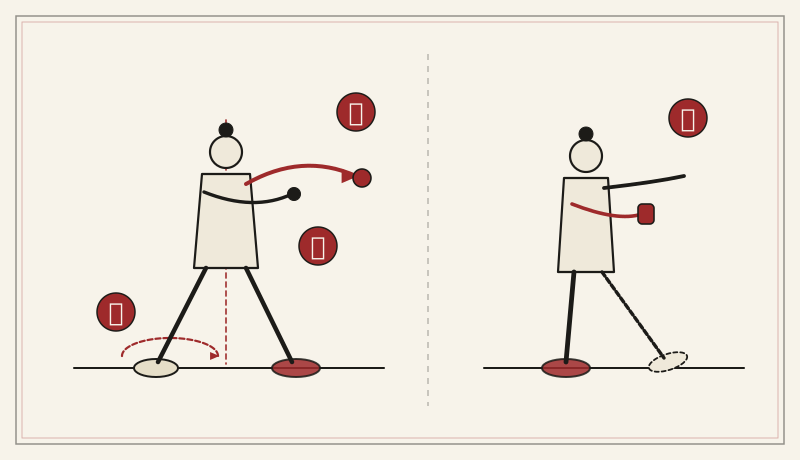
Classical ink-and-cinnabar biomechanical diagram of Turn Body and Chop with Fist (Zhuanshen Piechui) and Fist Under Elbow (Zhoudi Kanchui) with four numbered markers (①–④).

Figure 1: Turn Body and Chop with Fist (Zhuanshen Piechui) and Fist Under Elbow (Zhoudi Kanchui) — ① 180-degree rear-pivot footwork on the central axis (Zhuanshen Koubu); ② Waist-driven spiraling back-fist chop (Pieshenchui); ③ Guarding open palm tracking near the inner elbow (Huzhang Xiangsui); ④ Fist Under Elbow in Empty Stance (Zhoudi Kanchui).

  1. ① 180-Degree Pivot and Root (Zhuanshen Koubu 转身扣步): Shifting weight, turning the hooked foot in deeply on the heel, and stepping out along the new line of direction without losing vertical equilibrium.
  2. ② Spiraling Overhand Back-Fist Chop (Pieshenchui 撇身锤): Uncoiling the waist so the forearm and back of the fist roll forward and outward in a Peng-Lie arc at chest-to-brow height.
  3. ③ Guarding Palm at the Inner Elbow (Huzhang Xiangsui 护掌相随): The opposite open palm tracks lightly near the inner elbow or forearm to protect the centerline and balance the structure.
  4. ④ Fist Under Elbow in Empty Stance (Zhoudi Kanchui 肘底看锤): Settling into an agile Empty Heel Stance with the vertical fist nested quietly beneath the lead ward-off elbow.

3. Fist Under Elbow (Zhoudi Kanchui): Guarding the Center and Storing Elastic Reserve

Following the expansion of Pieshenchui (or after a transitional retreat such as Repulse the Monkey and Step Up to Seven Stars), Fist Under Elbow (Zhoudi Kanchui 肘底看锤) consolidates the practitioner's centerline. Sitting 70–80 percent of the weight into the rear right leg, let the left foot step half a pace forward to touch the ground lightly with the heel in a Left Empty Stance (Zuo Xubu 左虚步).

Simultaneously, extend the left open palm forward at chest-to-chin height with the palm facing right (or obliquely inward) in a rounded ward-off (Peng 掤) curve, while the right hand forms a vertical fist (lichui 立锤, eye of the fist quanyan 拳眼 facing upward) tucked quietly two to three cun (寸) beneath the left elbow. The phrase kanchui (看锤 — "watching over the fist" or "guarding fist") reminds the practitioner that the upper lead arm deflects and listens while the lower fist beneath the elbow stores coiled energy ready to issue forward or upward at any instant.

4. Key Alignment Checks and Solo Practice Drill

In the courtyard training of Wudang Mountain and our Singapore classes, we emphasize three alignment checks for this pair of postures: 1) Turn on the heel before shifting weight in the 180-degree pivot — never twist a weighted knee during Zhuanshen Piechui; empty the pivoting foot sufficiently, turn it from the hip socket, and only then transfer weight; 2) Keep a rounded curve in the chopping arm — if the right arm straightens completely in Pieshenchui, the shoulder uproots from the back; maintain a soft bend at the elbow with the left palm two inches from the inner forearm; 3) Relax the grip of the fist — hold both fists as if cradling a small fledgling bird: firm enough in structure that the wrist does not buckle, yet hollow enough at the center (laogong 劳宫) that Qi and blood circulate freely.

Practice the linked drill Zhuanshen Piechui → Deflect, Parry, and Punch (Banlanchui) → Zhoudi Kanchui slowly on both sides for six minutes, matching inhalations to the pivots and coilings and exhalations to the settles. Traditional Wudang Taijiquan builds lower-body stability, spinal coordination, and calm presence and does not replace professional medical care.

Seeker’s Q&A · Frequently Asked Questions

What is the core takeaway of Turn Body and Chop with Fist (Zhuanshen Piechui) and Fist Under Elbow (Zhoudi Kanchui) in Wudang Taijiquan?

Master the classical Wudang Taijiquan sequence of Turn Body and Chop with Fist (Zhuanshen Piechui) and Fist Under Elbow (Zhoudi Kanchui) — 180-degree heel-pivot stepping, waist-driven spiraling back-fist mechanics, inner-elbow palm guarding, and Empty-Stance vertical fist alignment.
