WUDANG TAIJIQUAN · 武当太极拳

Slanted Single Whip (Xie Danbian) and the Five-Finger Hook Hand (Goushou) in Wudang Taijiquan: Diagonal Corner Opening and Wrist-Drop Alignment 武当太极拳「斜单鞭」与「五指勾手」要诀:四隅斜角转换、腕顶领劲与扁担对拉练法

How to practice Slanted Single Whip (Xie Danbian) and the classical Five-Finger Hook Hand (Goushou) in Wudang Taijiquan—transitioning from Embrace Tiger Return to Mountain into the diagonal corner while keeping the hook wrist supple and the spine centered between the two hands.


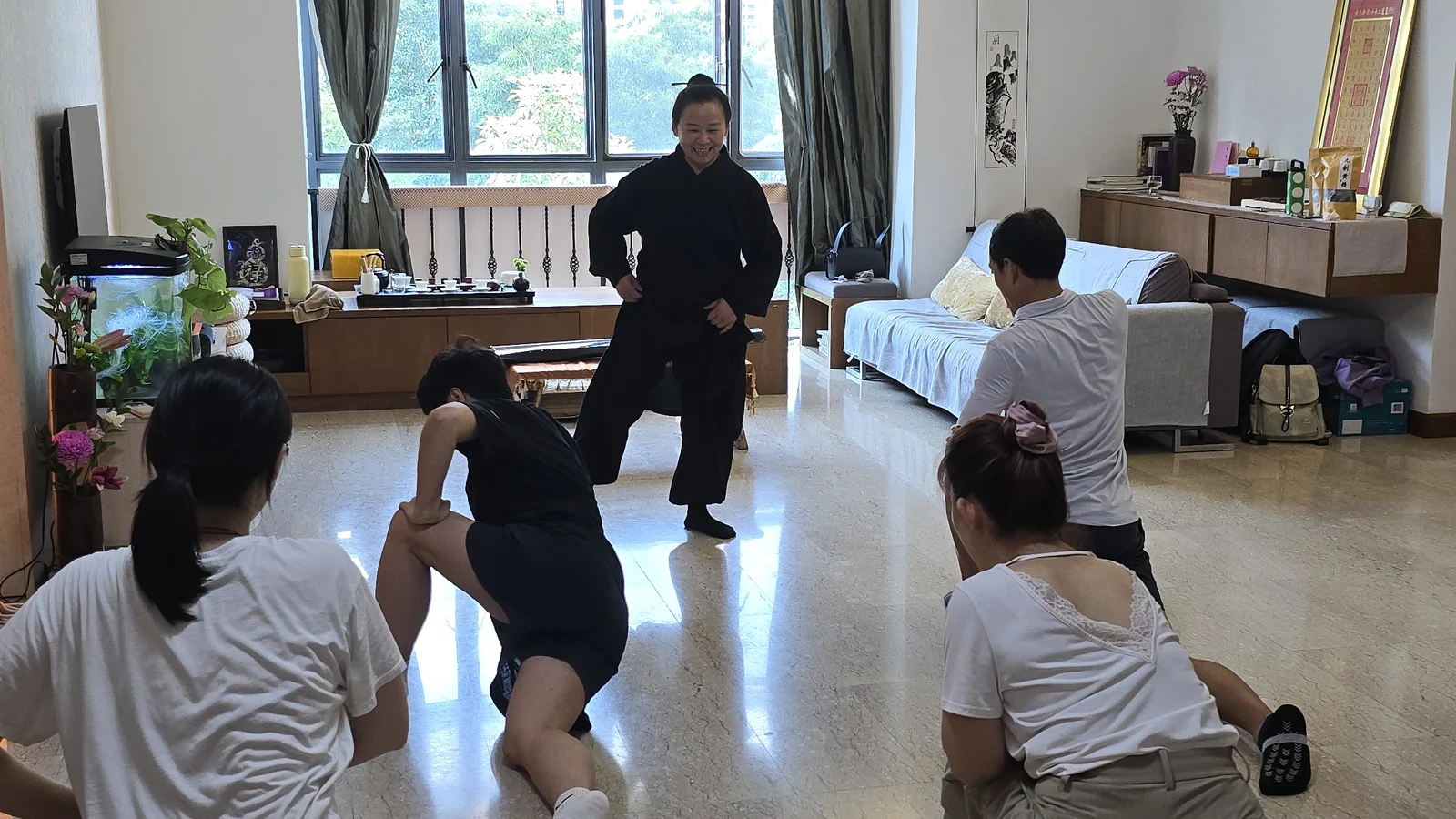
A Wudang taijiquan lesson in a sunlit room: students seen from behind kneel into deep lunges to open the hips while a teacher in black Taoist-style clothing stands in a wide stance, smiling, with an ink-painting scroll on the wall behind.

Why “Slanted” Single Whip (Xie Danbian)? Opening the Four Diagonal Corners (Si Yu)

In Wudang Taijiquan, students first learn the cardinal-direction Single Whip (Danbian 单鞭) following Grasp the Sparrow's Tail (Lanquewei 揽雀尾) along the main east-west axis of the form. Later in the routine—immediately after Embrace Tiger and Return to the Mountain (Baohu Guishan 抱虎归山)—a second variation appears: Slanted Single Whip (Xie Danbian 斜单鞭). Here the word xie (斜, 'slanted' or 'diagonal') does not mean leaning the spine off vertical! Rather, it refers to stepping into the Four Diagonal Corners (Si Yu 四隅—northeast, southeast, northwest, southwest) at a 45-degree angle to the main hall axis, fulfilling Wu Yuxiang's structural principle that 'the Four Corners supplement the Four Cardinal Directions' (四隅以辅四正). By stepping onto the diagonal corner after yielding in Baohu Guishan, the practitioner opens a spacious new line of Peng (掤) expansion.

How to Form the Classical Five-Finger Hook Hand (Goushou / Diaoshou) Without Stiffening the Forearm

Whether in cardinal Danbian or diagonal Xie Danbian, the rear hand forms Taijiquan's signature Hook Hand (Goushou 勾手, also called Diaoshou 刁手). Beginners often pinch all five fingertips together with white-knuckled force or bend the wrist backward into a tight cramp. In Wudang pedagogy, the Hook Hand is formed with the same 'supple sinews and firm grasp' (骨弱筋柔而握固) as the Hollow Fist: 1. Gather the Five Pad Tips Lightly: Bring the pad of the thumb to touch the pads of the index and middle fingers first, with the ring and little fingers gathering softly alongside them like a crane's beak (五指指肚轻拢如鹤嘴), leaving a small hollow inside the palm. 2. Let the Wrist Hang Naturally (Quwan Xiachui): Rather than squeezing the fingertips, allow the wrist joint to flex downward so the rounded top of the wrist (wanduan 腕顶) becomes the buoyant point of expansion, while the elbow stays slightly lower than the wrist (肘微低于腕).

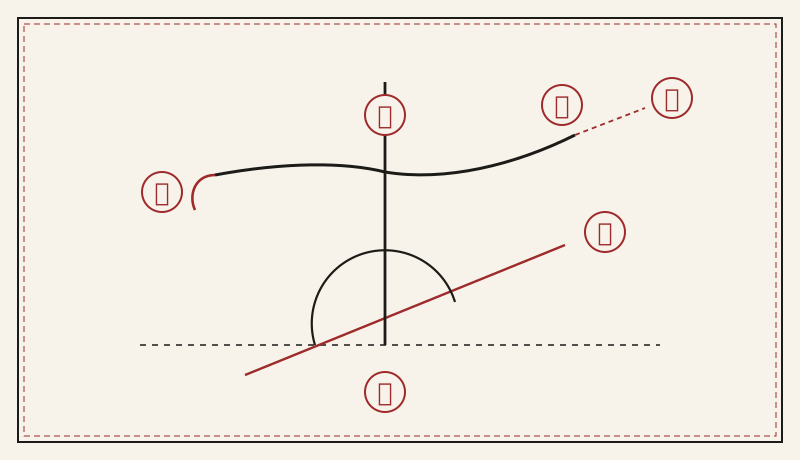
Classical Wudang ink-on-parchment diagram of Slanted Single Whip (Xie Danbian) showing Cardinal-to-Diagonal Corner Step (①), Five-Finger Hook Hand Goushou with Dropped Wrist (②), Diagonal Lead Tile-Ridge Palm (③), Central Spine Pivot Carrying Both Arms Like a Carrying-Pole (④), Open Rounded Crotch Yuandang (⑤), and Gaze Through the Lead Palm (⑥).

Key — ① Cardinal-to-Diagonal Corner Step (由四正迈入四隅斜角弓步); ② Five-Finger Hook Hand (五指轻拢成勾手,屈腕下垂而腕顶领劲); ③ Diagonal Lead Tile-Ridge Palm (前手瓦楞掌顺斜角旋推); ④ Spine as the Central Carrying-Pole (脊柱为扁担,两手前后对拉平衡); ⑤ Open Rounded Kua and Crotch (松胯圆裆,忌夹裆拧膝); ⑥ Gaze Looking Past the Lead Palm (目视前掌方向).

The Carrying-Pole Principle: Balancing Hook Hand and Lead Palm Across the Spine

When stepping out with the left foot into the diagonal left Bow Stance of Xie Danbian, beginners frequently over-rotate their shoulders so the right Hook Hand swings too far behind their back (勾手过背), pulling the chest wide open and twisting the front knee inward. Think instead of a traditional bamboo carrying-pole (biandan 扁担) resting across your upper back (Dazhui 大椎 and both shoulder blades): your spine is the central pivot, your right Hook Hand extends toward the right-rear diagonal (about 135 degrees from your front foot, never behind your spine's plane), and your left arm spirals open across the chest into a seated Tile-Ridge Palm (Walengzhang 瓦楞掌) along the left-front diagonal. Because the rear Hook Hand and the front Palm pull gently away from each other through the rounded upper back (babei 拔背), the torso feels effortlessly suspended between them.

A Four-Minute Baohu Guishan to Xie Danbian Diagonal Transition Drill

To make the transition into Xie Danbian smooth and knee-safe, practice it from the closing of Baohu Guishan (where you stand in a right Bow Stance facing the right-rear diagonal after Press An 按). Step 1 (Sit Back & Gather Hook): Inhale, shift weight slightly onto your left leg, pivot your right foot inward (Koubu), shift back onto the right leg, and let your right hand gather softly in front of your right shoulder into a five-finger Hook Hand (Goushou) as your left palm curves beneath your right elbow. Step 2 (Cat-Step to the Diagonal Corner): Empty your left foot and step out 45 degrees toward the left-front diagonal corner (迈向斜角), touching the heel down first. Step 3 (Shift Weight & Open the Whip): On a slow exhale, transfer weight into the left Bow Stance while your left palm arcs across your face (eyes watching the palm as if looking in a mirror) and settles forward with a seated wrist as the right Hook Hand anchors behind. Repeat 6 times per side. Safety note: Keep the rear hip and front hip open (圆裆) so your front knee tracks directly over your second toe—never let the pull of the rear Hook Hand drag your front knee inward.

Seeker’s Q&A · Frequently Asked Questions

What is the key structural alignment in Slanted Single Whip (Xie Danbian) and the Five-Finger Hook Hand (Goushou) in Wudang Taijiquan?

How to practice Slanted Single Whip (Xie Danbian) and the classical Five-Finger Hook Hand (Goushou) in Wudang Taijiquan—transitioning from Embrace Tiger Return to Mountain into the diagonal corner while keeping the hook wrist supple and the spine centered between the two hands.
