QIGONG & DAOYIN · 气功与导引

How to Close Standing Post & Qigong Practice Properly (Shougong): Gathering Qi to the Dantian and Five Classical Self-Massage Steps 武当站桩与气功“收功法”详解:引气归元与道家五步导引按跷(干浴面、鸣天鼓、摩腹温肾)

Why the classical proverb warns that “practising without closing scatters what you cultivated”—and how a 5-minute Wudang Shougong sequence seals warmth into the lower abdomen, eyes, scalp, and kidneys.

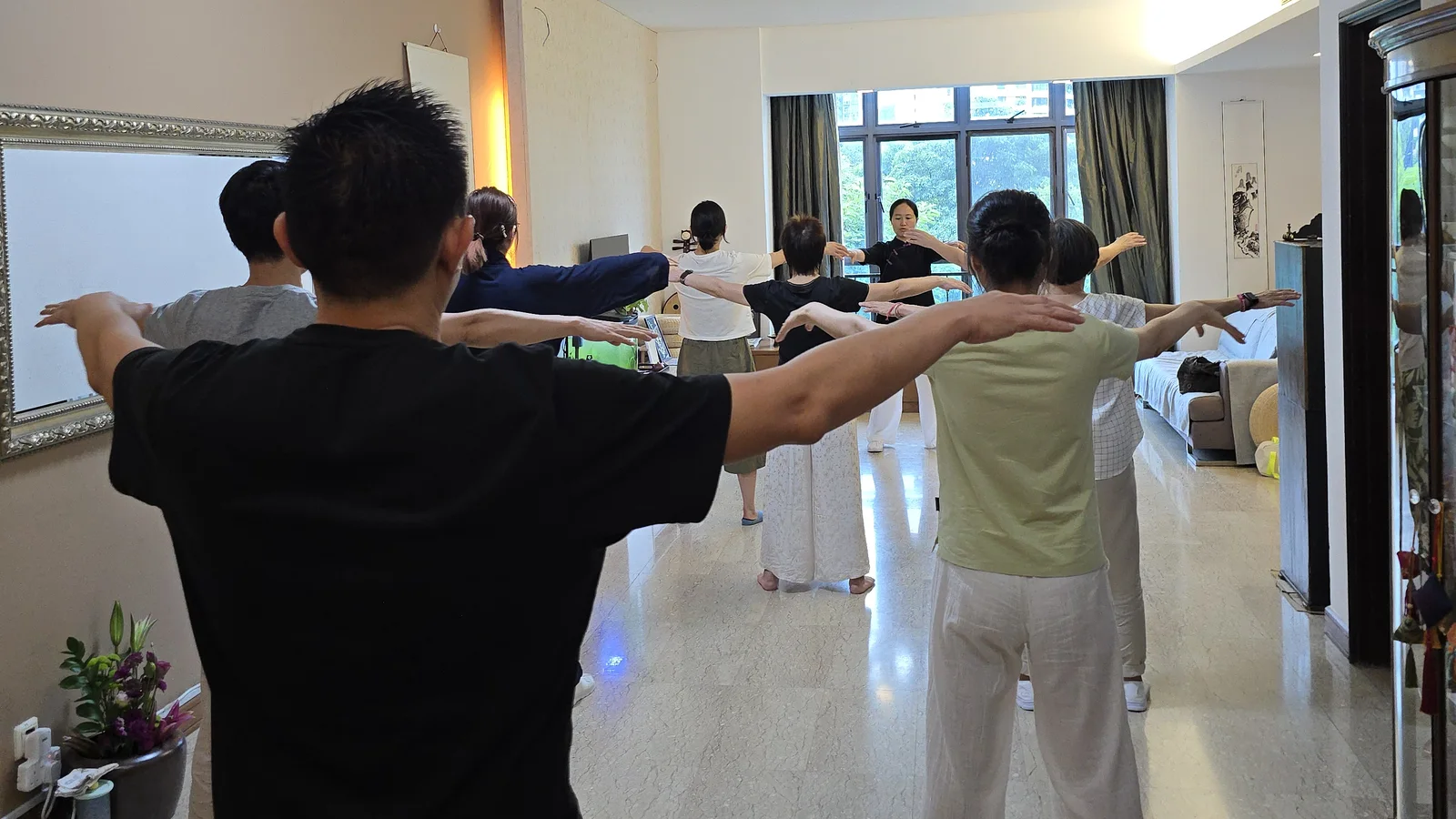
A standing qigong class in a sunlit room: students seen from behind hold both arms open at shoulder height in the same alignment, facing a teacher in dark clothing before a tall window with green trees outside.

There is an old saying shared across Taoist Qigong and internal martial arts halls: “Practising without closing properly leaves your effort half-finished” (练功不收功,不如不练功). When you stand in Zhan Zhuang (Standing Post) or complete a set of Baduanjin or Wudang Taijiquan, your palms may feel warm, and the mind settles into a deep, receptive stillness. If you abruptly drop your arms, check your phone, or rush out the door, you leave that mobilized vitality floating on the surface instead of storing it at the root.

In the Wudang tradition—drawing on Sun Simiao’s Tang-dynasty manual Yangxing Yanming Lu (《养性延命录》) and the Huangting Jing—the 5-minute transition between deep practice and everyday activity is called Shougong (收功, “Harvesting / Closing the Work”).

1. Why Closing Practice (收功) Echoes “Returning to the Root”

In Chapter 16 of the Tao Te Ching (Dao De Jing), Laozi observes: “The ten thousand things flourish together, and each returns to its root. Returning to the root is called stillness; stillness is called returning to life’s mandate” (归根曰静,静曰复命). During active Qigong or Taiji movement, Qi and warmth expand outward to nourish the limbs and meridians; during Shougong, you gently gather that warmth back into the lower Dantian and use the warmth of your own palms to nourish the eyes, face, scalp, ears, and kidneys.

2. The Complete 5-Minute Wudang Five-Step Shougong Sequence

Perform these five steps unhurriedly at the close of every standing post, Daoyin, or Taijiquan session:

  1. Step 1 — Three Breaths Gathering Qi to the Origin (三开合 · 引气归元): Stand with feet shoulder-width apart. Inhale slowly through the nose as both arms float out to the sides and curve upward to embrace the space before your chest; exhale gently as both palms descend along the midline, guiding awareness down into the lower abdomen below the navel (Natural Abdominal Breathing). Repeat three times, then rest both palms overlapped over the lower Dantian (left hand inside for men, right hand inside for women, or whichever feels natural) for six quiet breaths while swallowing any sweet saliva.
  2. Step 2 — Warming the Palms, Cupping the Eyes & Dry-Washing the Face (搓手熨目 · 干浴面): Briskly rub your palms together until the centers of the palms (Laogong 劳宫穴) feel warm. Cup the warm palms lightly over your closed eyes for ten seconds (Mingmu Yunjing). Then sweep the palms upward along the sides of the nose to the forehead and stroke outward-and-downward across the cheeks to the chin eighteen times, as if washing your face with warm spring water.
  3. Step 3 — Combing the Scalp & Beating the Heavenly Drum (十指干梳头 · 鸣天鼓): Curve all ten fingertips like a wooden comb and rake gently from the front hairline over the crown down to the nape of the neck eighteen times. Next, cover both ears with your palms (fingers resting on the back of the occiput) and lightly tap the base of the skull twelve times with your index fingers—producing a resonant, soothing drum-beat inside the head known as Ming Tiangu (鸣天鼓, “Beating the Heavenly Drum”).
  4. Step 4 — Kneading the Abdomen & Warming the Kidneys (摩腹消食 · 摩肾堂): Place both warm palms over the navel and circle gently across the abdomen eighteen times clockwise and eighteen times counter-clockwise. Then rub the palms warm again and stroke up-and-down across the lower back on both sides of the spine (Warming the Kidneys and Mingmen) until the waist feels supple and warm.
  5. Step 5 — Patting the Limbs & Unhurried Walking (拍打四肢 · 散步舒肢): Lightly pat down the outsides and up the insides of both arms and legs, gently shake out your wrists and ankles, and take twenty slow steps around the room before drinking a cup of warm water.

3. Two Common Mistakes to Avoid Right After Practice

  • Avoid cold wind or cold water immediately after standing: Because your pores open slightly during practice, wipe away any sweat with a dry towel and wait fifteen minutes before washing hands in cold water or stepping into a direct air-conditioning draft.
  • Never rush from deep stillness into jarring noise: Give your eyes and ears sixty seconds of gentle palm warmth so your inward focus (Jing, Qi, Shen) transitions smoothly into daily tasks.

4. Practising the Complete Arc Between Wudang Mountain and Singapore

Connecting the authentic cultivation tradition near Wudang Mountain’s UNESCO World Heritage ancient Taoist temples with our regular classes in Singapore, Wudang.Org teaches students both how to open a session and how to harvest its benefits properly. Compare our foundational sets in Choosing Your First Qigong Set or visit Start Here.

Safety note: Perform all self-massage strokes with gentle palm warmth rather than heavy force, and avoid pressing on bruised skin or acute inflammation; traditional Qigong and Daoyin are cultural wellness practices and do not replace medical care.

Seeker’s Q&A · Frequently Asked Questions

Why is closing practice (Shougong 收功) so important after Standing Post (Zhan Zhuang) or Qigong?

During practice, circulation opens to the extremities and the mind enters deep stillness. Shougong gently gathers that mobilized warmth back to the lower Dantian and transitions your senses smoothly back to daily life.


What is “Beating the Heavenly Drum” (Ming Tiangu 鸣天鼓) in Step 3?

Cover both ears gently with your palms while your fingers rest on the back of the head, then let your index fingers slip off the middle fingers to tap the occipital bone twelve times—creating a soothing drum-like resonance that refreshes the head and ears.

Why should I wait before washing my hands in cold water or standing in front of an air conditioner after Qigong?

Because standing and moving practice warms the body and opens the skin pores; letting sweat dry naturally and keeping warm for 10–15 minutes prevents cold draft from chilling the muscles and joints.
