
TAOIST PHILOSOPHY · 道家哲学

Returning to the Root (Guigen) and Restoring the Vital Mandate (Fuming) in Tao Te Ching Chapter 16 《道德经》第十六章“归根曰静,是谓复命”解:致虚守静与观复知常的修真枢机

Explore Chapter 16 of the Tao Te Ching (Dao De Jing) — attaining utmost emptiness (Zhi Xu Ji), guarding steadfast stillness (Shou Jing Du), observing the return of the ten thousand things to their root (Guigen Yue Jing), and restoring the vital mandate (Fuming) in Wudang internal cultivation.


An ancient tree with massive exposed roots beside stone steps and a stone balustrade descending through misty forest, with peaks beyond.

1. Textual Foundation: The Great Cycle of Chapter 16 of the Tao Te Ching

If Chapter 40 of the Tao Te Ching (Dao De Jing) states the law of Reversal and Return (Fan Zhe Dao Zhi Dong) in four compact words, Chapter 16 unfolds that law into the most complete meditation manual in the entire text: "Attain the utmost emptiness; guard steadfast stillness. The ten thousand things arise together; thereby I observe their return. Things flourish in luxuriant profusion, and each returns to its root. Returning to the root is called stillness; this is called returning to one's vital mandate; returning to one's vital mandate is called constancy; knowing constancy is called illumination. Not knowing constancy, one acts recklessly and meets with misfortune" (致虚极,守静笃。万物并作,吾以观复。夫物芸芸,各复归其根。归根曰静,是谓复命;复命曰常,知常曰明。不知常,妄作凶).

Across the centuries, commentators in the Taoist Classics tradition have regarded this chapter as the bridge between cosmic observation (guanfu 观复) and personal longevity. Just as a mountain pine survives winter storms by drawing its sap down from the wind-tossed branches into its deep subterranean roots, human beings renew their vitality (fuming 复命) only when they regularly withdraw outward mental and sensory dispersion back into quietness.

2. "Attain Utmost Emptiness, Guard Steadfast Stillness": How to Observe the Return (Guanfu)

Why must a practitioner first "attain utmost emptiness and guard steadfast stillness" (zhi xu ji, shou jing du 致虚极,守静笃) before they can "observe the return" (guanfu 观复)? Imagine standing beside a mountain pool on Wudang Mountain: as long as the water surface is whipped by wind or stirred up with mud, you see only fragmented ripples. When the mud settles and the surface becomes mirror-still (echoing the Mirror-Like Mind and the Classic of Clarity and Stillness, Qingjing Jing), the entire trajectory of the clouds and pines above becomes visible at a glance.

In ordinary life, our eyes are captivated by the noisy upward explosion of things (wanwu bing zuo 万物并作) — growth, ambition, novelty, and expansion. Yet someone whose heart-mind is empty and still sees the other half of the circle: every wave that rises must subside into the sea; every blossom that opens in spring must return its nourishment to the root in autumn (ge fu gui qi gen 各复归其根). Seeing both the outgoing blossom and the inward return is what Laozi calls Guanfu (观复 — contemplating the cyclical return).

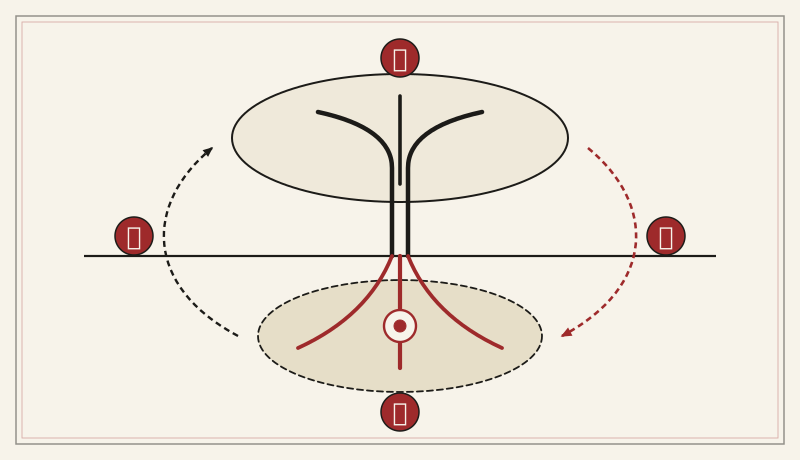
Classical ink-and-cinnabar diagram of Tao Te Ching Chapter 16 (Guigen and Fuming) with four numbered markers (①–④) illustrating utmost emptiness and stillness, the flourishing canopy of things, the return to the deep root, and the illumination of knowing constancy.

Figure 1: Returning to the Root in Tao Te Ching Chapter 16 — ① Attaining utmost emptiness and guarding steadfast stillness (Zhi Xu Ji, Shou Jing Du); ② The ten thousand things arising in profusion in the outer canopy (Wanwu Bing Zuo, Fu Wu Yunyun); ③ Each returning to its deep root in stillness to restore the vital mandate (Guigen Yue Jing, Shi Wei Fuming); ④ Knowing constancy as illumination (Fuming Yue Chang, Zhi Chang Yue Ming).

  1. ① Utmost Emptiness & Steadfast Stillness (Zhi Xu Ji, Shou Jing Du 致虚极·守静笃): Clearing mental clutter so the heart-mind becomes a quiet observatory.
  2. ② Flourishing of the Ten Thousand Things (Wanwu Bing Zuo, Fu Wu Yunyun 万物并作·夫物芸芸): The visible, active phase of spring and summer growth.
  3. ③ Returning to the Root & Restoring Life (Guigen Yue Jing, Shi Wei Fuming 归根曰静·是谓复命): Drawing dispersed sap and spirit back to the root to replenish congenital vitality.
  4. ④ Knowing Constancy as Illumination (Fuming Yue Chang, Zhi Chang Yue Ming 复命曰常·知常曰明): Acting in harmony with cyclical law rather than blind, reckless meddling (Wang Zuo).

3. From Stillness (Jing) to Restoring the Vital Mandate (Fuming) and Illumination (Ming)

Look closely at the four-link chain in Chapter 16: Root (Gen 根) → Stillness (Jing 静) → Restoring the Mandate (Fuming 复命) → Constancy (Chang 常) → Illumination (Ming 明). Why is returning to the root called "restoring the vital mandate" (fuming 复命)? In classical Taoist thought (explored in Dual Cultivation of Xing and Ming and Nourishing the Lord of Life, Yangsheng Zhu), when we chase external desires non-stop, our vital energy leaks outward through the senses until our innate life-potential (Ming 命) is depleted.

When we quiet the senses and settle awareness back into the root, we are not falling into lifeless inertia; we are recharging the battery of life (fuming 复命). Recognizing this rhythm of expansion and restoration as the unchanging law of nature (chang 常) gives rise to true clarity (zhi chang yue ming 知常曰明). Conversely, ignoring the need for return and pushing endlessly outward is "reckless action" (wang zuo 妄作), which inevitably leads to exhaustion and disharmony.

4. Wudang Martial and Contemplative Practice: Rooting in the Feet and Lower Dantian

In the traditional training halls of Wudang Mountain and in our Singapore classes, Guigen Yue Jing (归根曰静) has two immediate physical addresses in the body: the soles of the feet (Yongquan 涌泉) and the lower dantian (下丹田). As the classical Taijiquan Lun states: "Its root is in the feet, issued through the legs, governed by the waist, and expressed in the fingers" (其根在脚,发于腿,主宰于腰,形于手指). Whenever your upper body feels flustered in Push Hands (Tuishou) or unstable in single-leg postures like Swinging Lotus Kick (Shuang Bailian), the remedy is always the same: return your weight and breath to the root.

Practice this three-minute "Returning to the Root" exercise before sleep or during Standing Post (Zhan Zhuang): 1) Stand or sit with the spine upright and eyes softly curtained; 2) With each exhalation, imagine the scattered sap of the day's thoughts descending from the head and chest down through the torso into the lower dantian and the soles of the feet; 3) Rest in that quiet root for nine breaths before moving again. Traditional Wudang philosophy and Daoyin support stress resilience and physical balance and never replace professional medical care.

Seeker’s Q&A · Frequently Asked Questions

What is the core takeaway of Returning to the Root (Guigen) and Restoring the Vital Mandate (Fuming) in Tao Te Ching Chapter 16?

Explore Chapter 16 of the Tao Te Ching (Dao De Jing) — attaining utmost emptiness (Zhi Xu Ji), guarding steadfast stillness (Shou Jing Du), observing the return of the ten thousand things to their root (Guigen Yue Jing), and restoring the vital mandate (Fuming) in Wudang internal cultivation.
