QIGONG & YANGSHENG · 气功与导引

Kneading Quchi (曲池 LI-11) and Shousanli (手三里 LI-10): Wudang Elbow-Gate Daoyin for Forearm Suppleness and Sunk Elbows (Zhui Zhou) 武当导引“按揉曲池与手三里”精解:疏通手阳明枢纽、舒缓肘腕紧绷与落实“沉肩坠肘”的养生法

How opening the He-Sea Pool at the Elbow Bend (Quchi) and Arm Three Miles (Shousanli) connects the shoulder wells to the Tiger’s Mouth and prevents elbow strain in weapons and desk work.

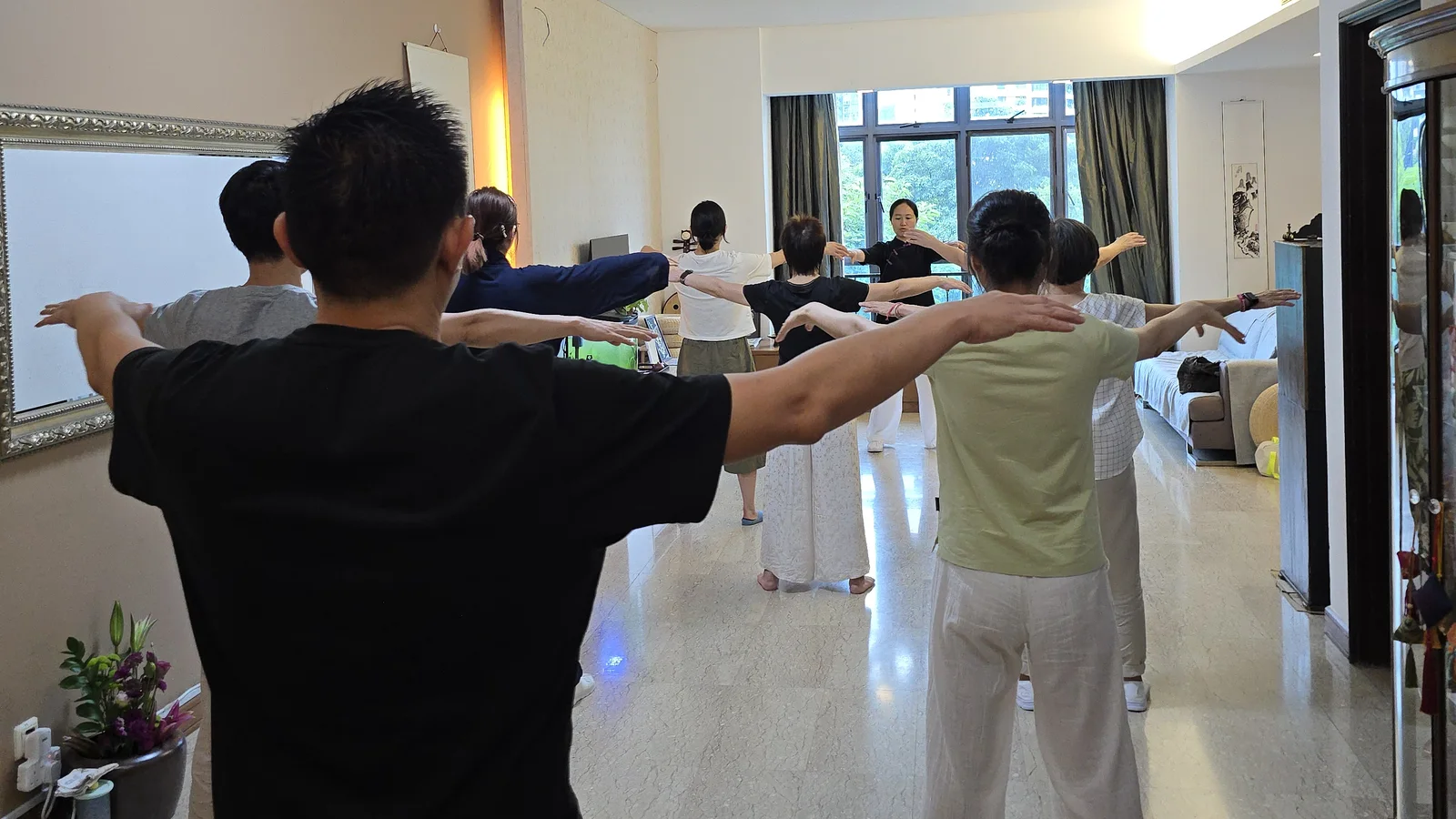
A standing qigong class in a sunlit room: students seen from behind hold both arms open at shoulder height in the same alignment, facing a teacher in dark clothing before a tall window with green trees outside.

1. Classical Meridian Theory: The Middle-Section Relay Bridge of the Arm (Zhong Jie 中节)

In classical Wudang martial biomechanics, the arm is divided into three sections (San Jie 三节): the shoulder is the root section (Gen Jie 根节), the hand is the tip section (Shao Jie 梢节), and the elbow is the middle section (Zhong Jie 中节). If the middle gate at the elbow is stiff or floating, energy from the waist and shoulder cannot reach the Tiger's Mouth (Hegu LI-4) and palm center (Laogong PC-8).

  1. Quchi (曲池, LI-11 — "Pool at the Bend," He-Sea Point of the Hand-Yangming Large Intestine Channel): When you bend your elbow to a 90-degree angle with the palm facing your chest, a transverse crease forms at the elbow bend. Quchi lies in the depression at the lateral (radial) end of that transverse cubital crease, midway between the crease end and the lateral epicondyle of the humerus. Because Qi and Blood gather here like water entering a deep pool at the bend of a river, Quchi is the master point for relaxing the elbow joint and clearing upper-body tension.
  2. Shousanli (手三里, LI-10 — "Arm Three Miles"): Located on the radial side of the dorsal forearm, 2 cun (three finger-breadths) distal to Quchi along the line connecting Quchi to the wrist crease, right on the muscular belly of the radial wrist extensors. Just as Zusanli (ST-36, "Leg Three Miles") invigorates the lower limbs, Shousanli is traditionally prized as a gate for easing forearm fatigue from gripping a Wudang straight sword (Taijijian) or typing at a keyboard.

2. Step-by-Step Wudang Elbow-Gate Daoyin Protocol

StepAnatomical Location & Arm PositionGentle Daoyin ActionBreath & Somatic Intention (Yi 意)
1. Bending the Elbow 90° to Open QuchiSit or stand upright; bend one arm at 90° across the front of the chest (palm facing inward) so the lateral elbow crease clearly appearsPlace the opposite thumb pad directly into the depression at the outer end of the elbow crease (Quchi LI-11) while the four fingers gently cradle the underside of the elbowInhale into the lower abdomen; let the shoulder blade and elbow weight sink downward
2. Breath-Synchronized Kneading at QuchiKeep the bent arm resting heavily in the supporting hand so the shoulder muscles do not workPress inward toward the bone on each slow exhale for 3 seconds, then knead in slow circles 24 times clockwise and 24 times counterclockwiseFeel a warm, pleasant distension spreading through the elbow joint and down the forearm
3. Three-Finger Measurement & Kneading ShousanliSlide the opposite thumb 2 cun (three finger-breadths) down the forearm from Quchi toward the thumb-side wrist onto the muscular ridge (Shousanli LI-10)Pluck and knead across and along the muscle belly (Bo Rou 拨揉) 24 times, releasing any ropy tightness in the forearm extensorsExhale slowly; feel stiffness from the wrist, index finger, and lateral elbow melting away
4. Cupped-Palm Patting & Sinking the Elbow (Zhui Zhou 坠肘)Cup the opposite palm (Kongxin Zhang) and pat lightly from the shoulder (Jianjing) down through Quchi and Shousanli to Hegu 9 times, then switch armsRest both arms in a low embrace posture (Baoqiu) for 3 quiet breaths, feeling the heavy, warm sensation at the tips of both elbowsAnchor the tactile memory of Chen Jian Zhui Zhou (沉肩坠肘, sunk shoulders and dropped elbows)

3. Bridging Elbow Daoyin to Taijiquan and Weapons Practice

  • Curing the "Flying Elbow" (Fei Zhou 飞肘): When practicing Deflect, Parry, and Punch (Banlanchui) and Rufeng Sibi or Wrapping and Coiling in Wudang Straight Sword, if the elbow wings outward, the shoulder immediately shrugs. Having warmed Quchi and Shousanli, you can feel the elbow hanging with gentle downward gravity like a plumb bob.
  • Safety Note: Use steady, comfortable thumb-pad pressure rather than sharp fingernail digging; if the lateral epicondyle bone itself is tender from overuse, focus on gentle palm warming over Quchi and soft kneading on the muscular belly of Shousanli rather than pressing directly on the bone prominence.

Seeker’s Q&A · Frequently Asked Questions

Where are Quchi (LI-11) and Shousanli (LI-10), and why knead them before Taijiquan or sword practice?

Bend your elbow to 90 degrees with the palm facing your chest: Quchi (LI-11) is in the hollow at the outer end of the elbow crease. Shousanli (LI-10) is three finger-breadths (2 cun) below it toward the wrist, on the muscle of the forearm. In Wudang martial theory the elbow is the middle section of the arm; if it is stiff or floats, force from the waist and shoulder does not reach the hand. Kneading these two points eases forearm fatigue from gripping a sword or typing, and helps the elbow hang heavy (坠肘) so the shoulder does not shrug. Use the thumb pad, not the nail, and if the bone at the outer elbow is tender, warm the area with the palm and knead only the muscle.


How do Quchi and Shousanli help me stop the “flying elbow” in Taijiquan and sword practice?

In Deflect, Parry and Punch (Banlanchui), Rufeng Sibi, or the wrapping and coiling of the Wudang straight sword, an elbow that wings outward makes the shoulder shrug at once. When the line through Quchi and Shousanli is loose and open, the elbow tip hangs down like a plumb weight and the shoulder releases with it. To try: knead both points, then practise one slow movement and notice whether the elbow drops toward the earth.
