QIGONG & DAOYIN · 气功与导引

Zhan Zhuang Posture Troubleshooting: How to Fix Knee Strain, Shoulder Fatigue, Lower-Back Arching, Shaking Legs and Restless Thoughts 武当站桩常见问题排解指南:膝盖酸痛、肩膀僵累、塌腰翘臀、双腿发抖与杂念纷飞怎么办?

A practical diagnostic handbook for standing meditation—distinguishing productive muscular re-education from joint strain, and adjusting your frame millimetre by millimetre.

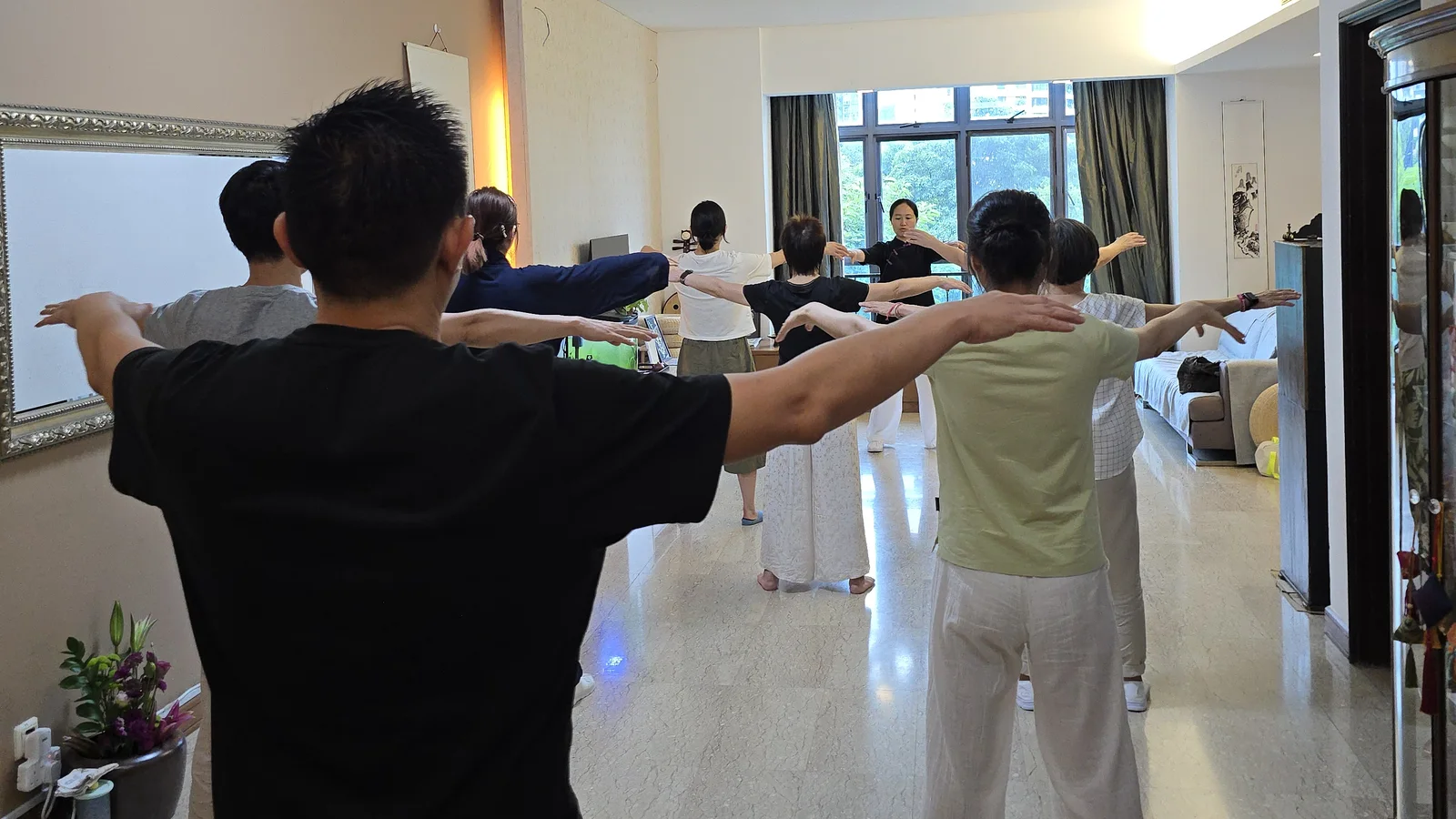
A standing qigong class in a sunlit room: students seen from behind hold both arms open at shoulder height in the same alignment, facing a teacher in dark clothing before a tall window with green trees outside.

Once you begin practising Zhan Zhuang (Standing Meditation) regularly—even for five or ten minutes a day—questions quickly arise on the mat. “Why are my shoulders burning after two minutes of holding the ball?” “Is it normal for my thighs to tremble?” “What should I adjust if I feel pressure on the front of my kneecaps?”

In traditional Wudang Qigong teaching, standing posture is not an endurance contest of gritting your teeth through discomfort (Wu Wei). As Chapter 24 of the Tao Te Ching (Dao De Jing) observes, “One who stands on tiptoe does not stand firm” (企者不立). Whenever a joint feels pinched or strained, your structure is simply asking for a two-millimetre alignment adjustment. Here is how to diagnose and resolve the five most common standing bottlenecks.

1. Issue 1: Pressure or Pinching in the Front of the Knees

  • Why it happens: Instead of folding the hip creases (song kua 松胯) and letting the pelvis sit slightly back as if perching on the edge of a high stool, the practitioner bends the knees straight forward over the toes, shifting weight onto the balls of the feet and loading the patellar tendon.
  • Immediate 3-point fix:
    1. Rise half an inch higher so your stance is comfortable and unstrained.
    2. Soften the hip creases (inguinal fold) so 55–60% of your weight settles toward the front edge of the heels and the centre of the arches (Yongquan), never jamming into the toes.
    3. Check that the centre of each kneecap points directly along the line of the second toe (yuan dang 圆裆—never caving inward or twisting outward) and never extends past the vertical line of the toes.

2. Issue 2: Burning Deltoids and Tight Neck in Hunyuan Zhuang (“Holding the Ball”)

  • Why it happens: Holding the arms up with the upper trapezius and neck muscles while clamping the armpits shut.
  • Immediate 3-point fix:
    1. Lower your hands two inches so they rest comfortably between navel and lower-chest height rather than shoulder height.
    2. Apply Sunk Shoulders and Dropped Elbows (Chenjian Zhuizhou): imagine two small paper lanterns hanging from the tips of your elbows, drawing the elbows slightly lower than both the wrists and the shoulders.
    3. Imagine resting your forearms lightly on a floating wooden ring in warm water, leaving a hollow space the size of a small apple under each armpit. If your shoulders still tire during a 10-minute session, smoothly lower your hands into low abdomen-cradling posture (Bao Dan Zhuang 抱丹桩) for two minutes before raising them again.

3. Issue 3: Lower-Back Tightness or Arching (Ta Yao 塌腰)

  • Why it happens: Sticking the tailbone backward (anterior pelvic tilt) or puffing the chest forward compresses the lumbar vertebrae and cuts off Natural Abdominal Breathing.
  • Immediate 3-point fix: Soften the sternum inward a millimetre (hanxiong 含胸), let the tailbone hang heavy toward the space between your two heels like a plumb bob, and feel the lower back (Mingmen 命门) widen and lengthen as you exhale.

4. Issue 4 & Issue 5: Trembling Thighs and a Restless Mind

  • Why do the legs shake mildly after 3–5 minutes? Gentle, involuntary quivering in the thighs is a normal sign that superficial, habitually tense muscles are fatiguing and handing load over to deeper postural stabilizers. So long as your knees are pain-free and your breathing stays smooth, simply stand a fraction higher and breathe through it; the trembling naturally subsides after a few weeks of consistent practice.
  • What if my mind keeps racing through to-do lists (“galloping while standing”)? Do not fight your thoughts with force. Give the mind a concrete somatic anchor (Shouyi & Xinzhai): spend three breaths scanning the crown, three breaths softening the jaw and shoulders, three breaths softening the hips, and three breaths feeling the warmth of the soles against the floor (“Breathing from the Heels”).

Connecting the contemplative heritage near Wudang Mountain’s UNESCO World Heritage ancient Taoist temples with our regular classes in Singapore, Wudang.Org guides students through safe, progressive internal training. Explore Choosing Your First Qigong Set, visit Start Here, or join our Singapore Baduanjin workshop and Tai Chi Retreat Camp.

Safety note: Warm muscular fatigue in the thighs is normal, whereas sharp, stabbing, or pinching pain inside a joint (knee, hip, or lower spine) is a signal to stop immediately and adjust your height and alignment; traditional Qigong is a cultural wellness practice and does not replace medical diagnosis or physical therapy.

Seeker’s Q&A · Frequently Asked Questions

Why do my knees hurt during Zhan Zhuang standing meditation, and how do I fix it?

Knee strain often comes from pushing the knees forward over the toes instead of folding the hip creases (kua). Stand half an inch higher, fold the hips back slightly so 55–60% of weight rests toward the heels and arches, and align the kneecaps with the second toes.


Is it normal for my legs to shake or tremble during Zhan Zhuang?

Yes. Mild, painless quivering in the thigh muscles is a normal stage as superficial tension releases and deeper postural stabilizers engage. Keep breathing calmly and stand slightly higher if needed; the shaking subsides with regular practice.

What should I do when my shoulders get tired holding the Hunyuan Zhuang ball posture?

Never clench your teeth and shrug through shoulder pain. Drop the elbows slightly lower than the wrists, keep a hollow space under the armpits, or smoothly lower your hands to cradle the lower abdomen (Bao Dan Zhuang) for two minutes before floating them back up.
