QIGONG & DAOYIN · 气功与导引

Wudang Eye-Brightening & Upper-Cervical Daoyin (Mingmu Yunjing): Palm-Cupping Warmth, Gaze Rotation and Suboccipital Release for Screen Fatigue 武当明目运睛与枕颈疏导法:温掌熨目、旋目远眺与风池松解的五分钟护眼功课

Why staring at a close screen tightens both the ocular muscles and the base of the skull—and how classical Taoist “Warming the Orbit” (Yunyan) and “Moving the Gaze” (Yunjing) restore soft, spacious vision.

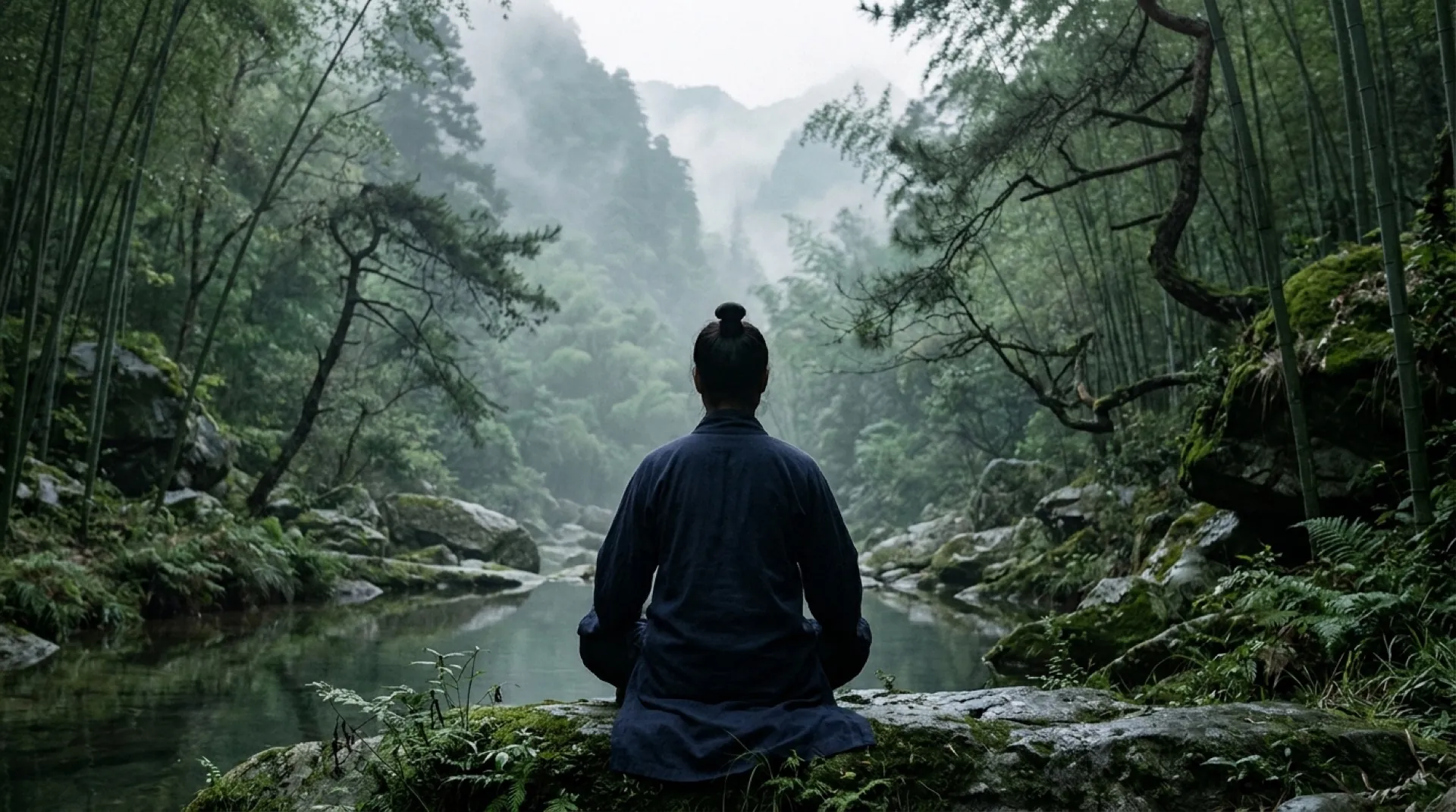
A figure in a dark robe with hair in a topknot, seen from behind, seated cross-legged on a mossy rock beside a still pool in a misty bamboo ravine.

When we spend six or eight hours reading code, spreadsheets, or messages on a glowing rectangle eighteen inches from our nose, our eyes are locked into a narrow, high-alert tunnel. Because the small suboccipital muscles right under the base of the skull reflexively contract with every tiny eye movement, digital eye strain often arrives hand-in-hand with a tight forehead, a heavy brow, and a stiff upper neck (Desk Neck and Shoulder Daoyin).

In classical Taoist Qigong and Daoyin, the eyes are regarded as the primary window of Shen (spirit/vital attention, see The Three Treasures: Jing, Qi, Shen). Already in the early medieval health manual Yangxing Yanming Lu (《养性延命录》) and the Huangting Jing tradition, masters taught daily “Warming the Eyes” (熨眼, Yunyan) and “Moving the Gaze” (运睛, Yunjing) to rest the visual spirit and unlock the base of the skull.

1. Why Tunnel Vision Drains Shen and Tightens the Upper Neck

Two classical principles explain why five minutes of ocular Daoyin refreshes the whole upper body:

  • “The Liver Opens into the Eyes, and the Sinews Gather at the Neck”: In traditional meridian theory and modern anatomy alike, sustained close-up staring keeps the ciliary and extraocular muscles in constant isometric contraction while locking the upper cervical vertebrae (C1–C2) so the head stays fixed in front of the monitor.
  • Withdrawing the Outward Gaze (收视返听): In Chapter 11 of the Zhuangzi (《在宥》), Guangchengzi advises: “Guard the inner and close off the outer; much scheming through the eyes and ears brings exhaustion.” Softening the gaze from a sharp point into a wide horizon helps the body ease out of tense vigilance and back toward a calmer, more comfortable state (Natural Abdominal Breathing).

2. A 5-Minute Wudang “Mingmu Yunjing” (明目运睛) Desk & Window Routine

Practise this four-step sequence once at mid-morning and once in the late afternoon, with glasses removed and hands clean:

  1. Minute 1 — Brisk Palm-Warming & Hollow Cupping (搓掌极热 · 温煦熨眼): Recording the method preserved in Yangxing Yanming Lu (“Often rub the hands until warm to comfort the eyes,” 常以手摩热熨眼), rub your two palms briskly together for 15–20 seconds until the centers of the palms (Laogong 劳宫) feel warm. Gently cup the hollowed palms over your closed eyes so the heels of the hands rest on the cheekbones and the fingers rest on the forehead—applying zero pressure directly on the eyeballs. Take five slow abdominal breaths, letting the warmth and darkness melt tension behind the eyes.
  2. Minute 2 — Tracing the Rim of the Orbit (轻刮眼眶 · 点按攒竹丝竹空): Using the smooth inner knuckles of your bent index fingers, gently stroke from the inner ends of the eyebrows (Zanzhu 攒竹) outward along the bony upper orbital ridge to the temples (Sizhukong 丝竹空), then lightly along the lower bony rim beneath the eyes, six times. Keep the touch light against the bone, never pulling the delicate eyelid skin.
  3. Minutes 3–4 — Slow Horizon Circles & Far-Near Pine Gazing (顺逆运睛 · 极目远眺): Keep your head and chin completely still (suspended from the crown). With eyes softly closed or half-veiled, roll your gaze slowly in a wide, unhurried circle—up toward the brow, right, down, and left—six times clockwise and six times counter-clockwise. Then open your eyes softly, look out a window at the farthest tree canopy or cloud line for twenty seconds, and shift your gaze back to your own thumb held twelve inches away for five seconds (repeating three times).
  4. Minute 5 — Releasing the “Wind Pool” at the Base of the Skull (拿揉风池 · 虚领收功): Place the pads of both thumbs into the two natural hollows just below the base of the skull on either side of the thick neck tendons (Fengchi 风池穴). Let the weight of your head lean back slightly into your thumbs as you trace eight slow, gentle circles while exhaling through the nose. Finish by sitting quietly with eyes closed for three breaths (Neiguan).

3. Pairing Eye Daoyin with Evening Wind-Down and Walking Practice

4. Cultivating Clear Vision Between Wudang Mountain and Singapore

Connecting the contemplative heritage near Wudang Mountain’s UNESCO World Heritage ancient Taoist temples with our regular classes in Singapore, Wudang.Org shares time-tested methods for everyday vitality. Compare our foundational sets in Choosing Your First Qigong Set, visit Start Here, or join our Singapore Baduanjin workshop.

Safety note: Always wash your hands before touching the face, never press directly on the eyeballs (cup only over the surrounding bony orbit), and skip eye-rolling if you experience vertigo, acute eye inflammation, or recent ophthalmic surgery; this cultural wellness routine does not replace an optometrist or ophthalmologist examination.

Seeker’s Q&A · Frequently Asked Questions

How do I perform Taoist palm-cupping (“Warming the Eyes” 熨眼) safely without pressing on the eyeballs?

After rubbing your palms briskly until warm, curve your hands slightly like two shallow bowls: rest the heels of the palms gently on the cheekbones and the fingers on the forehead so the warm centers of the palms (Laogong) hover just over the closed eyelids with zero direct pressure.


Why is massaging the Fengchi (风池) points at the base of the skull traditionally used for tired eyes and a stiff neck?

The suboccipital muscles beneath the Fengchi hollows at the base of the skull contract reflexively whenever our eyes fixate on a close screen. Gently releasing that junction relaxes upper-cervical tension and eases the feeling of heaviness behind the brow.

How often should I do the 5-minute Mingmu Yunjing routine during desk work?

Practising the full 5-minute routine once at mid-morning and once in the afternoon—plus a 20-second window gaze toward distant trees every hour—prevents cumulative ocular and neck stiffness.
