Your First Tai Chi Class: What Actually Happens
第一堂太极拳课:到底会发生什么
You have booked a first Tai Chi (Taijiquan) class, or you are thinking about it, and a small voice is asking what you will be expected to do. Will everyone else know the moves? Will you be the stiff one at the back? This page walks you through the hour so that very little of it is a surprise. Every school runs its classes a little differently, so read what follows as what many classes tend to look like, not as a rule.
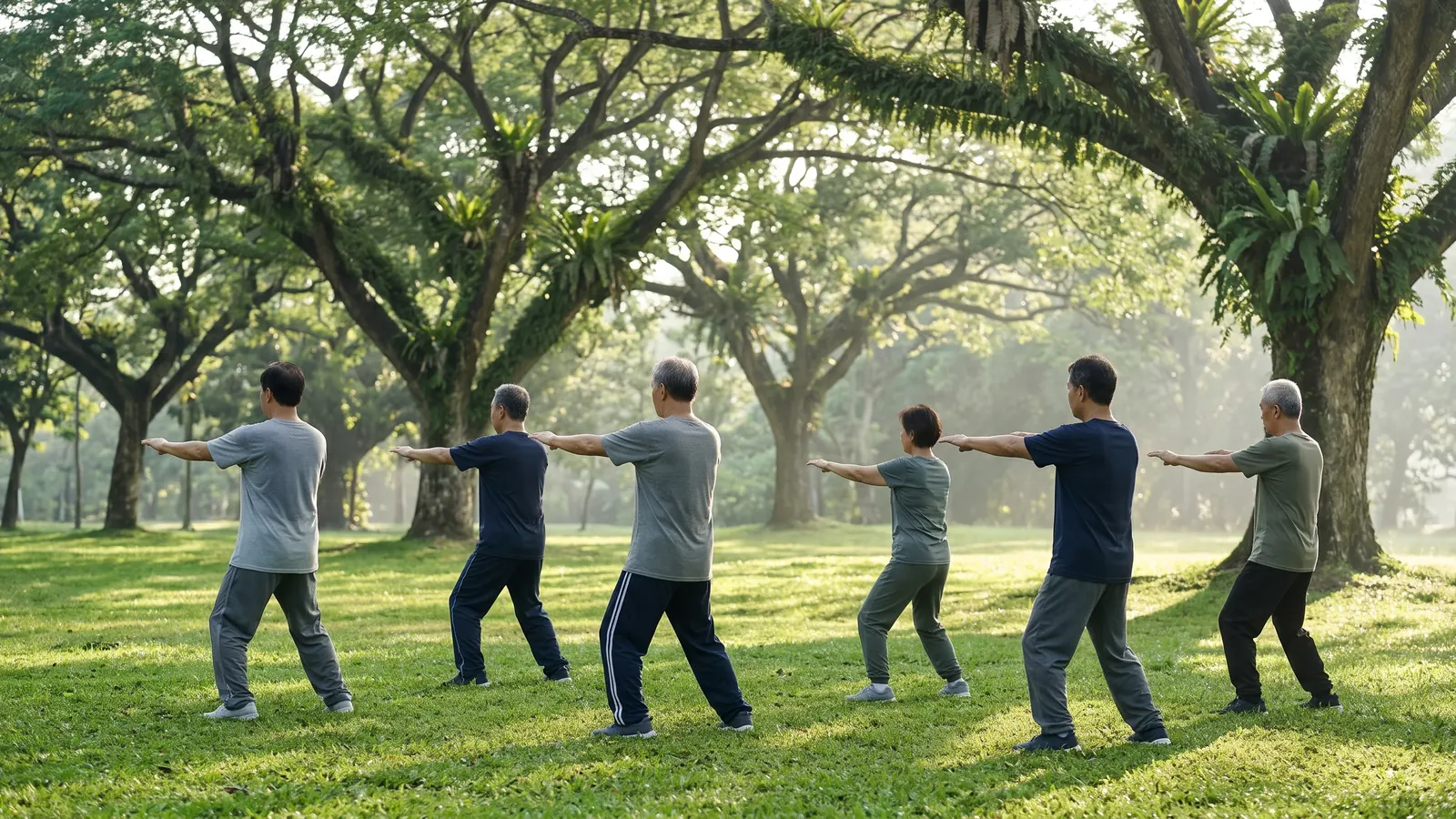
What to wear and bring
Choose clothes you could comfortably sit on the floor in: loose trousers or shorts that do not pull at the knee, and a top that lets your arms rise to shoulder height. The reason is simple. Tai Chi asks you to turn, sink and shift your weight, and anything tight turns into a second thing to worry about.
For shoes, many people like flat, thin-soled, flexible shoes, because a thick cushioned heel makes it harder to feel the ground under you. Some classes are held in socks or barefoot on a clean floor, so ask the organiser if you are unsure. Bring water, and a small towel if you tend to warm up quickly.
Try this: the evening before, lay out what you will wear and stand in it for a minute. Raise your arms slowly to shoulder height and bend your knees a little. If anything pinches, change it now rather than in the class.
How a class often runs
Many classes follow a shape like this, though the order and length vary:
- A greeting and a gentle warm-up. Loosening the neck, shoulders, waist and knees, often with slow turning and swinging.
- Standing. You stand with your feet about shoulder-width apart and simply notice your weight, your posture and your breathing. If you want to know what this is, our guide to standing practice explains it.
- A few movements, taught in pieces. The teacher shows one small section, you copy it several times, then add the next.
- Part of the form. The form is the connected sequence of movements Tai Chi is known for. In a first class you will usually meet only the opening of it, not the whole thing.
- A cool-down and a closing. Often a few quiet breaths and a short thanks.
Why is it often built this way? Many teachers find that the body learns better once it has settled, and that a movement is easier to remember after you have felt the standing it grows out of. If you would like to see how the same ideas look in practice before you go, our page on Tai Chi for beginners describes the body checks a teacher is likely to ask for.
What you will probably feel
Most first-timers feel clumsy. Your arms go one way and your feet another, and the teacher seems to glide. This is ordinary. You are learning to do several unfamiliar things at once, slowly, and slowness is harder than it looks: a slow movement leaves nowhere to hide an unbalanced step.
You may also feel bored, or restless while standing. That is ordinary too. Standing still is rarely something we practise, and the mind often protests when it is asked to stay with one posture. Many people also find their legs tire sooner than they expected, because holding a slightly bent knee is real effort, even though nothing looks strenuous.
The common beginner mistakes are worth knowing in advance. People tend to grip with their shoulders, hold their breath while concentrating, lock the knees to feel stable, and try to copy the shape of an arm instead of letting the movement start from the legs and waist. If you catch yourself doing any of these, you have done what everyone does, and noticing it is the lesson.
Try this: in the first movement, ask yourself only one question: am I breathing? If you are, and nothing hurts, carry on. Everything else can wait.
Class manners
Good manners in a Tai Chi class are mostly plain courtesy, and they help you learn.
- Greet the teacher. A nod, a smile or a hello is enough. Some classes open and close with a small bow or a salute, with the hands held in front of the body. If so, watch what others do and follow gently; nobody expects you to know it.
- Watch before you copy. When a movement is demonstrated, look at the whole of it first, including the feet. Copying too early means you learn the arms and miss the legs, which is where the movement starts.
- Ask questions. If you cannot see, cannot hear or are lost, say so. Teachers expect it, and the person beside you is almost certainly wondering the same thing.
- Tell the teacher about any injury before class begins. A bad knee, a stiff back, a recent sprain, an operation or pregnancy all change what suits you. A good teacher can offer a smaller or higher stance, a chair, or a different movement.
- Keep your phone away and arrive a few minutes early. It leaves you time to settle, and it spares the class a disturbance.
Stop rules, and when to see a doctor first
Gentle movement still asks something of your body. Stop and tell the teacher if you feel pain, dizziness, unusual breathlessness or chest pain. Call 995 at once for chest pain or tightness, severe difficulty breathing, or fainting. Ordinary muscle tiredness in the thighs is one thing; sharp, increasing or joint pain is another, and you do not have to push through it. Resting or sitting out a movement is a normal part of learning.
See a doctor before you start if you are pregnant, recovering from an injury, or have a medical condition, such as a heart, blood pressure or balance problem. This page is cultural and practical information, not medical advice, and a doctor or physiotherapist who knows your situation can tell you what is suitable. If you sprain or strain something, the NHS guidance on sprains and strains is a sensible first reference.
What not to expect in week one
Do not expect to remember the form; most people remember a few movements and lose them by the next morning. Do not expect to feel dramatic changes, or to understand what the teacher means by phrases such as “sink the shoulders” or “relax the waist”. Those ideas make sense only after weeks of repetition. Do not expect to look like the people who have practised for years, and do not compare yourself with them. Tai Chi is a slow art, and the first weeks are mainly for getting familiar with the room, the teacher and your own habits.
It also helps to know that “Tai Chi” and “Qigong” are not the same thing, and that classes under either name vary. If you are unsure which suits you, read Tai Chi vs Qigong before you commit.
One thing to notice afterwards
When the class ends, do not rush to your phone or the door. Stand for half a minute in the same posture you used in class and notice one thing: where your weight is. Is it more in one foot? In the heels or the toes? Are your shoulders level, and is your jaw tight? You do not need to fix anything. Noticing is the first skill, and it will serve you more than any single movement you learned that day.
If you are looking for a class in Singapore, see Tai Chi and Qigong in Singapore, and for the people who teach on this site, see our teachers. Go gently, go slowly, and be patient with yourself. Nervousness before a first class is very common, and for many people it fades by the second.
Read next: between classes, follow Practising at home in your first week.


