Practising at Home in Your First Week
第一周在家练习:一份十五分钟的简单计划
You have been to one or two Tai Chi (Taijiquan) or Qigong classes, and now there is a gap of several days before the next one. Should you practise at home? Yes, a little, if you do it simply. This page gives you a plan small enough to keep: fifteen minutes a day, built only from things you have already met in class. It does not teach anything new. If your first class is still fresh in your mind, you have all you need.
Why short and daily beats long and rare
A habit is built from repetition, and repetition is easier when it is small. One long session on the weekend is easy to skip and easy to overdo. Fifteen minutes is short enough that you will not argue with yourself about starting. It also keeps you from a common beginner mistake at home: carrying on after your form has gone sloppy, which only practises the sloppiness.
Try this: before reading further, decide now what time tomorrow you will do your fifteen minutes. A fixed time beats a good intention.
Where and when
You need a clear patch of floor with room to step and turn without touching furniture. Wear what you wore in class, or anything loose. Flat, bare or sock-clad feet suit many people, but use whatever is safe on your floor; a slippery surface is a reason to wear grippy socks or move to another room.
Choose the same time each day, because a time that repeats becomes a cue. Many people find the morning easiest, because the day has not yet filled up. Avoid practising straight after a big meal: wait a while, since turning and bending on a full stomach is uncomfortable. If you practise in the evening, our page on an evening wind-down routine shows how a quiet end to the day can fit together.
The 15-minute plan
The plan has four parts. The order matters: you settle before you stand, and you stand before you move.
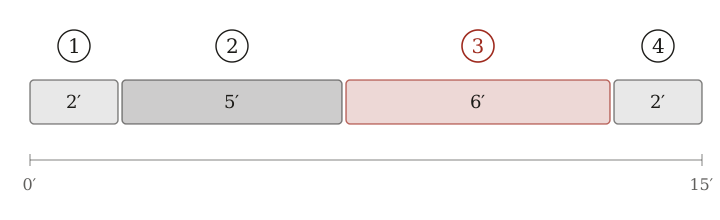
Fifteen minutes a day, in four parts.
- Settle, about 2 minutes
- Stand, about 5 minutes
- Move: two or three movements from class, about 6 minutes
- Close, about 2 minutes
- Settle (about 2 minutes). Stand or sit quietly. Let your eyes rest and your hands hang. Notice the floor under your feet, the sounds in the room, and that you are about to practise. This is not a technique, only a way of arriving. If your mind is busy, let it be busy and carry on.
- Stand (about 5 minutes). Take the standing posture you learned in class, feet about shoulder-width apart, knees slightly soft, not locked. Our guide to standing practice explains what teachers are usually looking for. If the posture troubles you, posture troubleshooting covers the usual complaints. Five minutes is a long time at first; if your legs tire sooner, rest and stand again.
- Move (about 6 minutes). Choose two or three simple movements you already learned in class, such as the opening of the form or a section of a set like Baduanjin. Repeat them slowly, a few times each. Do not add a movement you only half remember.
- Close (about 2 minutes). Finish by standing quietly again, hands resting at your sides. Notice where your weight is and how your shoulders feel. Then take a moment before you pick up your phone or walk away.
Why this shape? Settling gives the body time to arrive before you ask it to learn. Standing is the base that movement grows from. Moving is where you practise what class taught you, and closing stops the practice from ending abruptly. Teachers often describe qigong as a matter of the body, the breath and the mind working together; the three regulations sets out that idea if you want to read more.
Breathing stays natural all the way through. Do not hold your breath, do not try to breathe deeply or in a special pattern, and do not force it to match the movement. If you notice you are holding it, let it go and carry on. A breathing technique is something to learn from your teacher in person, not to invent at home.
Remembering without a video
You may be tempted to look for a video to copy. A video cannot see you, and it may show a different school's version of the movement. A better habit is to rely on what your own teacher showed you.
Straight after class, or the same evening, write a few words in a notebook for each movement: its name if you know it, and one or two plain words that remind you, such as “knees soft” or “turn from the waist”. Do not draw stick figures or write a long description; a few words are enough. At home, practise the part you remember, and no more. At the next class, bring your notebook and ask the teacher about whatever you were unsure of. That question is useful to them; it shows them exactly where you are.
Try this: write down three movements from your last class right now, in three words each. Leave a gap for what you forget.
When you forget a movement
You will forget movements. Everyone does. The rule is simple: when you cannot remember what comes next, stop and stand. Settle, breathe naturally, and rest in the standing posture until the time is up. Never invent a movement to fill the gap. An invented movement is practised as if it were correct, and your teacher will have to undo it later. Standing is never wasted time.
A seven-day view
You do not need a different plan each day. Keep the same four parts, change a little, and give yourself one thing to notice.
- Day 1: Do the plan as written. Notice how long five minutes of standing feels.
- Day 2: Same plan. Notice your shoulders: are they lifted?
- Day 3: Same plan, but move a little more slowly. Notice your knees: are they locked?
- Day 4: Rest day, or only the settle and stand parts. Rest is part of learning.
- Day 5: Return to the full plan. Notice your feet: where does your weight fall?
- Day 6: Same plan. Notice whether you are holding your breath during the movements.
- Day 7: Do the plan, then write a few lines in your notebook: what felt easier, what you forgot, and what you want to ask at your next class.
Do not expect to feel something dramatic by the end of the week. A better result is a small habit and a list of questions.
Signs to stop, and when to see a doctor first
Gentle movement still asks something of your body. Stop if you feel pain beyond ordinary muscle tiredness, dizziness, unusual breathlessness or chest pain, or if you feel faint. Sit down and rest. If unusual breathlessness or chest pain continues or returns, seek medical advice; the NHS page on shortness of breath is a sensible reference. Call 995 at once for chest pain or tightness, severe difficulty breathing, or fainting. Tired thighs after a few minutes of standing are common; sharp, increasing or joint pain is different, and you do not have to push through it.
Check with a doctor before you start if you are pregnant, recovering from an injury, or have a medical condition. If you sprain or strain something, do not apply heat or massage to a fresh sprain, and see the NHS guidance on sprains and strains. This page is cultural and practical information, not medical advice. If you are unsure about a movement, leave it out and ask your teacher.
One thing to carry into next class
At your next class, tell the teacher one thing you noticed at home and one thing you could not remember. That small exchange is worth more than any amount of solo guessing. For more reading on the standing and posture you will keep returning to, begin with the Qigong section. Be patient with the first week: showing up fifteen minutes at a time is the practice.
If you have not been to a class yet, start with Your first Tai Chi class.


