QIGONG & DAOYIN · 气功与导引

Circling the Abdomen to Harmonize the Center (Mofu / Tuanfu): Wudang Abdominal Daoyin Around Shenque and Qihai 摩腹(团腹)和胃固元:武当传统导引的环脐摩运、天枢中脘气海调摄与归根要法

A classical Wudang Daoyin guide to Mofu (摩腹 / 团腹), examining Sun Simiao's 'rubbing the abdomen a hundred times' method, key umbilical acupoints (Shenque, Zhongwan, Tianshu, Qihai, Guanyuan), and clockwise-counterclockwise spiral pacing.


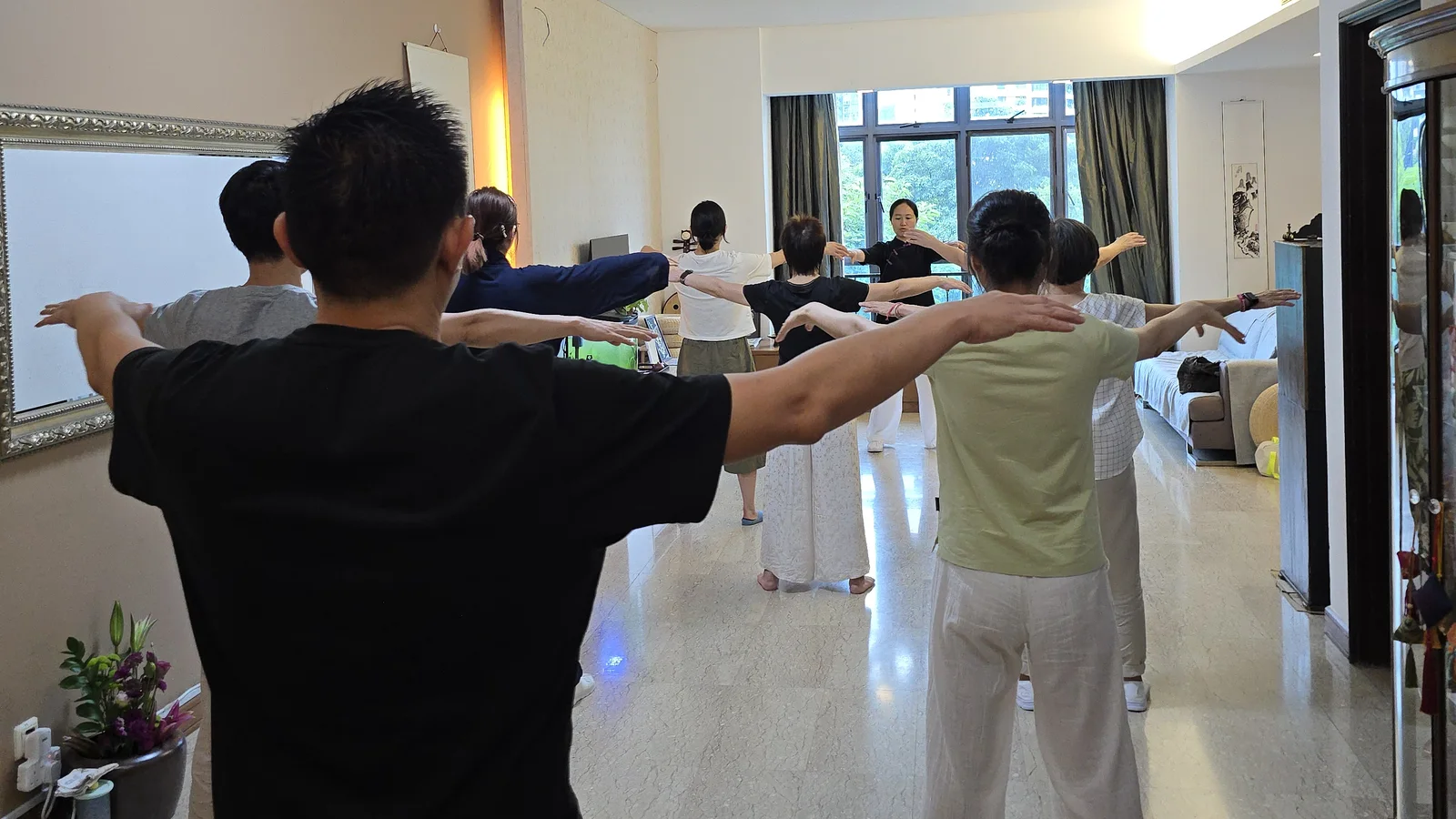
A standing qigong class in a sunlit room: students seen from behind hold both arms open at shoulder height in the same alignment, facing a teacher in dark clothing before a tall window with green trees outside.

Sun Simiao's Longevity Maxim: 'Always Rub the Abdomen with the Hand'

In classical Taoist cultivation and traditional Chinese longevity literature, the abdomen is honored as the 'Palace of the Five Viscera and Six Bowels' and the seat of the lower Dantian (Xia Dantian, 下丹田). Tang-dynasty Taoist physician Sun Simiao (孙思邈) recorded in his Qianjin Yaofang (千金要方, studied under Taoist Classics): 'After a meal, always rub the abdomen with your hand several hundred times and walk slowly for several hundred paces' (食毕,常以手摩腹数百遍,缓行数百步). In the Ming dynasty, Gao Lian's Zunsheng Bajian (遵生八笺) and Wudang internal alchemy manuals further refined this into Tuanfu (团腹, 'Gathering and Circling the Abdomen')—a gentle seated or supine self-massage that complements standing Spleen-Stomach stretching (Single Arm Aloft to Harmonize Spleen and Stomach) and lumbar warming (Rubbing the Kidney Shu Points).

The Five Umbilical Gates: Shenque, Zhongwan, Tianshu, Qihai, and Guanyuan

Taking the navel—Shenque (神阙, CV-8, 'Spirit Palace Gate')—as the central hub, the circular sweep of the palm gently warms four surrounding meridian gates arranged like a compass rose: above the navel along the Conception Vessel lies Zhongwan (中脘, CV-12, the Front-Mu point of the Stomach); to the left and right two cun beside the navel lie the twin Tianshu points (天枢, ST-25, the pivot between ascending Spleen Qi and descending Stomach/Intestinal Qi); and below the navel lie Qihai (气海, CV-6, 'Sea of Qi') and Guanyuan (关元, CV-4, 'Origin Pass').

Thirty-Six Clockwise and Thirty-Six Counterclockwise Spirals

Sitting upright or lying supine with the knees slightly bent so the abdominal wall is completely soft (Wudang Qigong & Daoyin), rub both palms together until warm, then place the right palm over the navel with the left palm resting lightly atop the back of the right hand (or vice versa). Beginning with a small circle around Shenque, spiral slowly outward in a clockwise direction (up the right side of the abdomen, across Zhongwan, and down the left side—following the anatomical path of the large intestine) for thirty-six revolutions. Then reverse direction, spiraling gently counterclockwise from the outer perimeter back inward to the navel for thirty-six revolutions to gather and consolidate Qi at Qihai and Guanyuan.

Timing, Pressure, and Quiet Dantian Settling

As taught in the Wudang Mountain tradition and our Start Here guide, avoid practicing Mofu with heavy pressure immediately on an overfull stomach or when the bladder is full; wait thirty minutes after eating, or practice upon waking and in the evening before Warming Yongquan with Laogong. Keep the palm pressure light, warm, and rhythmic, finishing with six quiet breaths with both palms resting still over the lower abdomen.

Seeker’s Q&A · Frequently Asked Questions

What is the key structural alignment in Circling the Abdomen to Harmonize the Center (Mofu / Tuanfu)?

A classical Wudang Daoyin guide to Mofu (摩腹 / 团腹), examining Sun Simiao's 'rubbing the abdomen a hundred times' method, key umbilical acupoints (Shenque, Zhongwan, Tianshu, Qihai, Guanyuan), and clockwise-counterclockwise spiral pacing.
