QIGONG & YANGSHENG · 气功与导引

Warming Taiyuan (太渊 LU-9) and Lieque (列缺 LU-7) Along the Radial Wrist: Wudang Hand-Taiyin Lung Daoyin for Deepening Breath, Releasing the Nape, and Rounding the Tiger’s Mouth (Hukou) 武当导引“温揉太渊与列缺”精解:疏通手太阴肺经脉会与任脉总枢、舒解头项僵滞与圆活太极“虎口”的养生法

Completing the four-gate compass of the wrist: how interlocking the Tiger's Mouths locates Lieque and Taiyuan to connect Lung breath directly down the Conception Vessel.

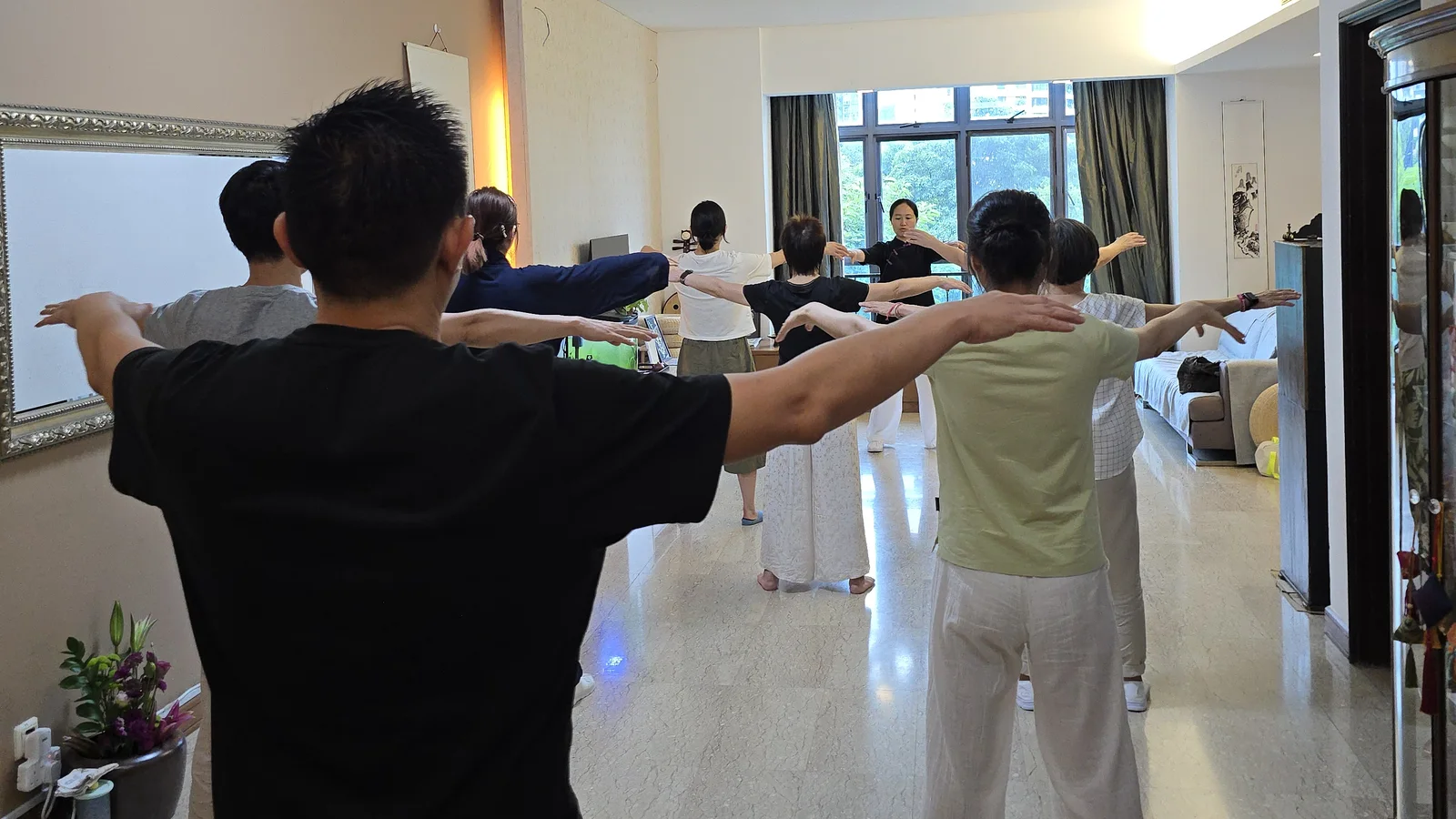
A standing qigong class in a sunlit room: students seen from behind hold both arms open at shoulder height in the same alignment, facing a teacher in dark clothing before a tall window with green trees outside.

1. Completing the Four-Gate Compass of the Wrist: Why Taiyuan (太渊 LU-9) and Lieque (列缺 LU-7) Govern Breath and the Conception Vessel

In Wudang Daoyin, the human wrist is viewed as a miniature compass ring (Huan 环, echoing Zhuangzi's Daoshu Huanzhong) through which the six hand meridians communicate with the spine, chest, and lower Dantian. Having opened the ulnar little-finger border at Houxi (SI-3, opening the Governing Vessel Du Mai) and Wangu (SI-4), the central palmar-dorsal axis at Neiguan (PC-6, opening Yinwei Mai) and Waiguan (TE-5, opening Yangwei Mai), and the palm heart at Laogong (PC-8) and Shaofu (HT-8), we now complete the circle on the radial (thumb-side) border of the wrist along the Hand-Taiyin Lung Meridian:

  1. Taiyuan (太渊, LU-9 — "Great Abyss," Shu-Stream Earth Point, Yuan-Source Point of the Lung Channel & Hui-Meeting Point of All Vessels Mai Hui Taiyuan 脉会太渊): Located on the anterolateral aspect of the wrist, at the radial end of the distal transverse wrist crease, in the depression between the radial artery and the tendon of the abductor pollicis longus. In the Nan Jing (45th Difficulty) and Lingshu, because the Lung governs Qi (Fei Zhu Qi 肺主气) and all blood vessels converge at the radial pulse (Cunkou 寸口) to be propelled by breath, Taiyuan is honored as the "Convergence of Vessels" (Mai Hui 脉会)—a deep, quiet spring where Lung breath and arterial circulation meet.
  2. Lieque (列缺, LU-7 — "Broken Sequence / Lightning Cleft," Luo-Connecting Point of the Lung Channel, Eight-Vessel Confluence Point Opening the Conception Vessel Ren Mai 任脉 & Four-Command Point for the Head and Nape): Located on the radial margin of the forearm, 1.5 cun proximal to the palmar wrist crease, nestled in the tiny bony cleft (Chilong 赤龙裂隙) right between the tendons of the brachioradialis and abductor pollicis longus above the styloid process of the radius. Notice the remarkable symmetry across the wrist:
  3. On the ulnar (pinky) edge, Houxi (SI-3) opens the posterior Governing Vessel (Du Mai 督脉) up the spine.
  4. On the radial (thumb) edge, Lieque (LU-7) opens the anterior Conception Vessel (Ren Mai 任脉) down the front midline through the throat, chest, and Zhongwan, Qihai, and Guanyuan! Furthermore, because the Luo branch of Lieque communicates directly with the Hand-Yangming Large Intestine channel ascending the neck, the classical Four Command Points Song (Si Zong Xue Ge 四总穴歌) declares: "For the head and nape, seek Lieque" (Touxiang Xun Lieque 头项寻列缺).
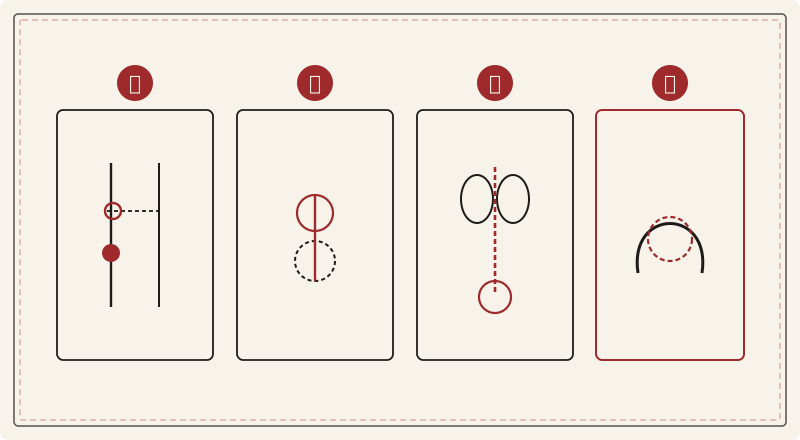
Classical four-panel Wudang Daoyin diagram illustrating the interlocked Tiger's Mouth (Hukou) method for locating Lieque (LU-7) and radial wrist-crease Taiyuan (LU-9), thumb-pad warming along the radial border, Lung-to-Ren Mai deep breath descent, and rounded Hukou in Taijiquan
Figure 1 — Radial-Wrist Lung & Conception-Vessel Gates (Taiyuan LU-9 & Lieque LU-7) Wudang Daoyin: ① Classical interlocked-Hukou method: crossing the two Tiger’s Mouths so the index fingertip lands in the radial styloid cleft of Lieque (LU-7, 1.5 cun above the wrist) above Taiyuan (LU-9); ② Thumb-pad circular kneading and gentle radial-edge stroking; ③ Lieque Tong Ren Mai (列缺通任脉): connecting Lung inhalation smoothly down the anterior Conception Vessel to the lower Dantian while freeing the nape; ④ Maintaining a rounded, unpinched Hukou in Wudang Taijiquan and Jianfa.

2. Classical "Interlocked Tiger's Mouths" Palpation & Four-Stage Wudang Breath Daoyin

How did ancient Wudang and medical masters find the exact bony cleft of Lieque (LU-7) without measuring tape? By using the famous "Interlocked Tiger's Mouths" (Liang Hukou Xiangjiao 两虎口相交) method, followed by four gentle stages with natural abdominal breathing:

StageExact Palpation & Hand PositionGentle Daoyin Action & RepetitionsBreath & Somatic Verification
1. Interlocking the Tiger's Mouths to Find Lieque (LU-7)Spread the thumb and index finger (Hukou 虎口) of both hands; slide the web of your right Hukou snugly against the web of your left Hukou with the left thumb pointing upward and the right index finger resting flat along the thumb-side edge of the left wristPress gently with the tip of your extended right index finger just past the bony prominence (radial styloid process): you will feel a distinct V-shaped cleft between two tendons—that exact hollow is Lieque (LU-7); slide 1.5 cun down to the wrist crease to feel Taiyuan (LU-9)Inhale softly through the nose; notice how naturally the index fingertip drops into the Lieque cleft
2. Circular Thumb Kneading at Lieque (LU-7) & Nape RotationSupport the left wrist with your right hand and place your right thumb pad lengthwise over the Lieque cleftKnead left Lieque in 24 slow clockwise and 24 counterclockwise circles while very gently turning your head 15 degrees left and right; switch wristsReleases thumb-tendon strain from smartphone use while simultaneously loosening the posterior neck (Touxiang Xun Lieque)
3. Gentle Pulse-Side Warming at Taiyuan (LU-9)Slide your right thumb pad down to the radial end of the left wrist crease at Taiyuan (LU-9)Using feather-light, warm pressure (never crushing the radial artery), circle gently 24 times each way and stroke smoothly from Taiyuan through LiequeDeepens and slows the inhalation, helping the chest feel wide and unhurried
4. Pairing Radial Lieque and Ulnar Houxi (Ren-Du Xiangying)Stand or sit in Wuji posture; softly open both Tiger's Mouths (Hukou) as if holding a small sphere in each handBreathe 9 slow microcosmic breaths: on the inhale, feel cool clarity descend from the throat along Ren Mai (opened by Lieque) into Qihai–Guanyuan; on the exhale, feel the spine lengthen effortlessly (Du Mai, opened by Houxi)Harmonizes the front and back midlines of the torso (Wuzhen Pian Water-Fire balance)

3. Biomechanical Role in Wudang Taijiquan and Weapons: Keeping the Tiger's Mouth Rounded (Hukou Yuancheng 虎口圆撑)

In Wudang Taijiquan, Wudang straight sword (Jianfa), and the Taoist horsetail whisk (Fuchen), why do teachers constantly correct students who pinch their thumb tightly against their index finger or hyper-extend their thumb backward?

  • When the Thumb Clenches or Hyper-Extends, Taiyuan and Lieque Jam: The tendon of the abductor pollicis longus runs directly across Lieque (LU-7) and Taiyuan (LU-9). If you stiffen your thumb during Ward-Off (Peng), Single Whip, or when gripping a sword hilt, you pinch off the Lung meridian at the wrist—causing your breathing to rise into your upper chest and your shoulder to lock.
  • The "Rounded Tiger's Mouth" (Hukou Yuan 虎口圆): When Taiyuan and Lieque are warm and relaxed, the space between the thumb and index finger forms a natural, semicircular crescent moon. Combined with a gently hollowed Laogong and Shaofu in the palm and a settled Wangu and Houxi on the pinky edge, the entire wrist becomes the frictionless "Center of the Ring" (Huanzhong) described by Zhuangzi.

4. Living Practice on Wudang Mountain and in Singapore & Safety Guidelines

Across the morning courtyards of the UNESCO World Heritage ancient Taoist temples on Wudang Mountain (No. 72 Jianhe 2nd Road, Wudangshan, Hubei, China; UNESCO World Heritage guide) and daily classes at Lee Wudang International Pte. Ltd. (58A Smith Street (2nd Floor), Singapore 058962; beginner guide), warming Lieque and Taiyuan is especially valued by students who spend hours scrolling on phones or working in air-conditioned offices:

  • Gentle Contact Over the Radial Artery at Taiyuan: At Taiyuan (LU-9), the radial pulse beats just beneath the skin; use soft, soothing thumb-pad warmth rather than heavy digging.
  • Non-Medical Self-Care Scope: Avoid pressing over acute De Quervain's thumb tenosynovitis or wrist fractures; this traditional Daoyin exercise supports respiratory ease, neck suppleness, and martial alignment and does not replace clinical medical care.

Practice Reflection for Students

Try the classical interlocked-Hukou test right now: cross the web of your right thumb-and-index finger over your left thumb web, let your right index fingertip drop into the tiny bony cleft on the edge of your left wrist (Lieque LU-7), and knead gently for eighteen slow breaths while noticing how your neck and chest simultaneously soften.

Seeker’s Q&A · Frequently Asked Questions

Where are Taiyuan (LU-9) and Lieque (LU-7), and what are they used for in Wudang Daoyin?

Both are on the thumb side of the wrist, on the Lung channel. Taiyuan (LU-9) is at the thumb-side end of the wrist crease, beside the radial pulse. Lieque (LU-7) is 1.5 cun above the crease, in a small bony cleft on the edge of the radius: cross the webs of your two thumbs, and the tip of the upper index finger falls into it. Classical theory calls Taiyuan the meeting point of the vessels, links Lieque with the Conception Vessel down the front of the body, and says “for the head and nape, seek Lieque”. Kneading them gently for a few slow breaths is used to ease the breath and soften the neck. Keep the touch light, and do not press over an inflamed thumb tendon or a wrist fracture; this does not replace medical care.


How can I apply this in practice?

Try the classical interlocked-Hukou test right now: cross the web of your right thumb-and-index finger over your left thumb web, let your right index fingertip drop into the tiny bony cleft on the edge of your left wrist (Lieque LU-7), and knead gently for eighteen slow breaths while noticing how your neck and chest simultaneously soften.
