QIGONG & YANGSHENG · 气功与导引

Wudang Brow-Soothing & 'Opening the Heavenly Gate' Daoyin (Kai Tianmen & Yintang): Calming the Upper Dantian and Forehead 武当“开天门与推坎宫(舒展印堂)”导引术:澄澈上丹田、舒解眉心紧锁的静神功法

Learn the traditional Chinese Tuina and Wudang Daoyin sequence—Opening the Heavenly Gate (Kai Tianmen), Pushing the Kang Palace (Tui Kanggong), and Soothing Yintang—to release brow furrowing, mental fatigue, and screen strain.


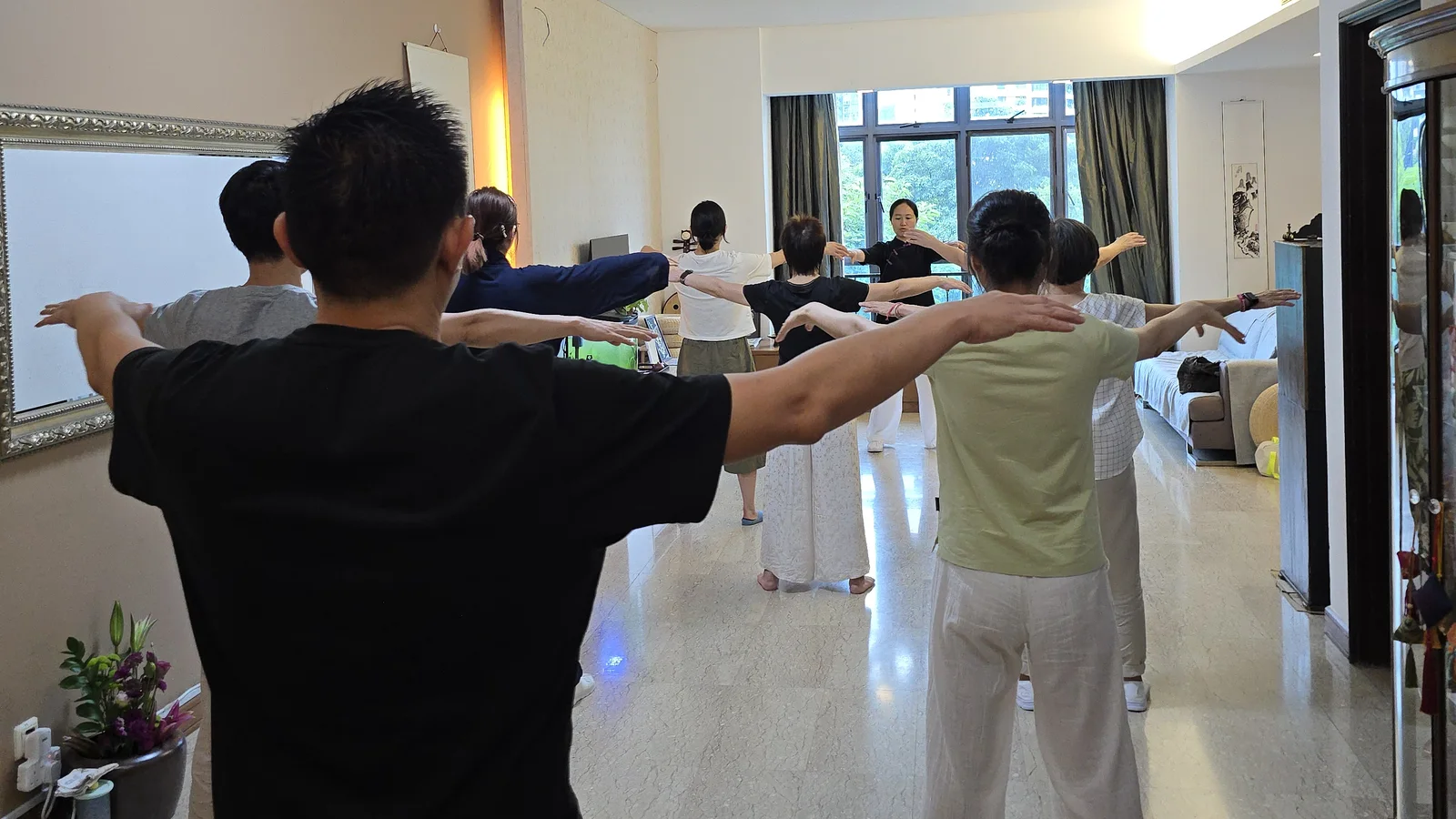
A standing qigong class in a sunlit room: students seen from behind hold both arms open at shoulder height in the same alignment, facing a teacher in dark clothing before a tall window with green trees outside.

1. Classical Foundations: The Hall of Impression (Yintang) and the Upper Dantian

In classical Chinese meridian anatomy and Wudang internal cultivation (Huangting Jing and Xingming Guizhi), the space right between the eyebrows is called Yintang (印堂, the 'Hall of the Seal / Impression'), serving as the outer gateway to the Upper Dantian (Shang Dantian 上丹田 / Niwan 泥丸, the Palace of the Mind-Spirit Shen).

Just as our Middle Dantian (Shanzhong) Daoyin harmonizes the chest and our Heart-Kidney Harmonization Daoyin anchors the lower abdomen and soles, traditional Wudang self-massage uses three classical forehead strokes—known since the Ming dynasty as Opening the Heavenly Gate (Kai Tianmen 开天门) and Pushing the Kang Palace (Tui Kanggong 推坎宫)—to clear congestion from the brow and eyes.

2. Why Intense Concentration Knots the Brow and Tires the Spirit (Shen)

Whenever a person stares at small text, squints into glare, or wrestles with a problem, the small corrugator and procerus muscles between the eyebrows contract into a vertical knot. In Taoist cultivation, a knotted Yintang traps yang qi in the forehead—leaving the eyes dry, the forehead heavy, and the mind unable to settle even after the screen is turned off.

By gently smoothing Yintang upward toward the hairline and outward along the eyebrow ridges (complementing our Eye and Neck Refresh Daoyin and Shaoyang Temple-Combing Daoyin), you invite the whole body to soften.

3. Three-Step Wudang 'Opening the Heavenly Gate' & Brow Daoyin (4 Minutes)

Wash your hands, sit upright with relaxed shoulders, and practice this four-minute sequence:

1. Opening the Heavenly Gate (Kai Tianmen 开天门): Place the soft pads of both thumbs lightly at Yintang (midpoint between the eyebrows). Alternating your left and right thumbs in a smooth, continuous rhythm, stroke vertically upward along the center of the forehead from Yintang to the anterior hairline (Shenting GV-24, 'Courtyard of the Spirit'). Perform 24 to 36 gentle upward strokes while breathing quietly into the abdomen.

2. Pushing the Kang Palace / Eyebrow Ridge (Tui Kanggong 推坎宫): Place both thumb pads at the inner ends of your eyebrows (Zanzhu BL-2). Simultaneously glide both thumbs horizontally outward along the bony upper orbital ridge over the midpoint of the eyebrows (Yuyao) all the way to the temples (Taiyang). Repeat 24 slow, soothing outward sweeps, feeling the space between your eyebrows widen like an open valley.

3. Warm Palm Cupping & Sinking Qi (Wenzhang Yumu 温掌熨目): Rub both palms together until warm, cup your hollow palms lightly over your closed eyes and brow without pressing on the eyeballs, and take 6 slow breaths, imagining any remaining warmth in the forehead melting down through the throat and chest into the lower dantian.

4. Daily Integration & Safety Guidelines

Practice this four-minute sequence between afternoon reading blocks or right before your evening meditation to keep the Upper Dantian clear and unstrained.

Safety note: use feather-light thumb-pad pressure on the forehead and never press directly on the eyeballs, contact lenses, or irritated skin. This traditional Wudang Daoyin routine is for educational relaxation and wellness support and is not a substitute for medical care.

Seeker’s Q&A · Frequently Asked Questions

What is the core takeaway of Wudang Brow-Soothing & 'Opening the Heavenly Gate' Daoyin (Kai Tianmen & Yintang)?

Learn the traditional Chinese Tuina and Wudang Daoyin sequence—Opening the Heavenly Gate (Kai Tianmen), Pushing the Kang Palace (Tui Kanggong), and Soothing Yintang—to release brow furrowing, mental fatigue, and screen strain.
