QIGONG & DAOYIN · 气功与导引

“Swaying the Head and Swinging the Tail to Calm Heart-Fire” (Yaotou Baiwei Qu Xinhuo): Wudang Baduanjin Fifth-Brocade Complete Guide 武当八段锦「摇头摆尾去心火」单式深修:心肾相交、尾闾引动与高架护颈护膝指南

A step-by-step practitioner's guide to the Fifth Brocade of Baduanjin (Yaotou Baiwei Qu Xinhuo)—exploring what 'Heart-Fire' means in classical Taoist physiology, how gentle torso-and-pelvis circling unites Heart and Kidneys (Kan and Li), and how to practice safely with high-stance modifications.


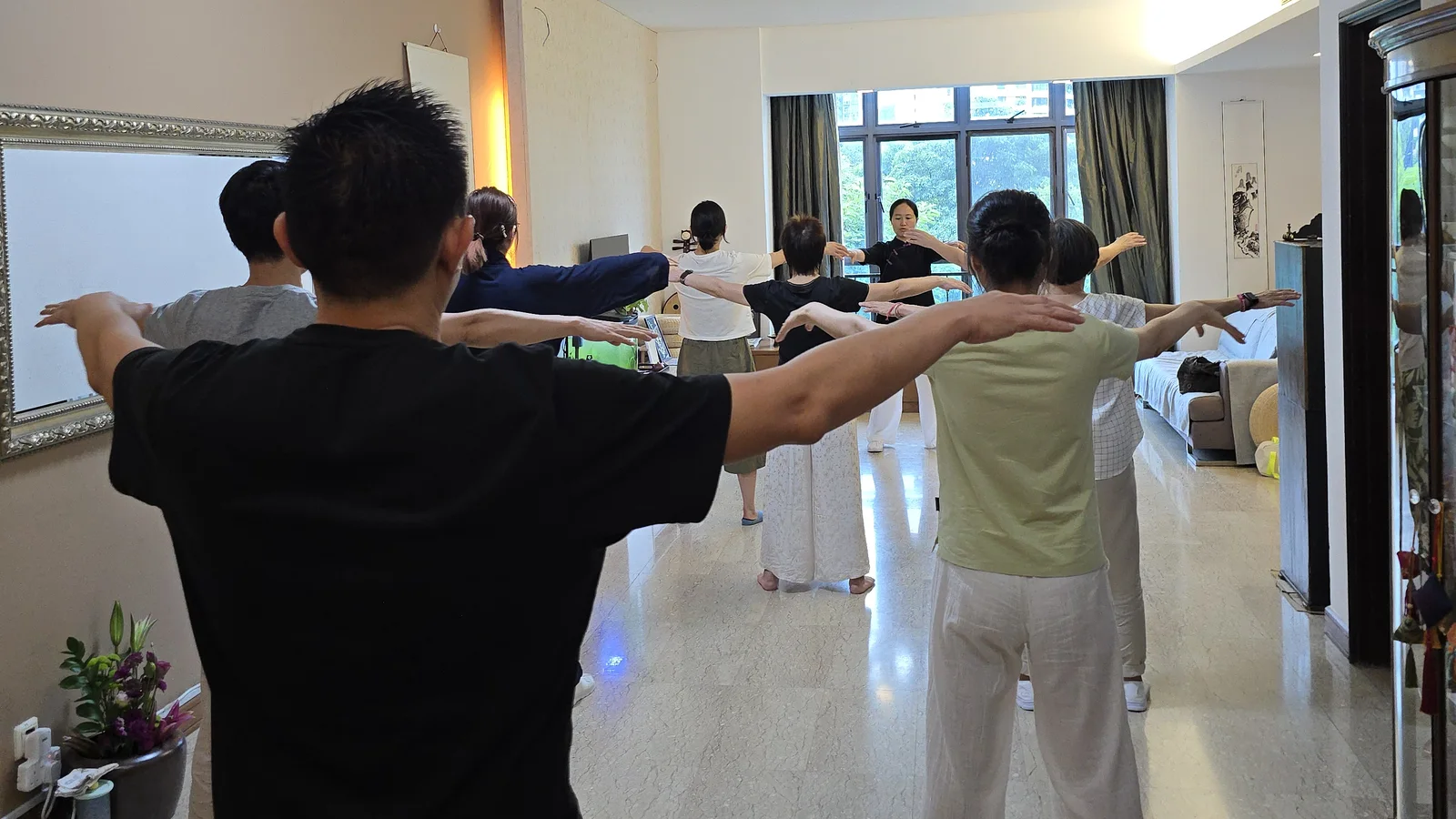
A standing qigong class in a sunlit room: students seen from behind hold both arms open at shoulder height in the same alignment, facing a teacher in dark clothing before a tall window with green trees outside.

What Is “Heart-Fire” (Xinhuo) in Classical Daoyin—and Why Does Moving the Tailbone Calm It?

The fifth movement of the classical Eight Brocades (Baduanjin 八段锦) is 'Swaying the Head and Swinging the Tail to Clear Heart-Fire' (Yaotou Baiwei Qu Xinhuo 摇头摆尾去心火). In classical Chinese medicine and Wudang internal cultivation, the Heart belongs to the Fire phase (心属火) in the upper chest, while the Kidneys belong to the Water phase (肾属水) in the lower back and pelvis. In a balanced state known as 'Water and Fire in Harmony' (Shuihuo Jiji 水火既济, Hexagram 63 of the I Ching), Heart-Fire descends to warm the Kidneys while Kidney-Water rises to moisten and cool the Heart. When we spend days in mental overwork, worry, or screen fatigue without moving the lower body, warmth and nervous excitation stagnate in the chest and head—experienced as restlessness, a dry mouth, tight shoulders, and difficulty winding down at night. By anchoring in a wide stance and gently circling the thoracic spine ('swaying the head') in coordination with the sacrum and pelvis ('swinging the tail' Weilu 尾闾), the fifth brocade guides stagnant upper-body tension down through the waist and legs.

Why “Swaying the Head” Actually Starts in the Hip Creases (Kua) and Thoracic Spine

The biggest mistake beginners make in Yaotou Baiwei is standing with a stiff pelvis and rolling only the neck in circles—which cramps the cervical vertebrae without engaging the lower body at all. In Wudang Baduanjin pedagogy, 'head' (tou 头) refers to the entire upper torso and cervical axis as one connected unit, and 'tail' (wei 尾) refers to the tailbone (Weilu 尾闾) and pelvis. With both hands resting lightly above the knees (thumbs facing inward or outward comfortably depending on shoulder openness), the movement is driven by folding into one hip crease (Kua), sweeping the straight spine across the front arc to the opposite knee, and gently counter-tilting the tailbone and neck along a smooth cone. Because the neck stays elongated in line with the thoracic spine, the cervical joints never grind or hyperextend backward.

Step-by-Step Four-Count Circling Routine (Left and Right)

Step out to about 1.5 times shoulder width in a comfortable high-to-moderate Horse Stance (Mabu 马步), resting your palms lightly on your upper thighs just above the knees with the elbows rounded outward. Count 1 (Incline Over the Left Knee): Inhale through the nose as you shift slightly left and fold at the left hip crease so your straight torso inclines diagonally over your left thigh, keeping your chest open and both heels flat. Count 2 (Sweep Across the Front Arc to the Right): Beginning a slow, unhurried exhale, sweep your torso smoothly across the front in a low horizontal arc from your left knee toward your right knee, letting the tailbone (Weilu) counterbalance softly behind. Count 3 (Turn and Gaze Toward the Opposite Heel/Tailbone): Reaching the right side, rotate the upper back slightly rightward and let your gaze look softly back toward your left heel (or tailbone) as the left elbow lengthens. Count 4 (Return to Center Upright): Inhale as your head, spine, and pelvis spiral smoothly back to the upright center position. Repeat to the right side first on the next cycle, completing 4 to 6 slow rounds per side.

High-Frame Modifications for Knee Comfort and Blood-Pressure Safety

Because Yaotou Baiwei combines a wide stance with forward-and-rotational trunk inclination, classical Wudang instruction emphasizes three safety adaptations: 1. Keep the Head Above Heart Level if Prone to Dizziness: Anyone with blood-pressure fluctuations, vertigo, or neck stiffness should practice a High-Frame Variation—standing in a mild knee bend and inclining the torso only 20 to 30 degrees forward rather than dipping the head low. 2. Never Push Down Hard on the Kneecaps: Rest your palms on the muscular lower thighs above the patella, supporting your torso with your hips and core rather than leaning heavy weight onto your knee joints. 3. Exhale Softly Through the Arc: Never hold your breath while sweeping across the front. Safety note: Move at half speed with smooth, continuous breathing; this traditional Daoyin is a gentle relaxation and mobility practice, not a medical treatment.

Seeker’s Q&A · Frequently Asked Questions

What is the key structural alignment in “Swaying the Head and Swinging the Tail to Calm Heart-Fire” (Yaotou Baiwei Qu Xinhuo)?

A step-by-step practitioner's guide to the Fifth Brocade of Baduanjin (Yaotou Baiwei Qu Xinhuo)—exploring what 'Heart-Fire' means in classical Taoist physiology, how gentle torso-and-pelvis circling unites Heart and Kidneys (Kan and Li), and how to practice safely with high-stance modifications.
