QIGONG & YANGSHENG · 气功与导引

Wudang Heart-Kidney Harmonization Daoyin (Xin Shen Xiang Jiao / Kan-Li Jiaogou): Guiding Fire Down to Water for Deep Rest 武当“心肾相交与劳宫擦涌泉”导引术:坎离既济、引火归元的晚间安眠功法

Grounded in classical Kan-Li (Water-Fire) inner alchemy and Wudang bedtime Daoyin, learn a gentle three-step sequence rubbing Laogong (PC-8) against Yongquan (KI-1) to settle restless thoughts and support restorative rest.


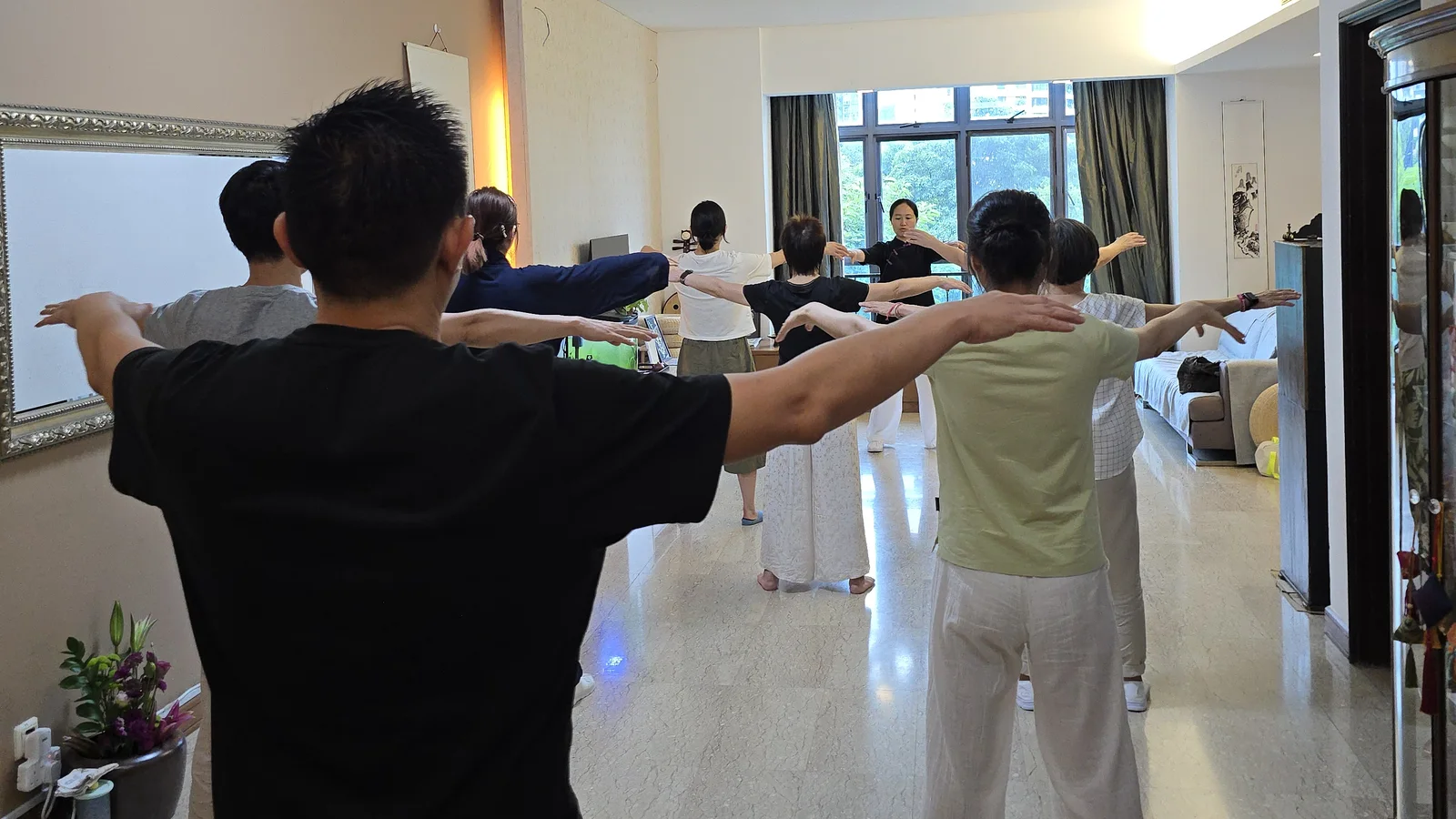
A standing qigong class in a sunlit room: students seen from behind hold both arms open at shoulder height in the same alignment, facing a teacher in dark clothing before a tall window with green trees outside.

1. Classical Foundations: Why Heart Fire Must Descend to Warm Kidney Water (Xin Shen Xiang Jiao)

In both classical Chinese medicine and Wudang internal alchemy (Neidan 内丹, studied in the Cantong Qi and Wuzhen Pian), human vitality depends on the continuous communion between two poles: the Heart (Fire / Li trigram 离) in the upper chest and the Kidneys (Water / Kan trigram 坎) in the lower abdomen and lumbar gate. Left to their purely physical tendencies, Fire naturally flares upward into the head while Water naturally sinks downward into coldness—a separation that leaves a person with a hot, racing mind above and cold feet below.

True harmony—called 'the intercourse of Heart and Kidneys' (Xin Shen Xiang Jiao 心肾相交) or 'the coupling of Water and Fire' (Shui Huo Ji Ji 水火既济 / Kan-Li Jiaogou 坎离交媾)—occurs when the quiet clarity of the Heart descends through the middle abdomen to warm Kidney Water, and the nourished Kidney essence steams gently upward to moisten the Heart.

2. How Evening Screen Light and Overthinking Separate Fire from Water

When we work late into the evening under bright screens or replay worries in bed, attention and blood flow remain pulled up into the eyes and forehead. In the language of our Summer Heart-Calming He-Breath Daoyin and Kidney and Mingmen Warming Daoyin, Heart Fire is floating unanchored at the top of the body instead of returning home to its root in the lower dantian and soles of the feet.

Rather than fighting insomnia with mental effort—which only adds more fuel to upper-body Fire—Wudang evening practice uses simple tactile bridges between the palms and soles to draw awareness smoothly downward.

3. Three-Step Wudang 'Laogong Meets Yongquan' Evening Daoyin (6 Minutes)

Practice this quiet six-minute sequence seated on the edge of your bed before sleep (as a deeper continuation of our Evening Wind-Down Qigong Routine):

1. Drawing the Gaze and Breath from Crown to Navel (Yin Huo Gui Yuan 引火归元): Sit comfortably with a soft sternum (as in our Chest and Pericardium Soothing Daoyin). Half-close your eyes so your gaze rests lightly on the tip of your nose, then down toward your navel. For 9 slow breaths, imagine each exhalation descending like warm sunset light from the chest through the solar plexus into the lower abdomen.

2. Rubbing the Palm Center against the Bubbling Spring (Ca Yongquan Jiao Xin Shen 擦涌泉交心肾): Rest your left ankle comfortably across your right knee. Place the center of your right palm (Laogong 劳宫, Pericardium 8, the Fire point of the hand) directly over the anterior third of your left sole (Yongquan 涌泉, Kidney 1, the Water point of the foot, explored in our Ankle and Yongquan Rooting Daoyin). Stroke briskly and smoothly back and forth from the arch to the heel 64 or 100 times until the sole feels noticeably warm, directly linking Pericardium/Heart Fire with Kidney Water. Switch legs and rub the right sole with your left palm.

3. Resting Palms on Dantian and Mingmen (Bao Yuan Shou Yi 抱元守一): Lie down or sit quietly with one palm resting over your navel (Shenque / Guanyuan) and the other resting lightly under your lower back or at your side, breathing softly for 12 breaths.

4. Restorative Integration & Safety Guidelines

Allow the warmth in the soles of your feet to act like a gentle anchor drawing all remaining daytime thoughts out of the head.

Safety note: keep the foot stroking comfortable and avoid pressing over broken skin, acute foot inflammation, or varicose veins. This traditional Wudang Daoyin routine is for educational relaxation and sleep hygiene support and is not a substitute for medical diagnosis or treatment.

Seeker’s Q&A · Frequently Asked Questions

What is the core takeaway of Wudang Heart-Kidney Harmonization Daoyin (Xin Shen Xiang Jiao / Kan-Li Jiaogou)?

Grounded in classical Kan-Li (Water-Fire) inner alchemy and Wudang bedtime Daoyin, learn a gentle three-step sequence rubbing Laogong (PC-8) against Yongquan (KI-1) to settle restless thoughts and support restorative rest.
