
QIGONG & YANGSHENG · 气功与导引

Warming Laogong (劳宫 PC-8) and Shaofu (少府 HT-8) in the Palm: Wudang Palm-Heart Fire-Gate Daoyin for Calming Restless Heat, Hollowing the Palm (Hanzhang), and Fostering Water-Fire Communion 武当导引“温揉劳宫与少府”精解:疏通掌心心包与心经荥火双枢、涵养太极“瓦楞含掌”与落实心肾相交的养生法

How curling the middle and little fingertips into the palm locates the twin Ying-Spring Fire points of the Pericardium and Heart channels, transforming anxious heat into calm lower-Dantian warmth.

A standing qigong class in a sunlit room: students seen from behind hold both arms open at shoulder height in the same alignment, facing a teacher in dark clothing before a tall window with green trees outside.

1. Classical Meridian Symmetry in the Palm: Why Laogong (劳宫 PC-8) and Shaofu (少府 HT-8) Are Paired as the Twin Fire Gates

In the previous guides of this upper-limb Wudang Daoyin series, we opened the ulnar wrist edge at Houxi (SI-3) and Wangu (SI-4) and unlocked the forearm rotational passes at Neiguan (PC-6) and Waiguan (TE-5). Now, following those pathways into the hollow of the palm itself, we arrive at the two sovereign Ying-Spring Fire Points (Ying-Huo Xue 荥火穴) documented in the Lingshu (Spiritual Pivot, Chapter 2 Benshu) and Huangfu Mi's Zhenjiu Jiayijing:

  1. Laogong (劳宫, PC-8 — "Palace of Toil," Ying-Spring Fire Point of the Hand-Jueyin Pericardium Channel): Located in the central hollow of the palm, between the 2nd and 3rd metacarpal bones, slightly closer to the radial edge of the 3rd metacarpal bone. Its classical palpation method requires no ruler: curl your fingers naturally into a relaxed fist; the exact spot where the tip of your middle finger touches the central palmar crease is Laogong. Why is it named "Palace of Toil"? Because the hand labors ceaselessly throughout the day while the Pericardium (Xinbao) serves as the envoy mansion surrounding the Heart sovereign.
  2. Shaofu (少府, HT-8 — "Lesser Mansion," Ying-Spring Fire Point of the Hand-Shaoyin Heart Channel): Located on the ulnar side of the palm along the exact same transverse palmar crease, in the depression between the 4th and 5th metacarpal bones. When you curl your fingers into that same relaxed fist, the exact spot where the tip of your little finger touches the palm is Shaofu. In classical Five-Shu (Wushu Xue 五输穴) theory, the Nan Jing (Classic of Difficulties, 68th Difficulty) states: "The Ying-Spring points govern heat in the body" (Ying Zhu Shen Re 荥主身热). Because both Laogong (Pericardium) and Shaofu (Heart) are Ying-Fire points sitting side by side in the palm, they directly regulate the warmth of the Heart-Mind (Li 离 ☲).

When a person is overworked, sleep-deprived, or mentally agitated, "floating Heart-Fire" (Xinhuo Shangyan 心火上炎) makes the palms feel dry and feverish while the lower abdomen and feet remain cold. Conversely, gently kneading Laogong and Shaofu and then resting the warmed palms over the lower abdomen (Qihai and Guanyuan) draws that scattered Fire downward to warm Kidney Water—physically enacting the Kan-Li Inversion (Qu Kan Tian Li 取坎填离) and Water-Fire Communion (Xinshen Xiangjiao 心肾相交) celebrated in Zhang Boduan's Wuzhen Pian.

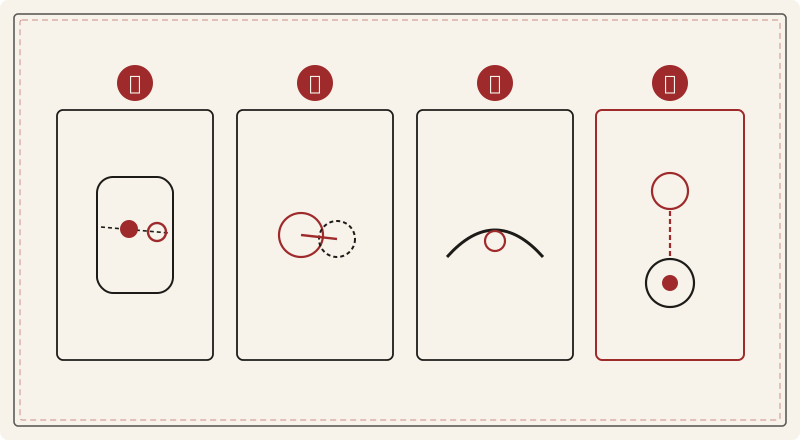
Classical four-panel Wudang Daoyin diagram illustrating the natural curled-finger location of Laogong (PC-8) and Shaofu (HT-8), opposite-thumb circular kneading across the palm crease, Tile-Ridge Palm (Waleng Zhang) arch in Taijiquan, and palm-over-Dantian Water-Fire Communion
Figure 1 — Twin Palm-Fire Gates (Laogong PC-8 & Shaofu HT-8) Wudang Daoyin Architecture: ① Natural curled-finger location: middle fingertip marking Laogong (PC-8, between 2nd & 3rd metacarpals) and little fingertip marking Shaofu (HT-8, between 4th & 5th metacarpals); ② Opposite-thumb kneading and horizontal brushing across the transverse palmar crease; ③ Waleng Zhang / Han Zhang (瓦楞掌/含掌): subtle gathering of Laogong and Shaofu forming a curved, breathable palm dome; ④ Xinshen Xiangjiao (心肾相交): overlapping warmed palms over the lower Dantian to unite Heart-Fire and Kidney-Water.

2. Four-Stage Wudang Palm-Fire & Water-Fire Communion Daoyin Protocol

Practiced either seated before meditation or standing in Wuji posture, perform these four steps with slow natural abdominal breathing:

StageExact Anatomical Palpation & PostureGentle Daoyin Action & RepetitionsBreath & Somatic Verification
1. Curled-Finger Self-Discovery (Qu Zhi Xun Xue 屈指寻穴)Sit or stand upright with shoulders relaxed; curl the fingers of your left hand softly toward the palm as if holding a small bird's eggFeel where the left middle fingertip touches the groove between the 2nd and 3rd metacarpal bones (Laogong PC-8) and where the left little fingertip touches the groove between the 4th and 5th metacarpal bones (Shaofu HT-8)Inhale calmly; notice how both points sit along the same transverse hollow of the palm
2. Opposite-Thumb Kneading of Laogong and Shaofu (Anrou Shuang Huo 按揉双火)Cradle the back of the left hand with your right fingers and place your right thumb pad directly into left Laogong (PC-8)Knead left Laogong in 24 slow clockwise and 24 counterclockwise circles, then slide the right thumb ulnarward between the 4th and 5th metacarpals to knead left Shaofu (HT-8) 24 circles each way; switch handsExhale slowly as any tightness in the palm fascia and chest melts away
3. Dry-Washing the Palms & Warming the Eyes (Cuo Zhang Yun Mu 搓掌熨目)Place both palms together in front of the chest (Huangting) and rub them briskly in oval circles 36 times until Laogong and Shaofu radiate warmthCup the warm hollow centers of both palms gently over your closed eyes (without pressing on the eyeballs) for 6 slow breathsApplies the Yinfu Jing principle Ji Zai Mu, soothing visual fatigue and calming the spirit
4. Overlapping Palms on the Water Palace (Wen Dan Ji Ji 温丹既济)Lower both warmed palms and overlap them directly over Qihai (CV-6) and Guanyuan (CV-4) below the navelRest in quiet stillness for 9 abdominal breaths, feeling the warmth of Laogong and Shaofu (Heart-Fire) sink deep into the lower Dantian (Kidney-Water)Complete by swallowing the clear Jade Fluid (Huangting Jing)

3. Biomechanical Role in Wudang Taijiquan: Forming the "Tile-Ridge Palm" (Waleng Zhang 瓦楞掌)

In Wudang Taijiquan, beginners often make one of two errors with their hands: either letting the fingers hang limp like wilted leaves (Ruanta Zhang), or stretching all five fingers backward into a flat, rigid board (Ban Zhang 板掌). Both errors disconnect the palm from the forearm.

Instead, Wudang tradition calls for the "Tile-Ridge Palm" (Waleng Zhang 瓦楞掌) or "Hollowed Palm" (Han Zhang 含掌):

  • Just like the curved blue-grey clay roof tiles on Wudang Mountain temples that shed rainwater without cracking, the palm maintains a gentle concave arch across its center.
  • How is that arch formed without stiffness? By softly drawing Laogong (PC-8) and Shaofu (HT-8) inward by two millimeters while the fingertips lengthen gently forward and the ulnar edge settles toward Wangu (SI-4). Whether you are forming the hollow fists of Twin Peaks Pierce the Ears (Shuangfeng Guan'er) or holding the "Alive Grip" (Huo Ba) of the Wudang straight sword and horsetail whisk (Fuchen), keeping Laogong and Shaofu softly hollowed allows Qi and tactile sensitivity to fill the hand.

4. Living Practice on Wudang Mountain and in Singapore & Safety Guidelines

Across the morning meditation halls of the UNESCO World Heritage ancient Taoist temples on Wudang Mountain (No. 72 Jianhe 2nd Road, Wudangshan, Hubei, China; UNESCO World Heritage guide) and daily classes at Lee Wudang International Pte. Ltd. (58A Smith Street (2nd Floor), Singapore 058962; beginner guide), warming Laogong and Shaofu is practiced both at the start and close of every session—and before sleep, many practitioners also rub warm Laogong against the center of the opposite foot sole (Yongquan KI-1) 36 times to deepen Heart-Kidney harmony. Always use smooth thumb-pad pressure and avoid pressing over open cuts or acute palmar tendonitis; this non-medical Daoyin method supports everyday calm and joint health.

Practice Reflection for Students

Right now, curl your left fingers lightly into your palm to feel where your middle finger (Laogong) and little finger (Shaofu) touch, knead both spots gently with your right thumb for thirty seconds, then rest both warmed palms over your lower abdomen for three slow breaths.

Seeker’s Q&A · Frequently Asked Questions

Where are Laogong (PC-8) and Shaofu (HT-8), and why rest the warmed palms on the lower abdomen afterward?

Curl your fingers into a relaxed fist: Laogong (PC-8) is where the tip of the middle finger touches the palm, and Shaofu (HT-8) is where the tip of the little finger touches it. Both are Ying-Spring fire points, of the Pericardium and Heart channels, which classical theory associates with heat. When you are overworked or short of sleep, the palms may feel hot and dry while the lower abdomen and feet stay cold. Kneading the two points gently and then resting the warm palms over the lower abdomen gives bodily form to the Taoist image of bringing Fire down to meet Water (心肾相交). Use smooth thumb-pad pressure and avoid open cuts or an inflamed tendon in the palm; this is everyday self-care, not medical treatment.


How can I apply this in practice?

Right now, curl your left fingers lightly into your palm to feel where your middle finger (Laogong) and little finger (Shaofu) touch, knead both spots gently with your right thumb for thirty seconds, then rest both warmed palms over your lower abdomen for three slow breaths.
