QIGONG & YANGSHENG · 气功与导引

Wudang Seated Eight Brocades (Zuoshi Baduanjin): Morning Bedside Daoyin from Clasping the Nape and Warming the Kidneys to Supporting Heaven 武当坐式八段锦(古法坐功导引)指南:清晨醒后叩齿鸣鼓、托天按顶与摩肾攀足全套功法

Explore the classical Seated Eight Brocades (Zuoshi Baduanjin) preserved in Song and Ming longevity manuals—a gentle 10-minute seated morning sequence to awaken the spine, shoulders, waist, and breath before standing.

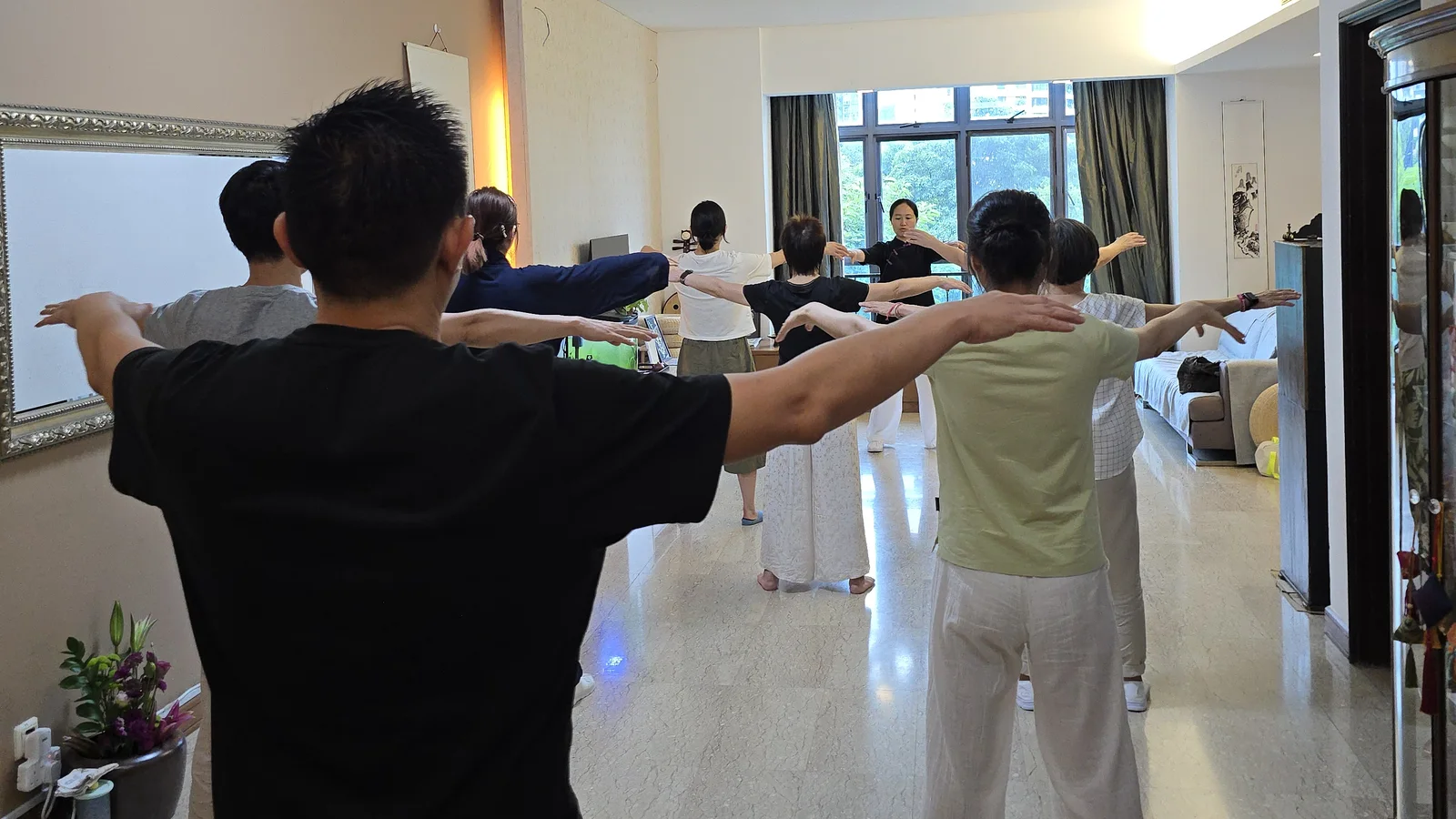
A standing qigong class in a sunlit room: students seen from behind hold both arms open at shoulder height in the same alignment, facing a teacher in dark clothing before a tall window with green trees outside.

1. Textual Origins: “Literary” Seated Brocades Alongside Standing Baduanjin

Most modern practitioners first meet the standing Eight Brocades (Baduanjin 八段锦)—whose eight standing postures we explored in Part 1 and Part 2 of our standing Baduanjin guide. Yet in classical Taoist longevity literature, standing Baduanjin (sometimes called the “Northern” or “Active” set) has always been paired with an equally important companion: Seated Eight Brocades (Zuoshi Baduanjin 坐式八段锦, also known as the “Literary” set Wen Baduan 文八段, later expanded in the Ming dynasty into the Twelve Seated Brocades Shierduanjin 十二段锦).

Preserved in the Yuan-dynasty Taoist Canon compendium Xiuzhen Shishu (《修真十书》, Volume 19) and illustrated with commentary in the Ming scholar Gao Lian’s 1591 longevity manual Zunsheng Bajian (《遵生八笺》), this seated sequence was designed to be practiced at dawn upon waking—before stepping onto the cold floor—to transition the body gently from sleep stillness into upright circulation.

2. Why Dawn Seated Daoyin Prepares the Body for Standing Practice

In traditional Wudang daily rhythm (see The Twelve Two-Hour Periods of the Day), immediately jumping out of bed into vigorous stretching when the joints and breath are still cool and sluggish goes against the principle of gradual awakening. Practicing seated Daoyin on a firm cushion or at the edge of the bed serves three clear physiological and contemplative roles:

  • Gathering scattered morning attention: By beginning with quiet breath, tapping the teeth (Kouchi), and beating the Heavenly Drum (Ming Tiangu), the mind wakes up calmly without rushing toward external tasks.
  • Unloading the lower limbs while opening the spine: Because the pelvis rests securely on a seat or mat, practitioners with stiff morning ankles or knees can lengthen the thoracic spine, ribs, and shoulder blades without lower-body strain.
  • Warming the kidney court before upright weight-bearing: Frictioning the lower back (Mo Shentang) and gently reaching toward the soles warms the lumbar fascia before standing Zhan Zhuang or Wudang Taijiquan.

3. The Classical Eight Seated Movements Step by Step

Sit comfortably cross-legged on a firm mat or upright on the front third of a stable chair with your feet flat on the floor:

  1. Quiet Sitting & Tapping the Teeth (宁神叩齿 · Ningshen Kouchi): Rest both hands at the lower abdomen, take six slow nasal breaths, and lightly tap the molars together 24 to 36 times to awaken jaw and facial circulation.
  2. Clasping the Nape & Looking Left and Right (抱项左右顾 · Baoxiang Zuoyou Gu): Interlace the fingers behind the base of the skull, let the elbows open gently outward while drawing the shoulder blades softly together, and turn the head slowly left and right three times each with the breath.
  3. Beating the Heavenly Drum (鸣天鼓 · Ming Tiangu): Cover the ears lightly with the palms and tap the occipital ridge 24 times with the index and middle fingers to refresh the head and upper neck.
  4. Interlacing Fingers to Support Heaven (双手托天 · Shuangshou Tuotian): Interlace the fingers in front of the abdomen, inhale as you turn the palms upward above the crown to lengthen the ribs and spine, and exhale as the arms float down the sides. Repeat six times.
  5. Drawing the Bow Left and Right (左右开弓 · Zuoyou Kaigong): While seated upright, extend one hand outward and draw the opposite elbow back horizontally at shoulder height as if drawing a soft bow, opening the chest and upper back three times per side.
  6. Massaging the Kidney Court (摩运肾堂 · Moyun Shentang): Rub both palms together until warm, place them over the lower back on either side of the spine, and massage up and down 36 times until a gentle warmth spreads across the waist.
  7. Reaching for the Soles with Soft Knees (攀足舒腰 · Panzu Shuyao): Extend the legs forward with the knees slightly bent (or keep feet flat on the floor if seated on a chair), exhale as you slide the hands smoothly down the shins toward the ankles without forcing a stiff-legged bend, and inhale as you roll slowly back upright. Repeat six times.
  8. Swallowing the Jade Fluid & Settling at the Dantian (咽津收功 · Yanjin Shougong): Rest the palms over the lower abdomen for six quiet breaths before standing up unhurriedly.

4. Adapting Seated Baduanjin for Chair Practice & Safety Notes

Whether you practice on a meditation cushion at home or on an office chair during a midday break in Singapore, every movement of Seated Eight Brocades can be performed with the feet flat on the floor. Never yank the back of the neck when clasping the nape, and always keep the knees softly unlocked when reaching forward toward the ankles. Safety note: this traditional seated Daoyin sequence is for gentle daily mobility and relaxation; if you have an acute spinal disc injury, severe vertigo, or post-surgical restrictions, consult a qualified physician before practicing.

Seeker’s Q&A · Frequently Asked Questions

What is the difference between Seated Eight Brocades (Zuoshi Baduanjin) and Standing Eight Brocades?

Recorded in Song–Ming compendia such as Xiuzhen Shishu and Zunsheng Bajian, Seated Eight Brocades (Wen Baduan) is practiced seated at dawn upon waking, combining self-massage (tapping the teeth, beating the Heavenly Drum, warming the lower back) with gentle spinal stretches before standing.


