QIGONG & DAOYIN · 气功与导引

Wudang Lung-Expanding & Defensive-Qi Daoyin (Xuanfei Yiqi): Opening the Cloud Gate (Yunmen), Drawing the Bow & the Metal “Si” Breath 武当宣肺益气与宽胸导引法:拍打中府云门、左右开弓与六字诀“呬”字功课

How slouched shoulders compress the upper chest—and how an 8-minute Wudang sequence combining sub-clavicular tapping, Baduanjin bow-drawing, and the dental “Si” breath restores deep, clear respiration.

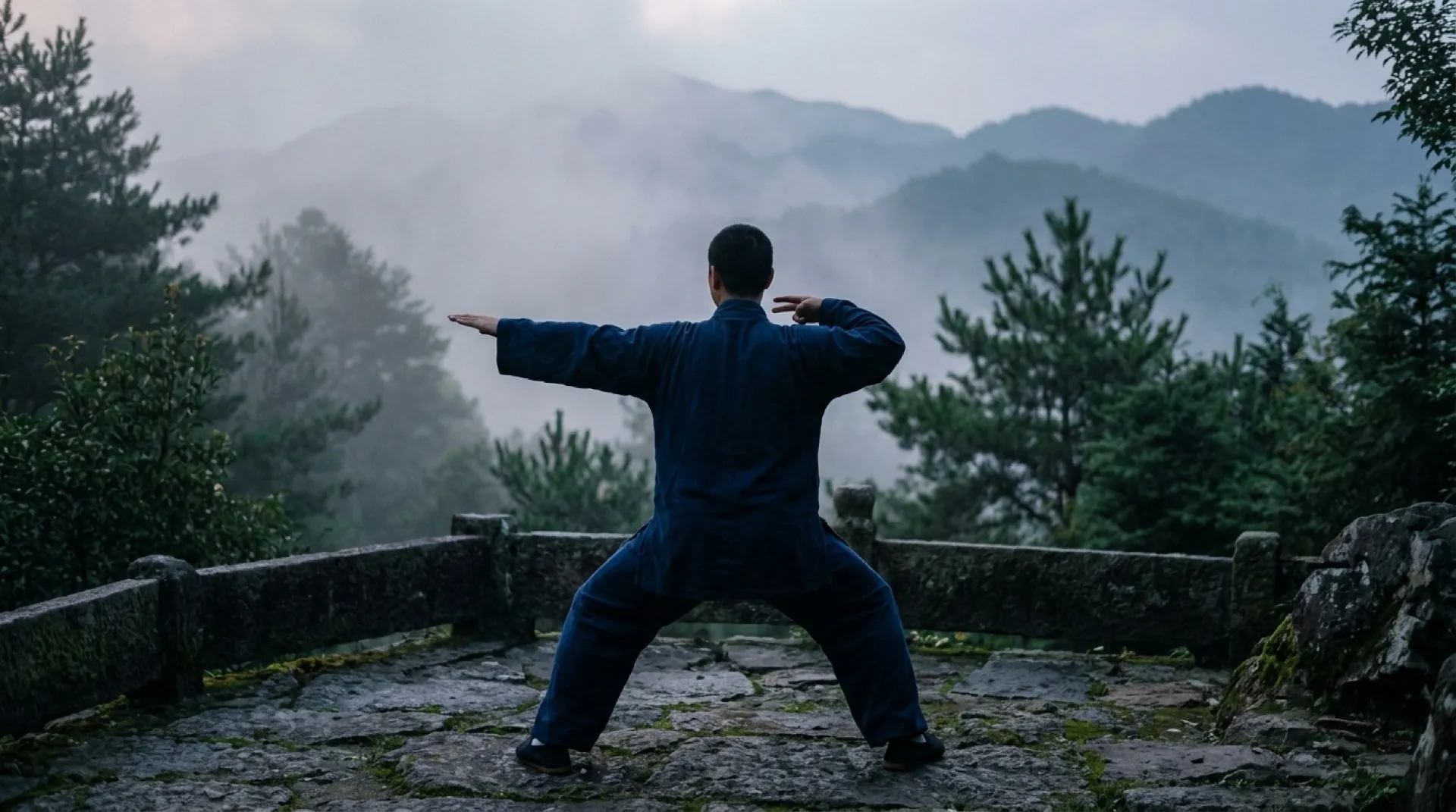
A practitioner in indigo training clothes, seen from behind, in a wide horse stance with one arm extended to the side and the other drawn back as if drawing a bow, on a stone terrace facing misty mountains.

In the Huangdi Neijing (《黄帝内经》), the Lungs are compared to a high canopy—“the Canopy of the Five Viscera” (肺为五脏之华盖)—that governs the rhythm of respiration and distributes Defensive Qi (Weiqi 卫气) across the skin and surface of the body. Yet modern desk work does the exact opposite of opening a canopy: hours of typing pull the collarbones inward, tighten the pectoralis minor beneath the shoulders, and restrict breathing to the top third of the chest.

By uniting gentle hollow-palm tapping of the Lung alarm points with Section 2 of Baduanjin (“Drawing the Bow Left and Right”) and the dental “Si” (呬) exhalation from Liuzijue (Six Healing Sounds), this 8-minute Wudang Xuanfei Yiqi (宣肺益气) routine opens the upper chest and deepens Natural Abdominal Breathing.

1. Why the Hollow Beneath the Collarbone Is Called “Cloud Gate” (云门穴)

  • Zhongfu (中府, LU-1) and Yunmen (云门, LU-2): Located in the soft depression just below the outer end of the collarbone (in the deltopectoral triangle), these two points are where the Hand Taiyin Lung meridian emerges from the chest toward the arm. When your shoulders slouch forward, this “Cloud Gate” becomes congested and tender; gently patting it with a cupped palm immediately invites the collarbones to broaden.
  • Letting Out Stale Air Like Nanguo Ziqi (“Exhaling Gently Toward Heaven”): Before you can take a deep, refreshing breath, you must first release the stale air trapped in a tight ribcage.

2. An 8-Minute Wudang “Xuanfei Yiqi” Daily Routine

Practise standing by an open window or in fresh morning air:

  1. Minutes 1–2 — Cupped-Palm Patting of the Cloud Gate (空心掌轻拍云门中府): Stand with feet shoulder-width apart. Curve your right fingers slightly to form a “hollow palm” (空心掌, so air cushions the contact) and gently pat the soft hollow just below the outer third of your left collarbone (Yunmen and Zhongfu) 36 times while breathing naturally. Switch hands and pat beneath the right collarbone 36 times.
  2. Minutes 3–5 — “Drawing the Bow Left and Right” to Expand the Thoracic Canopy (左右开弓 · 展肩扩胸): Inspired by Section 2 of Baduanjin (and the Five-Bow structure of Wangong Shehu), step into a comfortable high horse stance. Cross both wrists before the chest on an inhalation; exhale slowly as your left hand forms the sword-finger bow grip pushing out to the left while your right hand draws the bowstring horizontally across the chest toward the right shoulder—feeling both collarbones and shoulder blades glide open without shrugging (Chenjian Zhuizhou). Alternate six times per side.
  3. Minutes 6–8 — The Metal “Si” Exhalation to Clear Stale Breath (呬字清肺 · 齿音绵长): From Liuzijue, stand upright and inhale as both palms rise before the chest; turn the palms forward and press slowly outward as you bring your upper and lower front teeth lightly near each other, draw the corners of the mouth slightly back, and let a long, silent “Si” (呬 / ss-) breath glide out through the narrow gap between the teeth for six to eight seconds. Repeat six times, then close by folding both hands over the lower Dantian (Shougong).

3. Best Times to Practise

  • In the early morning when Lung Qi is naturally active, during the crisp autumn season, or whenever you feel shallow-breathed after hours at a keyboard.

4. Cultivating Clear Breath Between Wudang Mountain and Singapore

Connecting the fresh pine-scented air near Wudang Mountain’s UNESCO World Heritage ancient Taoist temples with our regular classes in Singapore, Wudang.Org helps students build resilient breathing habits. Compare our foundational sets in Choosing Your First Qigong Set, visit Start Here, or join our Singapore Baduanjin workshop.

Safety note: Always use a soft, cupped hollow palm when patting below the collarbone (never strike the clavicle bone itself), and breathe gently without hyperventilating; traditional Qigong is a cultural wellness practice and does not replace medical care.

Seeker’s Q&A · Frequently Asked Questions

Where are the “Yunmen” (云门, Cloud Gate) and “Zhongfu” (中府) points located?

They sit in the soft triangular hollow just below the outer third of the collarbone (clavicle), slightly medial to the front of the shoulder. Always pat this soft muscular depression gently with a cupped hollow palm rather than striking the collarbone.


How is the “Si” (呬) breath produced in Liuzijue to nourish the Lungs?

Bring the upper and lower front teeth gently close together with a tiny gap between them, draw the corners of the mouth slightly back, and let a long, silent stream of air glide out through the teeth for six to eight seconds without vocal-cord strain.

Why should I use a “cupped hollow palm” (Kongxinzhang 空心掌) during chest patting?

Cupping the palm traps a cushion of air that sends a warm, penetrating acoustic vibration into the fascia without slapping or bruising the skin.
