QIGONG & DAOYIN · 气功与导引

Tiger, Bear & Ape Frolics in Classical Wuqinxi (Five Animal Frolics): Sinew-Bone Power, Spleen-Stomach Ambling & Agile Spirit 传统五禽戏之“虎戏”、“熊戏”与“猿戏”详解:虎威强筋骨、熊晃和脾胃与猿捷灵心神

Completing Hua Tuo’s five-animal Daoyin cycle from the Book of the Later Han—how the Tiger stretches the spinal bow, the Bear massages the middle abdomen, and the Ape refreshes the eyes and heart.

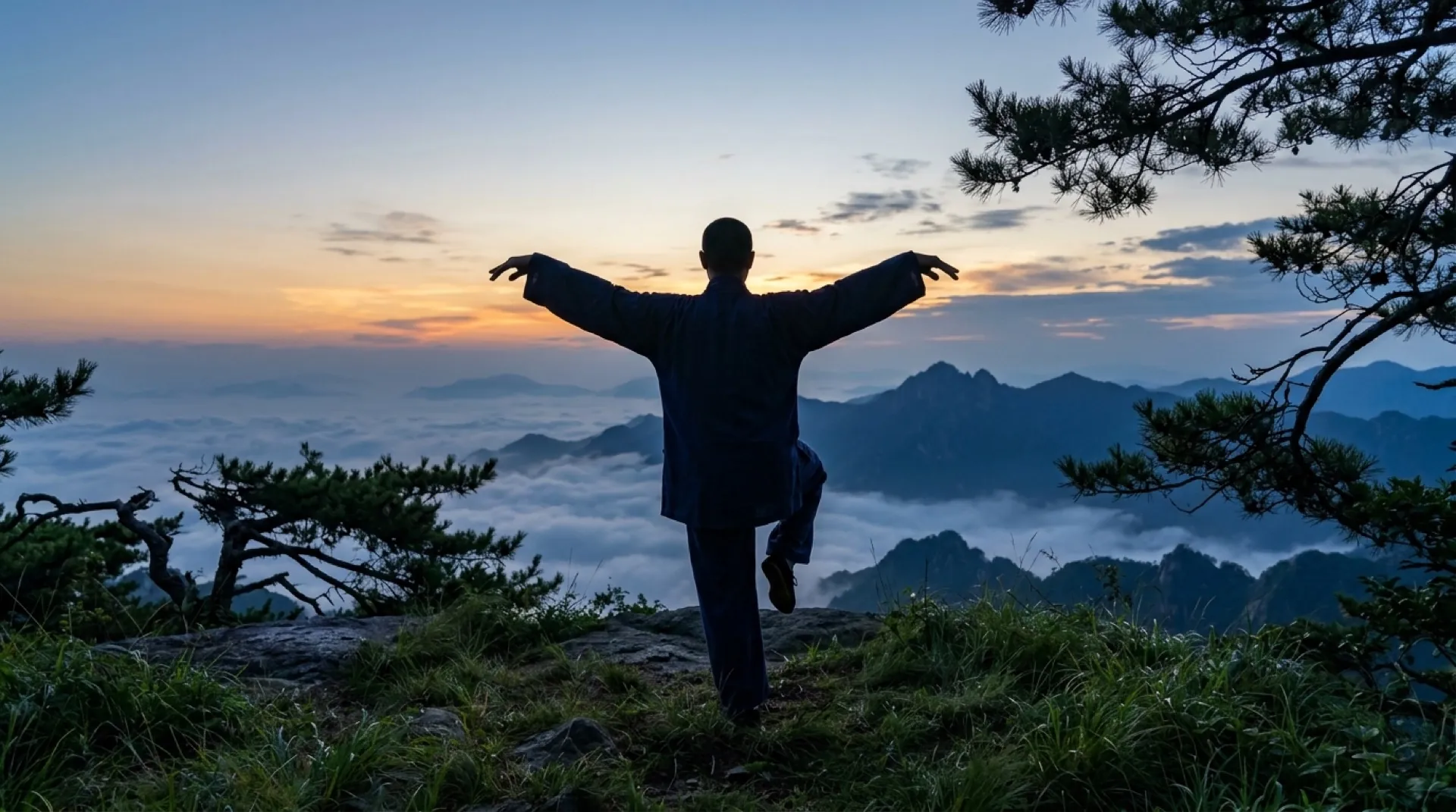
A practitioner seen from behind, standing on one leg with both arms spread wide like wings on a grassy summit among pines, above a sea of clouds at dawn.

In our companion guide—Deer & Crane Frolics in Classical Wuqinxi—we explored how the Deer rotates the waist and the Crane opens the wings and balance. Together with the Tiger Frolic (虎戏, Huxi), the Bear Frolic (熊戏, Xiongxi), and the Ape Frolic (猿戏, Yuanxi), these five archetypes complete the full Five Animal Frolics (五禽戏, Wuqinxi) recorded in Hua Tuo’s biography in the Book of the Later Han (《后汉书·方术列传·华佗传》: “the first is called Tiger, the second Deer, the third Bear, the fourth Ape, and the fifth Bird”).

1. The Three Archetypes: Tiger Sinews, Bear Center, and Ape Spirit

  • The Tiger (虎戏 — Sinews, Bones, and the Spinal Wave): In classical Daoyin, the Tiger embodies dignified power in the sinews and bones and a spirited gaze (虎威在目). Its upward reach and forward pounce lengthen the entire spine like a great bow (Wugong) before coiling back into the hips.
  • The Bear (熊戏 — Grounded Weight & Middle-Burner Massage): Mentioned in Zhuangzi Chapter 15 as “Xiongjing” (熊经, “poised like a bear”), the Bear appears heavy on the outside yet supple and hollow within. Its circular waist-rolling gently kneads the Spleen and Stomach (Jianpi Hewei).
  • The Ape (猿戏 — Agile Wrists, Alert Eyes & Calm Heart): The Ape embodies nimble alertness. By rising lightly onto the toes, drawing the shoulders softly, and turning the eyes to “pick fruit,” it refreshes the neck, eyes (Mingmu Yunjing), and Heart spirit (Qingxin Anshen).

2. A 10-Minute Daily Practice: Tiger, Bear, and Ape

  1. Minutes 1–3 — Tiger Lifting & Tiger Pouncing (虎举 · 虎扑): Stand with feet shoulder-width apart. Curve your ten fingertips into “tiger claws” (虎爪, palms rounded and fingers hooked with elastic tension). Inhale as you raise both tiger paws overhead as if lifting a heavy cauldron; curl the fingers into hollow fists and exhale as you draw them down past the shoulders, then open the claws and press down to the hips. Next, for Tiger Pouncing, inhale as the hands draw up along the torso and exhale as you bow the spine forward in a wave—lengthening from tailbone to crown (folding at the hip crease) before sitting into a high Empty Stance. Repeat six rounds.
  2. Minutes 4–6 — Bear Turning the Abdomen & Bear Ambling (熊运 · 熊晃): Curl your hands into soft “bear paws” resting lightly over the middle abdomen. Keep your feet planted and roll your waist and upper abdomen in a slow, heavy vertical-and-horizontal circle—six times clockwise and six times counter-clockwise—letting the internal organs rock gently inside the abdominal cavity. Then shift weight from left foot to right foot in a slow, grounded bear amble, letting the opposite shoulder and hip sway in unison.
  3. Minutes 7–10 — Ape Lifting & Ape Picking Fruit (猿提 · 猿摘): Gather all five fingertips of each hand together into “ape hooks” (猿钩). Inhale as you rise onto the balls of your feet (stimulating the six foot meridians), draw your wrists up before the chest, and look briskly to the left and right; exhale as the heels settle and the shoulders melt downward (releasing neck stiffness). Finish with the 5-minute Wudang Shougong.

3. Putting All Five Animals Together: The Classical Sequence

When you have 20 minutes for a complete session, follow Hua Tuo’s exact order from the Hou Hanshu: 1. Tiger → 2. Deer → 3. Bear → 4. Ape → 5. Bird (Crane)—moving naturally from sinew-awakening (Tiger) and spinal rotation (Deer) through abdominal grounding (Bear) and agile coordination (Ape) into spacious, quiet breathing (Crane).

4. Practising Complete Wuqinxi Between Wudang Mountain and Singapore

Connecting the living Daoyin heritage near Wudang Mountain’s UNESCO World Heritage ancient Taoist temples with our regular classes in Singapore, Wudang.Org welcomes students of every age to experience the complete Five Animal Frolics. Compare our four foundational sets in Choosing Your First Qigong Set or visit Start Here.

Safety note: In Tiger Pouncing, hinge at the hips rather than rounding the lower back forcefully, and keep Bear Ambling slow and stable; traditional Qigong is a cultural wellness practice and does not replace medical care.

Seeker’s Q&A · Frequently Asked Questions

How do the Tiger, Bear, and Ape Frolics complement the Deer and Crane Frolics in Wuqinxi?

Together the five animals form a complete five-element cycle: Tiger strengthens the sinews and bones (Kidney/Liver), Deer rotates the waist and spine, Bear massages the Spleen and Stomach, Ape enlivens the Heart spirit and wrists, and Bird/Crane expands the Lungs.


Why does the Ape Lifting movement (Yuanti 猿提) briefly raise the shoulders before dropping them?

In Ape Lifting, briefly drawing the shoulders and wrists upward on an inhalation and then letting them melt completely downward on the exhalation uses contract-release Daoyin to flush stagnant tension out of the trapezius and neck.

What is the key to performing “Bear Turning” (Xiongyun 熊运) comfortably?

Keep your hips and knees softly rooted while letting the middle abdomen (around the navel and solar plexus) initiate a slow, heavy circular motion—never forcing the lower back or holding your breath.
