QIGONG & YANGSHENG · 气功与导引

Wudang Ribcage & Diaphragmatic Breathing Daoyin (Xielei Kaihe): Unlocking Stiff Lower Ribs so Breath Settles Effortlessly 武当“胁肋开合与横膈调息”导引术:解开胸肋郁滞、令气沉丹田自然顺畅的练习

Grounded in Tao Te Ching Chapter 5 ('The space between Heaven and Earth is like a bellows') and the Huangting Jing, learn the Wudang lateral ribcage-expanding Daoyin routine to release chest tightness and deepen abdominal breath.


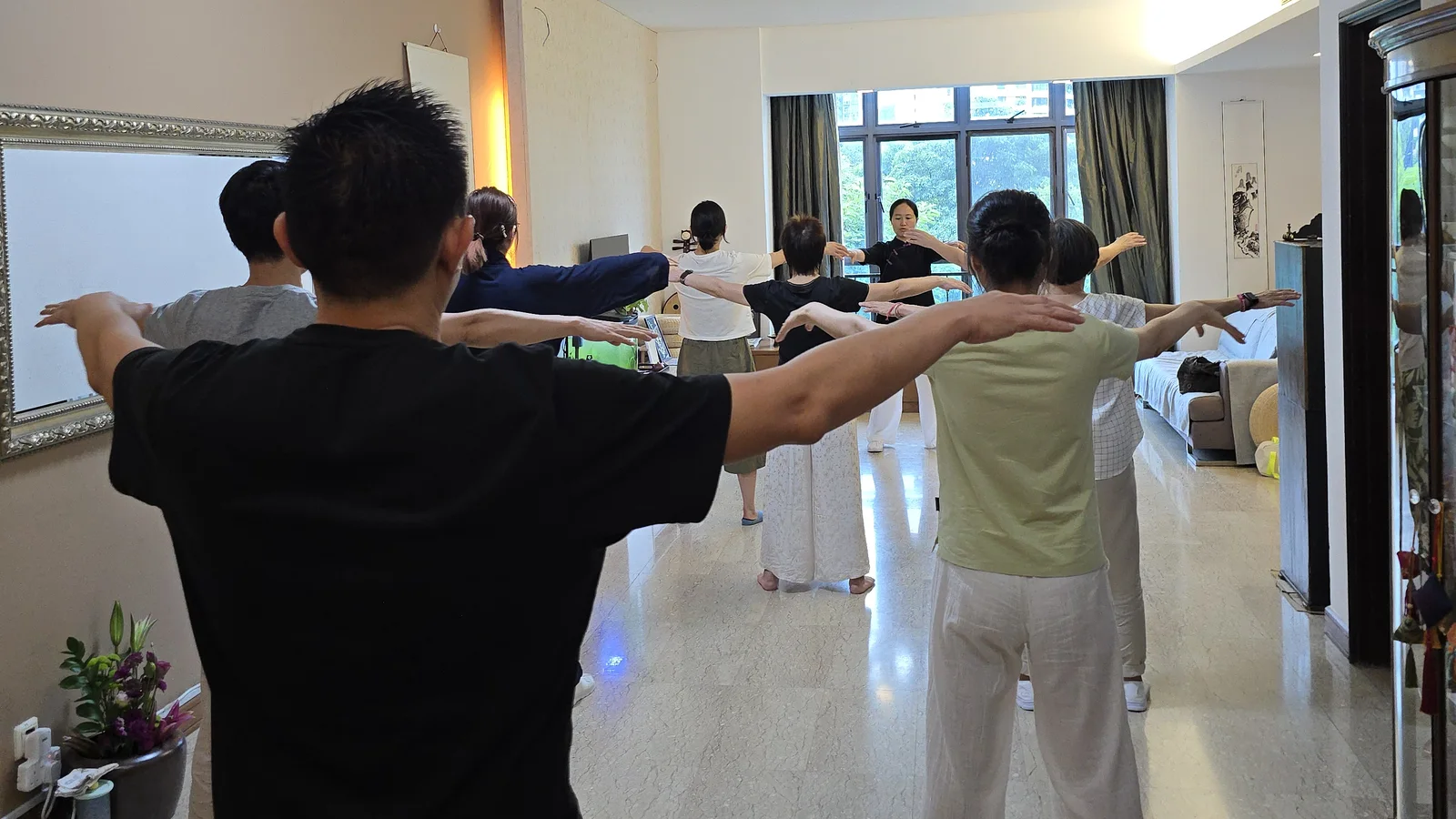
A standing qigong class in a sunlit room: students seen from behind hold both arms open at shoulder height in the same alignment, facing a teacher in dark clothing before a tall window with green trees outside.

1. The 'Bellows' of Chapter 5: Why Abdominal Breathing Requires Supple Lower Ribs

In Chapter 5 of the Tao Te Ching (Dao De Jing), Laozi compares the living space of the cosmos—and by extension the human torso in breath cultivation—to a traditional forge bellows (Tuoyue 橐籥): 'The space between Heaven and Earth—is it not like a bellows? Empty yet never collapsed; when moved, more and more comes forth.' In the Huangting Jing (Yellow Court Classic), the diaphragm and lower ribcage border the central 'Yellow Court' (Huangting) that links the Heart and Lungs above with the Spleen, Liver, and Kidneys below.

When beginners first learn natural abdominal breathing (Shun Fushi Huxi), they often make the mistake of pushing the lower belly forcefully outward while keeping the lower ribs (Xielei 胁肋) and sternum frozen. Because the dome of the diaphragm attaches directly along the inside of the lower six ribs, a stiff ribcage prevents the diaphragm from descending smoothly, creating a feeling of pressure in the solar plexus.

2. Feeling 360-Degree 'Gills of the Ribs' Expansion (Xielei Kaihe)

To experience how Wudang Qigong frees the diaphragm, stand or sit tall and wrap your palms around the sides of your lower ribcage—thumbs pointing toward your back ribs and fingers resting along the front costal arch just above the waist. Let your shoulders drop heavily (Chenjian) and allow your sternum to soften inward by a few millimeters (Hanxiong 含胸).

As you inhale quietly through the nose, instead of lifting your collarbones or shoving your navel forward, feel your lower ribs widen softly sideways and backward into your palms—like the gills of a fish or a bamboo basket gently expanding in 360 degrees. As you exhale slowly, feel the ribs elasticly recoil inward and downward while warmth settles effortlessly into the lower abdomen.

3. Three-Step Wudang Ribcage & Diaphragm Daoyin Routine (5 Minutes)

Practice this five-minute sequence alongside our soothing Liver Qi and rib-side Daoyin or before Zhan Zhuang standing meditation:

1. Hands-on-Ribs Accordion Breath (FuXie Tongxi 抚胁通息): With palms cradling the lower lateral ribs, take nine slow breaths focusing on equal expansion into the left palm, right palm, and rear kidney area (Mingmen), keeping the upper chest and neck completely quiet.

2. Crescent-Moon Intercostal Arc (Xinyue Kaixie 新月开胁): Stand with feet shoulder-width apart. Float the left arm overhead in a soft curve while the right palm rests on the right hip; inhale into the open left ribcage so the intercostal spaces fan open gently, then exhale as the left arm floats down. Repeat six times on each side without leaning the hips past the feet.

3. Subcostal Diaphragm Smoothing (Shunge Jiangqi 顺膈降气): On a long exhale with knees slightly softened, trace the pads of your fingers gently from the base of the sternum down along the left and right costal margins toward the flanks nine times, releasing held tension beneath the ribs.

4. Pacing, Dizziness Prevention, and Safety Notes

Never over-breathe or force deep inhalations to stretch the ribs from the inside; as we saw in Great Perfection Seems Incomplete (Chapter 45), a comfortable, unforced breath that stops short of straining keeps the ribs and diaphragm soft.

Safety note: if you feel lightheaded, pause and resume normal unguided breathing; avoid deep subcostal pressing immediately after meals or if you have rib injuries or abdominal conditions. This traditional Daoyin guide is for educational breath and posture wellness and is not a substitute for medical care.

Seeker’s Q&A · Frequently Asked Questions

What is the core takeaway of Wudang Ribcage & Diaphragmatic Breathing Daoyin (Xielei Kaihe)?

Grounded in Tao Te Ching Chapter 5 ('The space between Heaven and Earth is like a bellows') and the Huangting Jing, learn the Wudang lateral ribcage-expanding Daoyin routine to release chest tightness and deepen abdominal breath.
