QIGONG & YANGSHENG · 气功与导引

Wudang Knee-Warming & Zusanli Daoyin (Yangxi Huoxi): Gentle Patellar Mobilization, Alignment, and Self-Massage for Resilient Knees 武当“温膝活节”与足三里导引术:护持膝盖半月板与强健下肢的传统养生法

Grounded in Tao Hongjing's Yangxing Yanming Lu and Wudang internal martial arts alignment principles, learn a gentle knee-warming, patellar-gliding, and Zusanli (Stomach 36) self-massage routine.


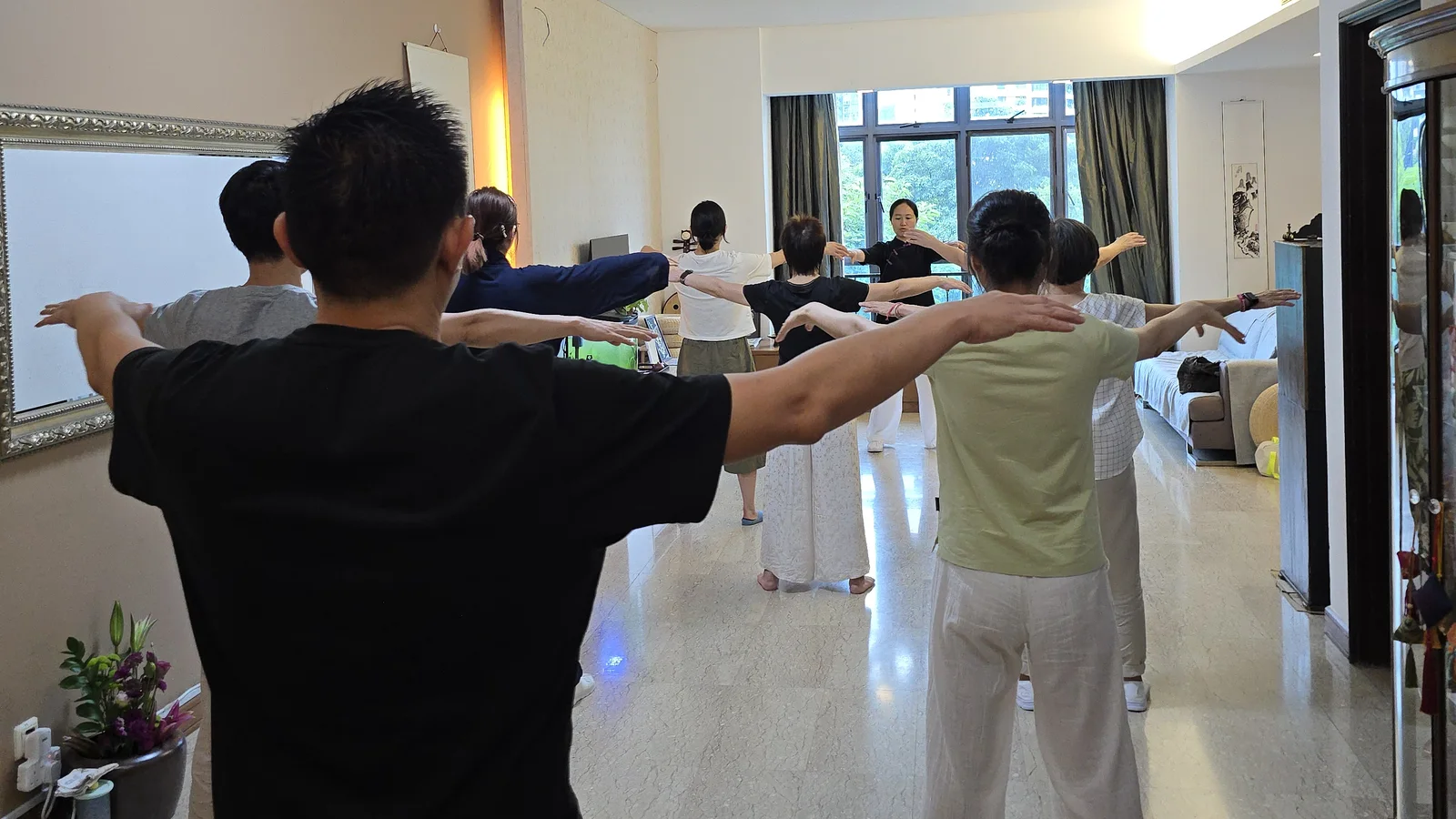
A standing qigong class in a sunlit room: students seen from behind hold both arms open at shoulder height in the same alignment, facing a teacher in dark clothing before a tall window with green trees outside.

1. Why Wudang Cultivation Begins and Ends with Caring for the Knees

Whether climbing the stone steps of Wudang Mountain, standing quietly in Zhan Zhuang (Standing Post), or transitioning through the low stances of Taijiquan, the knee joints serve as the middle hinges (Zhongjie 中节) of the legs, transmitting force between the rooted ankles and arches below and the supple hip creases (Kua) above.

Because the knee capsule and ligaments have relatively thin superficial tissue and are easily chilled by morning dampness or strained by locked postures, traditional Taoist longevity manuals such as Tao Hongjing's Yangxing Yanming Lu (Records on Nourishing Nature and Extending Life) emphasize warming the knees with the palms (Moxi 摩膝) and stimulating Zusanli (足三里, 'Leg Three Miles') before and after physical exertion.

2. The Three Golden Rules of Wudang Knee Alignment

As we noted in our Zhan Zhuang posture troubleshooting guide, no amount of self-massage can compensate for faulty alignment during standing or stepping. Keep three structural laws in mind whenever your knees bend:

First, kneecap-to-toe tracking: the center of the patella must point strictly along the line of the second toe, never caving inward (knees knocking) or twisting while the foot is planted. Second, sit into the hip crease first: initiate every lowering of stance by folding the inguinal crease (Songkua) backward rather than shoving the knees past the toes. Third, never lock into hyperextension: even in upright standing, keep a tiny breath of softness behind the knee crease (Weizhong 委中).

3. Three-Step Wudang Knee-Warming & Zusanli Daoyin Routine (5 Minutes)

Practice this gentle, low-load five-minute sequence seated or standing before morning Qigong or after long walks:

1. Warming the 'Eyes of the Knee' (Wenrou Xiyan 温揉膝眼): Sit comfortably with knees bent at 90 degrees or stand in a high, relaxed stance. Rub both palms briskly together until warm, then cup the centers of your palms (Laogong) over both kneecaps. Circle the palms firmly and warmly 18 times inward and 18 times outward around the border of the patella—especially warming Heding (鹤顶, 'Crane's Crown,' just above the kneecap) and the two hollows below the kneecap (Xiyan 膝眼, 'Eyes of the Knee').

2. Unloaded Patellar & Pendulum Glide (Xuangu Huoxi 悬股活膝): While seated on a bench or high stool so your feet hang just clear of the floor, let the lower legs swing gently forward and back 18 times with zero muscular effort, allowing synovial fluid to lubricate the joint space without compressive load.

3. Pressing and Drumming Zusanli (Anrou Zusanli 按揉足三里): Locate Zusanli (four finger-breadths below the outer hollow of the kneecap, one finger-breadth lateral to the crest of the shinbone). Press and circle this point with the thumbs or tap it gently with loose hollow fists 36 times on each leg.

4. Cold-Weather Protection & Joint Safety Notes

In traditional Wudang mountain practice, practitioners always cover the knees with warm cotton robes or cloth leg-wraps during dawn practice so cold wind does not penetrate the open joints while sweating—and avoid deep unloaded knee circles that grind bent knees under full body weight.

Safety note: do not use warming or massage on a fresh sprain or any recent knee injury, especially in the first couple of days. NHS guidance on sprains and strains advises avoiding heat and massage at first. If you have a recent injury, acute knee swelling, a meniscus tear, a ligament injury, or an osteoarthritis flare-up, see a doctor or physical therapist before trying this routine, and do only what they approve. This traditional Daoyin guide is for educational wellness practice and is not a medical treatment.

Seeker’s Q&A · Frequently Asked Questions

What is the core takeaway of Wudang Knee-Warming & Zusanli Daoyin (Yangxi Huoxi)?

Grounded in Tao Hongjing's Yangxing Yanming Lu and Wudang internal martial arts alignment principles, learn a gentle knee-warming, patellar-gliding, and Zusanli (Stomach 36) self-massage routine.
