QIGONG & DAOYIN · 气功与导引

Wudang “Firm Grasp” Hand Seal (Wogu) & Laogong-Warming Daoyin: From Tao Te Ching Chapter 55 to Settling Scattered Attention 武当「握固」手诀与温煦劳宫导引法:自《道德经》赤子之握至收摄心神实修指南

How to practice the classical Taoist Firm Grasp (Wogu) hand posture described in Tao Te Ching (Dao De Jing) Chapter 55, Baopuzi, and Yunji Qiqian—tucking the thumb softly to the base of the ring finger to calm mental restlessness and warm the hands in sitting or standing meditation.


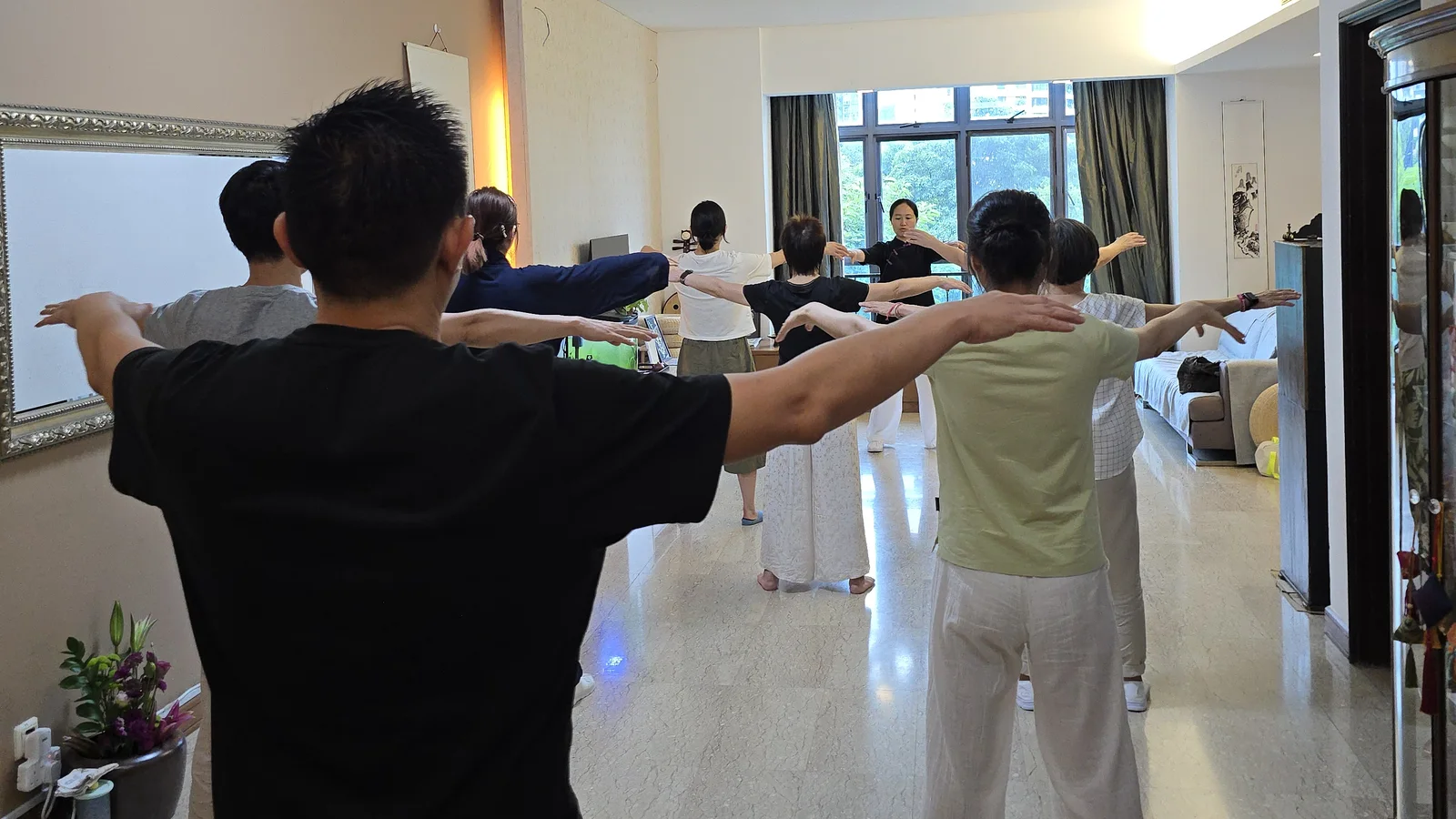
A standing qigong class in a sunlit room: students seen from behind hold both arms open at shoulder height in the same alignment, facing a teacher in dark clothing before a tall window with green trees outside.

What Is Wogu (“Firm Grasp”) in Classical Taoist Texts?

The term Wogu (握固, literally 'Firm Grasp' or 'Guarded Hold') appears first in Chapter 55 of the Tao Te Ching (Dao De Jing): 'Its bones are soft, its sinews are supple, yet its grasp is firm' (骨弱筋柔而握固). Observing how a sleeping or resting newborn naturally tucks its thumb inside its curled fingers, early Taoist physicians and meditation masters adopted Wogu as a foundational hand seal (shoujue 手诀) for quiet sitting, lying-down breath cultivation, and morning awakening. In the Song-dynasty Taoist encyclopedia Yunji Qiqian (云笈七签) and Ge Hong's Baopuzi (抱朴子), Wogu is defined simply and concretely: 'Bend the thumb and place it inside the palm at the root of the four fingers, then wrap the four fingers gently around it' (屈大母指著四小指内抱之).

Finger Landmarks: The Ring-Finger Root (Wumingzhi Gen) and Laogong (PC-8)

In Wudang quiet-sitting and Daoyin transmission, Wogu uses two precise tactile touchpoints on each hand. First, the pad of the thumb touches the palmar crease at the base of the ring finger (wumingzhi gen 无名指根部). Second, as the index, middle, ring, and little fingers fold gently over the back of the thumb, the tip of the thumb or the curled fingers lightly shelter Laogong (劳宫, Pericardium 8) at the center of the palm. Unlike a martial fist clenched for striking, Wogu uses no muscular squeezing at all—the fingers wrap around the thumb like a warm blanket, sealing the palm center so warmth accumulates naturally and fidgeting hands come to rest.

Three Practical Ways to Use Wogu: Morning Awakening, Quiet Sitting, and Walking

You can incorporate Wogu into three moments of daily life without any special equipment. 1. Upon Waking in the Morning: Before rising from bed, rest on your back for one minute with both hands lightly in Wogu beside your hips while taking six slow nasal breaths; classical Yangxing Yanming Lu (养性延命录) routines use this to gather attention before the day's activity begins. 2. During Quiet Sitting (Jingzuo): Rest the backs of both Wogu hands comfortably on your upper thighs near the hip creases with the shoulders dropped and elbows relaxed, helping quiet a busy mind that tends to fidget with the fingers. 3. During Slow Outdoor Walking: When walking in cool weather or after mental work, hold a soft Wogu as your arms swing gently at your sides, releasing and opening the fingers on every fourth exhale.

Rhythmic Wogu Opening-and-Closing Daoyin for Cold Hands and Desk Fatigue

For practitioners whose hands feel cold or stiff after hours at a keyboard, a two-minute rhythmic Wogu Daoyin restores warmth and suppleness. Sit tall with your forearms resting on your thighs, palms up. On a slow nasal inhale, touch the thumb tips to the base of the ring fingers and fold the four fingers gently over the thumbs into Wogu (using at most 20 percent of your grip strength—soft, never tight). Pause for one beat to feel the warmth inside the closed palms, then on a long nasal exhale open all five fingers smoothly like a lotus blossom. Repeat 18 times at the pace of your natural breath. Safety note: Never clench Wogu tightly or press with the fingernails; if you have thumb joint arthritis or carpal tunnel discomfort, keep the thumb resting lightly across the palm without folding it deeply.

Seeker’s Q&A · Frequently Asked Questions

What is the key structural alignment in Wudang “Firm Grasp” Hand Seal (Wogu) & Laogong-Warming Daoyin?

How to practice the classical Taoist Firm Grasp (Wogu) hand posture described in Tao Te Ching (Dao De Jing) Chapter 55, Baopuzi, and Yunji Qiqian—tucking the thumb softly to the base of the ring finger to calm mental restlessness and warm the hands in sitting or standing meditation.
