QIGONG & DAOYIN · 气功与导引

Cupped-Palm Tapping at Jianjing and Scapular Daoyin: Releasing the Shoulder Wells (GB-21) for Sunk Shoulders and Smooth Breath 叩拍肩井与旋肩开胛:武当松肩沉气导引按跷法指南

How traditional Wudang Anqiao percussive tapping at the trapezius ridge and circular shoulder-blade opening dissolve upper-body bracing before standing meditation

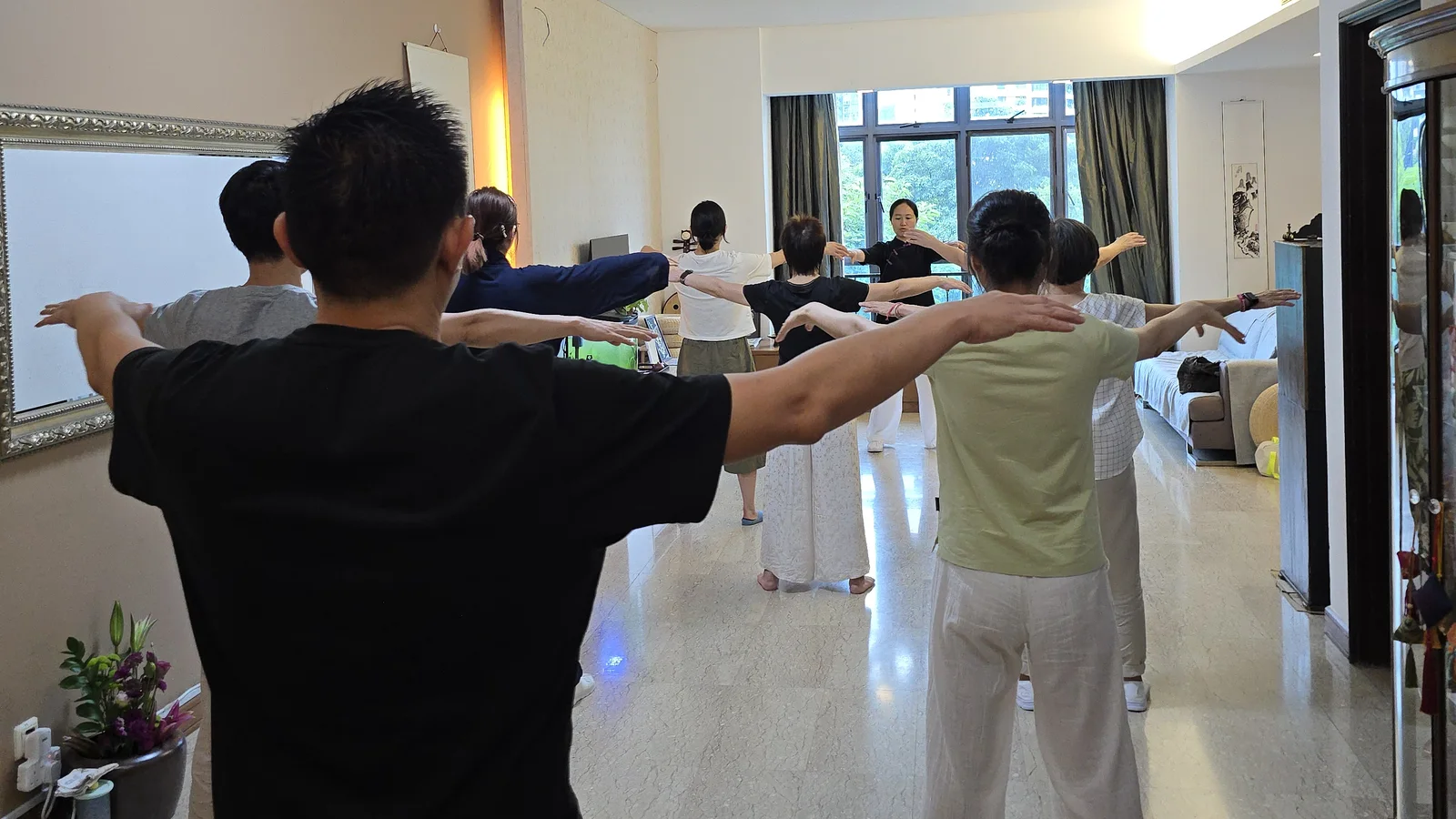
A standing qigong class in a sunlit room: students seen from behind hold both arms open at shoulder height in the same alignment, facing a teacher in dark clothing before a tall window with green trees outside.

In both modern desk work and beginner martial arts training, the upper trapezius ridge — midway between the base of the neck and the tip of the shoulder — is where habitual tension collects first. When the shoulders creep upward toward the ears, the ribcage stiffens, breathing becomes shallow, and the classical requirement of "sinking the shoulders and dropping the elbows" (Chenjian Zhuizhou 沉肩坠肘) becomes difficult to feel. In Wudang Qigong and Daoyin, practitioners prepare the upper frame by gently tapping and kneading Jianjing (肩井, "Shoulder Well," GB-21) before standing in Zhan Zhuang.

1. Why It Is Called the "Shoulder Well" (Jianjing 肩井)

Located at the highest point of the shoulder muscle halfway between the seventh cervical prominence (Dazhui 大椎) and the acromion (Jianyu 肩髃), Jianjing sits like a mountain wellhead along the Gallbladder Meridian. In classical Daoyin physiology, when the "wellhead" at the top of the shoulder is tight and congested, clear breath cannot descend smoothly to the lower abdomen (Natural Abdominal Breathing); when it opens and softens, warmth and relaxation flow down through the arms and flanks.

2. Four-Step Wudang Shoulder-Well Daoyin Routine

  1. Cupped-Palm Alternate Tapping (Kongxinzhang Kou Jianjing 空心掌叩肩井): Stand or sit upright with knees unlocked. Curve the fingers of your right hand into a soft "hollow palm" (Kongxinzhang 空心掌) so air cushions the impact, reach across the chest to tap the left Jianjing hollow rhythmically 24 to 36 times while exhaling smoothly through the nose, then switch hands to tap the right shoulder well 24 to 36 times.
  2. Thumb-and-Finger Kneading (Na Jianjing 拿肩井): Use the pad of the middle and index fingers together with the thumb to gently pinch, lift, and release the trapezius muscle bellies nine times on each side, letting the elbow of the massaged arm hang heavy.
  3. Opening and Closing the Scapular Gates (Kaihe Jianjia 开合肩胛): With fingertips resting lightly on the tops of your own shoulders, inhale through the nose as you bring the elbows forward and gently upward; exhale long and slow as you roll the elbows wide to the sides and let the shoulder blades slide down the back, repeating nine times.
  4. Sighing Release into Wuji (Xuqi Luojian 嘘气落肩): Let both arms hang beside the thighs, take one calm nasal inhalation, and release a silent, unhurried exhalation while feeling the shoulder wells melt vertically toward the hip creases (Shoulder with Hip).

3. Safety Notes and Complementary Guides

Safety note: Keep tapping gentle and elastic using a cupped palm rather than striking bony prominences; in traditional Chinese wellness cautions, forceful stimulation of Jianjing is avoided during pregnancy. This cultural Daoyin exercise supports postural relaxation and is not a medical treatment. Pair this routine with Kneading Fengchi and Warming Dazhui, Wudang Daoyin for Desk Stiffness, and our Start Here beginner pathway.

Seeker’s Q&A · Frequently Asked Questions

What is the key structural alignment in Cupped-Palm Tapping at Jianjing and Scapular Daoyin?

How traditional Wudang Anqiao percussive tapping at the trapezius ridge and circular shoulder-blade opening dissolve upper-body bracing before standing meditation.


