QIGONG & DAOYIN · 气功与导引

Deer & Crane Frolics in Classical Wuqinxi (Five Animal Frolics): Spinal Rotation, Single-Leg Poise & Hua Tuo’s “Door-Pivot” Principle 传统五禽戏之“鹿戏”与“鸟(鹤)戏”详解:华佗“户枢不蠹”、旋腰顾尾与展翅独立

Why the Book of the Later Han (Hou Hanshu) records that “a moving door-pivot never rots”—and how the Deer’s gentle waist-turning and the Crane’s wing-breathing nourish the kidneys and lungs.

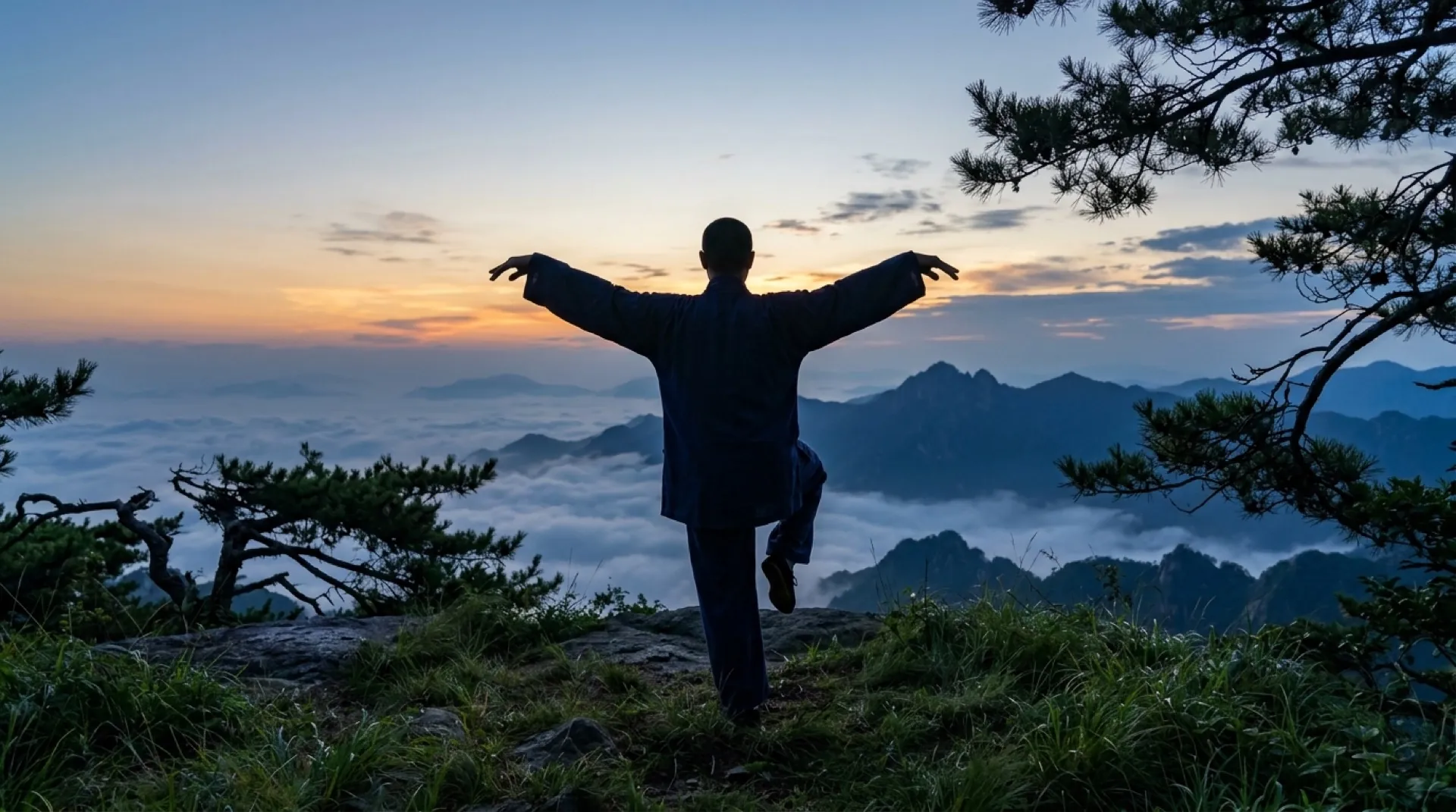
A practitioner seen from behind, standing on one leg with both arms spread wide like wings on a grassy summit among pines, above a sea of clouds at dawn.

Among the four foundational Qigong sets taught at Wudang.Org (alongside Baduanjin, Yijinjing, and Liuzijue), Wuqinxi (五禽戏, “The Frolics of the Five Animals”) is the oldest named dynamic Daoyin system in Chinese medical history. Already in Chapter 15 of the Zhuangzi (Keyi 《庄子·刻意》), early Taoist adepts are described as “breathing out the old and drawing in the new, hanging like a bear and stretching like a bird (熊经鸟申) purely for longevity.”

In the Book of the Later Han (《后汉书·方术列传·华佗传》), the physician Hua Tuo explains the core philosophy of Wuqinxi to his disciple Wu Pu in words that every modern desk worker should know by heart:

“The human body desires gentle labour, only it must never be pushed to exhaustion (人体欲得劳动,但不当使极耳). When the body moves gently, grain-qi digests and blood circulates smoothly through the vessels… Just as a moving door-pivot never gets worm-eaten (犹户枢不蠹), so the sages of old practised Daoyin… Therefore I haveA method called the Frolics of the Five Animals: the first is called Tiger, the second Deer, the third Bear, the fourth Ape, and the fifth Bird.”

1. Why the Deer (鹿戏) and the Bird/Crane (鸟/鹤戏) Pair So Well Together

While all five animals train the whole body, pairing the Deer Frolic (鹿戏) with the Bird/Crane Frolic (鸟戏 / 鹤戏) creates an ideal 10-minute daily practice for spinal suppleness and balance:

  • The Spirit of the Deer — Turning the Neck to Gaze at the Tail (鹿抵 · 旋腰顾尾): In Taoist lore, the deer is the emblem of tranquil longevity that turns its head backward to warm the Governing Vessel (Du Mai 督脉) and the Kidneys (Mingmen). Its spiral lateral bend releases the stiff lumbar and thoracic vertebrae that lock up from sitting.
  • The Spirit of the Crane — Spreading Wings in Poised Stillness (鸟伸 / 鹤飞 · 展翅独立): The crane embodies lightness, deep thoracic breathing (expanding the Lung canopy), and serene single-leg root (Crane Stepping).

2. A 10-Minute Daily Routine: Two Deer & Two Crane Movements

  1. Movement 1 — Deer Butting Antlers / Turning to Gaze at the Tail (鹿抵 · 转腰顾尾): Stand with feet shoulder-width apart and curl your fingers into soft “deer-antler” hands (thumb, index, and little fingers extended softly, middle and ring fingers curled). Step your left foot diagonally forward into a Bow Stance; as you exhale, arc both arms up and turn your waist and neck smoothly to the left to gaze backward toward your right heel—feeling a gentle crescent stretch along your right flank (rib-sides) and a mild contraction in the left waist. Inhale back to center and repeat to the right side, six rounds total.
  2. Movement 2 — Deer Running & Arching the Back (鹿奔 · 含胸拔背): Step forward, draw the hips slightly back into a high Empty Stance, and round the upper back between the shoulder blades (Jiaji 夹脊) while extending both wrists softly forward like a deer bounding lightly over moss—opening the entire posterior spine without hunching the neck.
  3. Movement 3 — Crane Stretching Upward & Opening the Chest (鸟伸 / 鹤展 · 引颈展翼): Bring the feet parallel. Inhale as both arms float up in front of the body with wrists soft; exhale as the hands press gently down behind the hips while the chest opens and the crown lifts toward the sky (Natural Abdominal Breathing). Repeat six times.
  4. Movement 4 — Crane Flying & Standing on One Leg (鸟飞 / 鹤立 · 展翅独立): Shift 100% of your weight into the right leg (rooting like Golden Rooster). Inhale as both arms float out to the sides like broad white wings while the left knee lifts gently in front (or touch the left toes lightly to the floor for assisted balance); exhale as the wings float down and the foot settles softly. Alternate six times per side, then close with Shougong.

3. Hua Tuo’s Golden Rule: “Move Without Reaching Exhaustion” (不当使极)

Unlike high-impact gym workouts that leave you gasping, Hua Tuo’s “door-pivot” rule states that Daoyin should bring a mild, pleasant warmth to the skin and joints while leaving you more energized than before you started.

4. Practising Classical Wuqinxi Between Wudang Mountain and Singapore

Connecting the living Daoyin tradition near Wudang Mountain’s UNESCO World Heritage ancient Taoist temples with our regular classes in Singapore, Wudang.Org teaches the complete Five Animal Frolics. Compare our four classic sets in Choosing Your First Qigong Set or visit Start Here.

Safety note: Turn the waist and neck smoothly within a comfortable range during Deer Butting, and keep the lifted foot low (or toes touching the floor) during Crane Flying if your balance is still developing; traditional Qigong does not replace medical care.

Seeker’s Q&A · Frequently Asked Questions

What is the meaning of Hua Tuo’s famous saying “A moving door-pivot never rots” (Hushu bu du 户枢不蠹) in the Hou Hanshu?

Recorded in Hua Tuo’s biography in the Book of the Later Han (Hou Hanshu), it means that wooden door hinges stay sound because they turn gently every day—teaching that moderate, regular movement (“without reaching exhaustion,” bu dang shi ji) keeps joints and circulation healthy.


What are the five animals in classical Wuqinxi (五禽戏)?

According to the Hou Hanshu, the five animals are the Tiger (Hu 虎), the Deer (Lu 鹿), the Bear (Xiong 熊), the Ape (Yuan 猿), and the Bird/Crane (Niao/He 鸟·鹤).

How do I form the “Deer Antler” hand gesture (Lujiaoshou 鹿角手) in the Deer Frolic?

Gently curl your middle and ring fingers into the center of the palm (touching near Laogong) while leaving the thumb, index finger, and little finger softly extended like the branches of a deer’s antler.
