QIGONG & DAOYIN · 气功与导引

Wudang Kidney-Warming & Mingmen Daoyin: Rubbing the Lumbar “Kidney Palace,” Gentle Waist Circles and Nourishing Lower-Body Vitality 武当温肾培元与命门导引法:摩热肾堂、松腰转胯与固护下元的十分钟日常功课

How traditional Taoist palm-warming on the lower back, gentle pelvic-waist rotations, and heel-descending breath relieve sedentary lumbar stiffness and nourish root vitality.

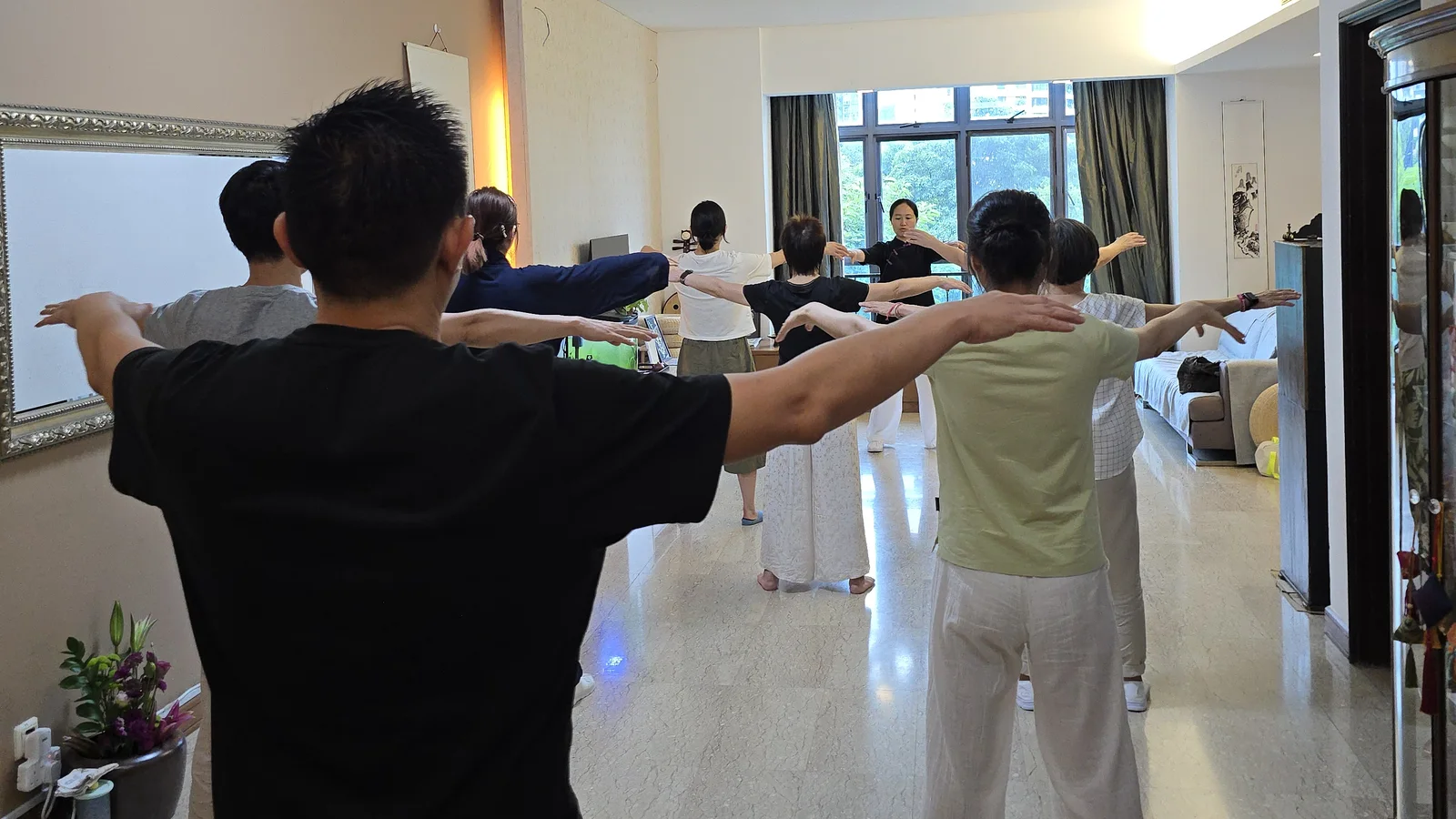
A standing qigong class in a sunlit room: students seen from behind hold both arms open at shoulder height in the same alignment, facing a teacher in dark clothing before a tall window with green trees outside.

In both classical Taoist Qigong and Wudang Taijiquan, the lower back and waist are revered as the central hinge of human vitality. The Taijiquan classics state that “the commander (主宰) is in the waist,” while the Huangting Jing (Yellow Court Classic) describes the lumbar region between the two kidneys—known as the Gate of Life (命门, Mingmen)—as the warm hearth that supports Essence (Jing) and Breath (Qi) throughout the whole body.

Yet in modern life, sitting for hours in air-conditioned rooms leaves the lumbar fascia compressed, cool, and stiff (see Lower-Back Arching in Zhan Zhuang). To restore warmth and supple mobility to the lower back without straining the spine, Wudang tradition pairs standing breathwork with a 10-minute sequence of “Rubbing the Kidney Palace” (摩肾堂, Mo Shentang) and Gentle Waist-Unlocking Daoyin.

1. Why the Lower Back and Mingmen Are the Root Hinge of the Body

  • Returning to the Root (归根复命): Chapter 16 of the Tao Te Ching (Dao De Jing) teaches: “All things flourish in abundance, and each returns to its root. Returning to the root is called stillness; stillness is called returning to vital mandate (Ming).” In Taoist body cultivation (Xing and Ming), when breath and awareness stay trapped in the head and chest, the lower back and legs feel weak and cold; when breath settles into the lower abdomen (Dantian) and warms the lumbar Mingmen opposite the navel, the legs regain their natural root.
  • The Waist as a Supple Axle: Every spiral in Silk-Reeling (Chansijin) and every weight shift in Grasp the Sparrow’s Tail passes through the lumbar-pelvic junction. Keeping this region warm and elastic protects the spine during daily movement.

2. A 10-Minute Wudang “Mo Shentang & Mingmen” Daily Routine

Practise this three-stage sequence in the morning (after your Morning Joint Warm-Up) or in the evening (before your Evening Wind-Down):

  1. Minutes 1–3 — Warming the Palms & Rubbing the “Kidney Palace” (搓手摩肾堂 · 温煦命门): Stand with feet shoulder-width apart and knees softly unlocked. Rub your two palms together briskly for twenty seconds until warm, then place both palms flat against your lower back on either side of the lumbar spine (covering the Shenshu 肾俞 acupoints just below the ribcage). Rub up and down along the muscles beside the spine thirty-six times at a steady, comfortable pace until a pleasant warmth spreads across the lower back. Then rest the back of one hand or both palms quietly over the midline Mingmen point (directly opposite the navel) for six slow abdominal breaths, feeling the lower back expand gently on each inhalation.
  2. Minutes 4–7 — “Turning the Millstone” Gentle Pelvic-Waist Circles (松腰转胯 · 玉带环周): Rest your hands lightly on your hips (Belt Vessel, 带脉) with thumbs pointing toward the lower back. Keeping your head and shoulders level at the center and your knees softly bent, trace twelve slow, horizontal circles with your pelvis and tailbone—first clockwise, then twelve times counter-clockwise. Move at half speed without forcing the range of motion, feeling the hip sockets (kua) and lower lumbar vertebrae oil themselves smoothly.
  3. Minutes 8–10 — Gentle Lumbar Wave & Settling the Root (抚背摩足 · 归根守一): Inspired by Section 6 of Baduanjin (“Two Hands Hold the Feet to Strengthen the Kidneys and Waist”), inhale as your palms rest on the lower back, then exhale as you bend the knees slightly and glide your palms smoothly down the backs of the thighs and calves to a comfortable height (mid-shin or ankles—never forcing a straight-legged forward bend if you have lower-back disc sensitivity). Roll back up vertebra by vertebra with knees bent, warm the lower back once more, and stand quietly for one minute with hands over the lower Dantian (Shouyi).

3. Integrating Lumbar Care into Desk Work and Martial Practice

  • During long desk days: Whenever you stand up from your chair, spend sixty seconds doing thirty-six brisk lumbar palm-rubs (Mo Shentang) alongside our Desk Neck and Shoulder Reset.
  • Before Taijiquan or Zhan Zhuang: Warming the Mingmen first makes it much easier to relax the tailbone in Zhan Zhuang and maintain single-leg poise in Golden Rooster Stands on One Leg.

4. Cultivating Root Vitality Between Wudang Mountain and Singapore

Connecting the living wellness heritage near Wudang Mountain’s UNESCO World Heritage ancient Taoist temples with our regular classes in Singapore, Wudang.Org helps seekers build sustainable daily habits. Compare our core methods in Choosing Your First Qigong Set, explore Start Here, or join our Singapore Baduanjin workshop.

Safety note: Rub the muscular bands on either side of the lumbar spine rather than pressing hard on the spinous processes themselves; if you have acute sciatica, lumbar disc herniation, or spinal stenosis, keep the knees bent and skip deep forward bending altogether, consulting your physician or physiotherapist first.

Seeker’s Q&A · Frequently Asked Questions

Where exactly is the “Kidney Palace” (Shentang 肾堂) and Mingmen (命门) on the lower back?

Mingmen sits on the midline of the lower back between the second and third lumbar vertebrae, directly opposite the navel. The “Kidney Palace” (Shentang) refers to the warm muscular bands on either side of Mingmen (around the Shenshu points, two finger-breadths lateral to the spine).


How many times should I rub the lower back during Mo Shentang (摩肾堂)?

Traditional manuals recommend rubbing the palms together until warm first, then stroking up and down beside the lumbar spine 36 times at a smooth, moderate pace until the lower back feels comfortably warm, followed by resting the palms quietly over Mingmen for 6 breaths.

How should beginners modify the forward glide if they have a stiff or sensitive lower back?

Always bend your knees softly first, keep the spine long, and glide your hands only to the backs of the knees or mid-calves rather than forcing a straight-legged toe touch. Roll back up slowly with knees bent.
