QIGONG & YANGSHENG · 气功与导引

Warming Shenmen (HT-7), Yinxi (HT-6), and Tongli (HT-5): Wudang Daoyin for the Ulnar Flexor Heart Meridian Wrist Corridor and Calm Taiji Palms 温煦神门(HT-7)、阴郄(HT-6)与通里(HT-5):武当手少阴心经腕侧四穴导引与太极宁神舒掌功

How softening the 1.5-cun radial groove beside the flexor carpi ulnaris tendon releases little-finger wrist curling, settles mental restlessness, and unifies the ulnar edge of the Wudang Tile Palm (Walingzhang).

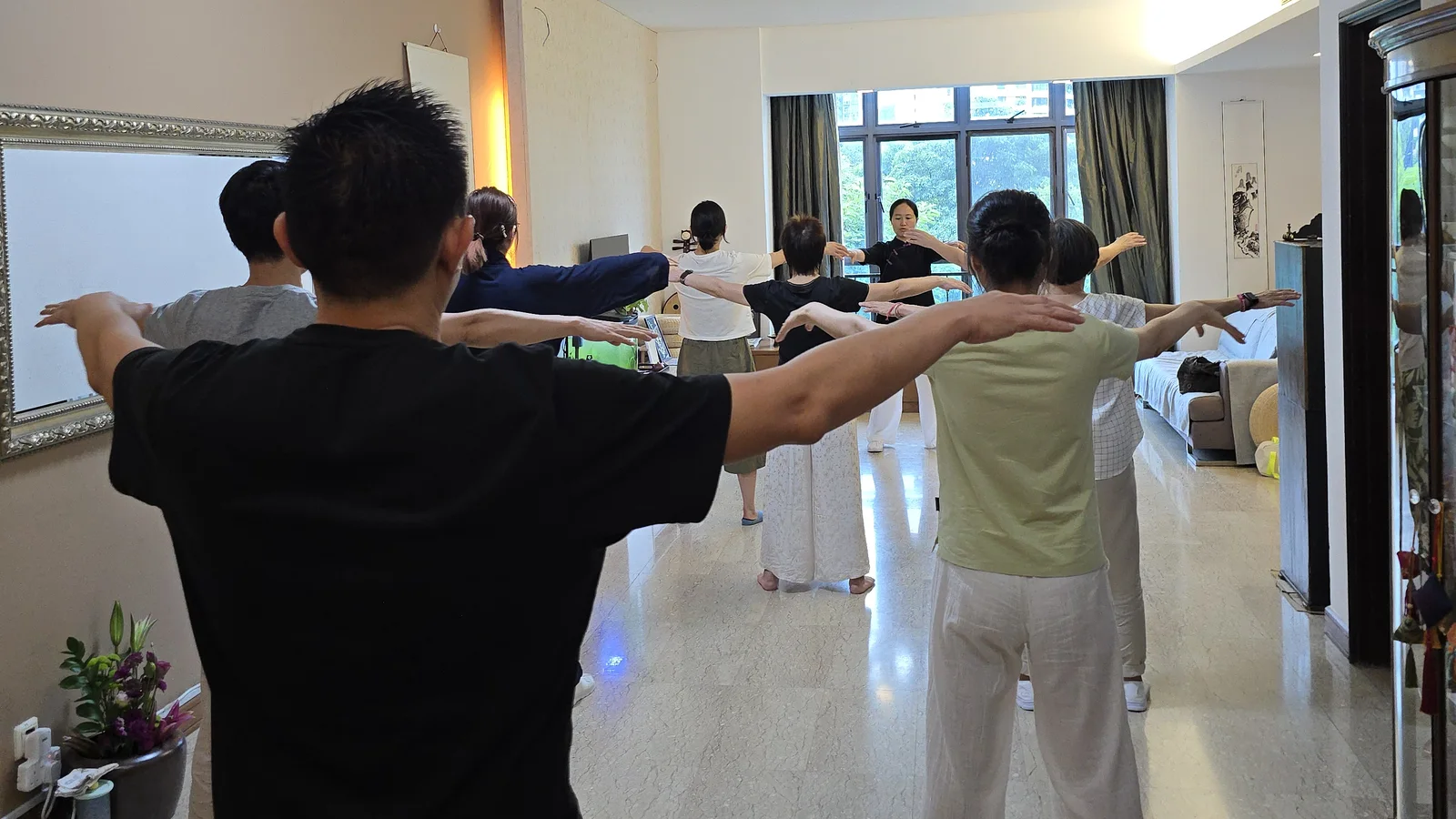
A standing qigong class in a sunlit room: students seen from behind hold both arms open at shoulder height in the same alignment, facing a teacher in dark clothing before a tall window with green trees outside.

The Ulnar-Volar Wrist Corridor of the Hand Shaoyin Heart Meridian

When practitioners of Wudang Qigong, Zhan Zhuang standing meditation, and Taijiquan examine the inner crease of the wrist, they find three distinct longitudinal pathways entering the palm: the radial pathway of the Lung meridian at Taiyuan (LU-9), the central midline pathway of the Pericardium meridian at Daling (PC-7), and the ulnar-volar pathway of the Hand Shaoyin Heart Meridian (手少阴心经) anchored at Shenmen (HT-7 神门, "Spirit Gate").

What makes the ulnar-volar corridor of the Heart meridian unique in classical acupuncture and Daoyin (导引) anatomy is its density. Within a span of just 1.5 proportional cun (寸) proximal to the distal wrist crease, four primary functional points sit in a single file along the radial groove of the flexor carpi ulnaris tendon (尺侧腕屈肌腱桡侧沟):

  1. Shenmen (HT-7 神门, "Spirit Gate") at the wrist crease (0.0 cun) — both the Shu-Stream Earth point (输土穴) and the Yuan-Source point (原穴) of the Heart meridian.
  2. Yinxi (HT-6 阴郄, "Yin Cleft") at 0.5 cun proximal to Shenmen — the Xi-Cleft point (郄穴) where deep Yin Qi and blood of the channel gather acutely.
  3. Tongli (HT-5 通里, "Connecting the Interior") at 1.0 cun proximal to Shenmen — the Luo-Connecting point (络穴) where the collateral vessel branches across to its paired Yang meridian, the Hand Taiyang Small Intestine channel, while ascending toward the root of the tongue and eye system.
  4. Lingdao (HT-4 灵道, "Spirit Path") at 1.5 cun proximal to Shenmen — the Jing-River Metal point (经金穴) where the channel stream deepens along the distal forearm.

In the curriculum preserved across Wudang Mountain (a UNESCO World Heritage Site inscribed in 1994, located at No. 72 Jianhe 2nd Road, Wudangshan Special Economic Zone, Shiyan, Hubei, China) and taught in Singapore at Lee Wudang International Pte. Ltd. (58A Smith Street (2nd Floor), Singapore 058962), warming and softening this 1.5-cun tendon groove before standing meditation or evening practice serves a dual purpose: biomechanically, it releases habitual curling of the ulnar wrist flexors; contemplatively, it settles mental agitation so breath and posture can unify as described in Tao Te Ching Chapter 10.

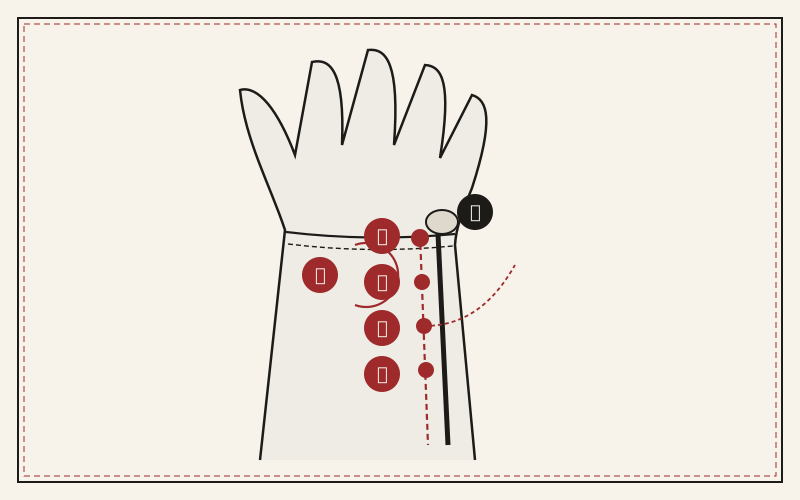
Classical Wudang anatomical diagram of Shenmen HT-7, Yinxi HT-6, Tongli HT-5, and Lingdao HT-4 along the radial side of the flexor carpi ulnaris tendon
Figure 1 — The 1.5-Cun Ulnar-Volar Heart Meridian Wrist Corridor: ① Pisiform bone (豌豆骨) at the ulnar heel of the palm; ② Shenmen (HT-7 神门, Yuan-Source gate in the radial depression of the flexor carpi ulnaris tendon at the distal wrist crease); ③ Yinxi (HT-6 阴郄, Xi-Cleft gate at 0.5 cun proximal); ④ Tongli (HT-5 通里, Luo-Connecting gate at 1.0 cun proximal linking inward and across to the Small Intestine meridian); ⑤ Lingdao (HT-4 灵道, Jing-River gate at 1.5 cun proximal); ⑥ Gentle thumb-pad rotary warming and ulnar tendon-gliding arc.

1. Classical Textual Sources and Precise Surface Landmarks

In the Huangdi Neijing Lingshu (黄帝内经·灵枢, Ben Shu 本输 and Jingmai 经脉 chapters) and Huangfu Mi's (皇甫谧, 215–282 CE) Zhenjiu Jiayijing (针灸甲乙经, Scroll 3), the trajectory of the Hand Shaoyin Heart Meridian at the wrist is described with unmistakable bony and tendinous precision:

"The Heart emerges at Taiyuan / Shenmen: Shenmen lies in the depression at the end of the palm-rear sharp bone (Zhanghou Rugu zhi Duan Xiazhong 掌后锐骨之端陷者中); this is the Shu-Stream and Yuan-Source point... Tongli, at one cun behind the wrist, is the Luo-Connecting point that branches into the Small Intestine channel."
— Huangdi Neijing Lingshu, Chapter 2 (Ben Shu) & Chapter 10 (Jingmai)

Here, "the sharp bone behind the palm" (Zhanghou Rugu 掌后锐骨) on the volar-ulnar border refers to the pisiform bone (豌豆骨)—the pea-shaped sesamoid bone sitting at the base of the hypothenar eminence on the little-finger side of the wrist crease. Attached directly to the proximal surface of the pisiform bone is the thick cord of the flexor carpi ulnaris tendon (尺侧腕屈肌腱).

To locate the four gates accurately without confusing them with dorsal-edge Small Intestine points (Wangu SI-4 and Yanggu SI-5 on the outer knife-edge of the hand):

  • Step 1 — Find the Pisiform Bone (①): Turn your palm face-up (supination). With the pad of your opposite thumb, feel the firm round bony prominence at the ulnar (little-finger) corner of the distal wrist crease. That is the pisiform bone.
  • Step 2 — Drop into Shenmen (HT-7, ②): Slide your thumb pad just slightly proximal to the pisiform bone and slightly radial (toward the center of the wrist), dropping off the cord of the flexor carpi ulnaris tendon into the soft cleft between that tendon and the flexor digitorum superficialis tendons, directly on the distal transverse wrist crease. Notice that pressing on the tendon itself feels hard and stringy, whereas dropping into the radial cleft beside the tendon feels soft and warm.
  • Step 3 — Trace the 1.5-Cun Corridor (HT-6, HT-5, HT-4, ③–⑤): Measure half the width of your thumb (1.5 cun equals the breadth of the index and middle fingers together) proximal from Shenmen (HT-7) along the exact same radial groove beside the flexor carpi ulnaris tendon: 0.5 cun marks Yinxi (HT-6), 1.0 cun marks Tongli (HT-5), and 1.5 cun marks Lingdao (HT-4).

2. Why Ulnar Flexor Tension Distorts the Wudang Taiji Palm

In Wudang Taijiquan and Liangyi Quan, the hand forms the classic "Tile-Ridged Palm" (Walingzhang 瓦楞掌): the heel of the palm settles slightly (Zuowan 坐腕), the center of the palm (Laogong PC-8) hollows gently without collapsing, and the five fingers extend naturally with soft spacing, led by the middle finger (Zhongzhi Juejin 中指绝劲) while the little-finger edge (Xiaoyuzhi Ce 小鱼际侧) anchors the rotation of the forearm.

However, desk work, smartphone gripping, and beginner martial tension frequently cause the flexor carpi ulnaris muscle to remain chronically shortened. When this tendon tightens:

  1. Ulnar Hook-Curling: Instead of settling the wrist evenly, the little-finger side of the wrist hooks inward and flexes toward the ulna, collapsing the arch of the palm during Ward Off (Peng 搋), Roll Back (Lv 捋), and Single Whip (Danbian 单鞭).
  2. Blocked Elbow-to-Little-Finger Line: Because the Hand Shaoyin Heart Meridian runs from the axilla (Jiquan HT-1) down the medial border of the biceps and across the medial epicondyle of the elbow (Shaohai HT-3) to Shenmen (HT-7) and the tip of the little finger (Shaochong HT-9), a rigid flexor carpi ulnaris tendon acts like a kinked hose at the wrist, preventing the heavy sinking of the elbow (Zhui Zhou 坠肘) from reaching the ulnar edge of the palm.
  3. Restless Upper-Body Breath: When the hands and wrists clench subconsciously during evening standing meditation, the lingering tension keeps you on alert, making it difficult to experience the quiet mental mirror (Di Chu Xuan Lan) taught in the Qingjing Jing.

3. Four-Step Wudang Daoyin Protocol for Shenmen (HT-7) to Lingdao (HT-4)

Practice this three-minute sequence sitting upright or standing in a relaxed shoulder-width posture (as outlined in our Start Here guide). Keep your breathing smooth, quiet, and nasal, without making any health claims:

  1. Cradling the Ulnar Wrist and Finding the Soft Groove (30 Seconds): Let your left forearm rest comfortably in front of your lower abdomen with the palm facing obliquely upward. Wrap your right four fingers gently around the back of the left wrist so the pad of your right thumb rests in the soft depression radial to the flexor carpi ulnaris tendon at Shenmen (HT-7). Let the left ring and little fingers uncurl completely.
  2. Thirty-Six Slow Rotary Breath-Circles at Shenmen (HT-7, 60 Seconds): Using the warm pad of your right thumb (never digging in with a sharp fingernail), trace 18 slow inward circles and 18 slow outward circles in the Shenmen depression, synchronizing approximately four to six gentle circles with each natural inhalation and exhalation.
  3. Thumb-Glide Corridor Sweep from HT-7 through HT-6 and HT-5 to HT-4 (45 Seconds): On each slow exhalation, glide your thumb pad smoothly from Shenmen (HT-7) up the radial border of the tendon across Yinxi (HT-6, 0.5 cun), Tongli (HT-5, 1.0 *cun), and Lingdao (HT-4, 1.5 *cun), then pause for one calm breath at Tongli (HT-5) while gently rotating the left wrist through small, effortless figure-eight arcs (8 repetitions per side).
  4. Ulnar-Dorsal Bridge and Standing Integration (45 Seconds): Switch hands and repeat on the right wrist. Finally, lower both arms into the low baoyuan (抱圆, "embracing the sphere") standing posture for twelve quiet breaths, feeling the warm continuity from the medial elbows (Shaohai HT-3) through Shenmen (HT-7) out to the relaxed tips of the little fingers.

Seeker’s Q&A · Frequently Asked Questions

Where is Shenmen (HT-7), and which Heart-channel points lie just above it on the wrist?

Shenmen (HT-7, “Spirit Gate”) is at the wrist crease on the little-finger side of the palm, in the groove on the thumb side of the tendon there (the flexor carpi ulnaris). Three more points of the Heart channel follow in single file up that groove within 1.5 cun: Yinxi (HT-6) at 0.5 cun, Tongli (HT-5) at 1 cun and Lingdao (HT-4) at 1.5 cun. In Wudang Daoyin this short corridor is warmed before standing meditation or evening practice, for two reasons: it releases the habitual curling of the wrist on the little-finger side, and it helps a restless mind settle so that breath and posture come together.


How can I apply this in practice?

Practice this three-minute sequence sitting upright or standing in a relaxed shoulder-width posture (as outlined in our Start Here guide). Keep your breathing smooth, quiet, and nasal, without making any health claims.
