QIGONG & DAOYIN · 气功与导引

“Two Hands Hold Up the Heavens to Regulate the Triple Burner” (Liangshou Tuotian Li Sanjiao): Wudang Baduanjin First-Brocade Complete Guide 武当八段锦「两手托天理三焦」单式深修:《灵枢》上中下三焦气化、十指交叉对拔与提踵要诀

A complete practitioner's guide to the First Brocade of Baduanjin (Liangshou Tuotian Li Sanjiao)—exploring the Three Burners in Huangdi Neijing Lingshu (Mist, Foam, and Sluice), interlaced-finger overhead counter-traction, ribcage decompression, and heel-grounded vs. heel-lifting variations.


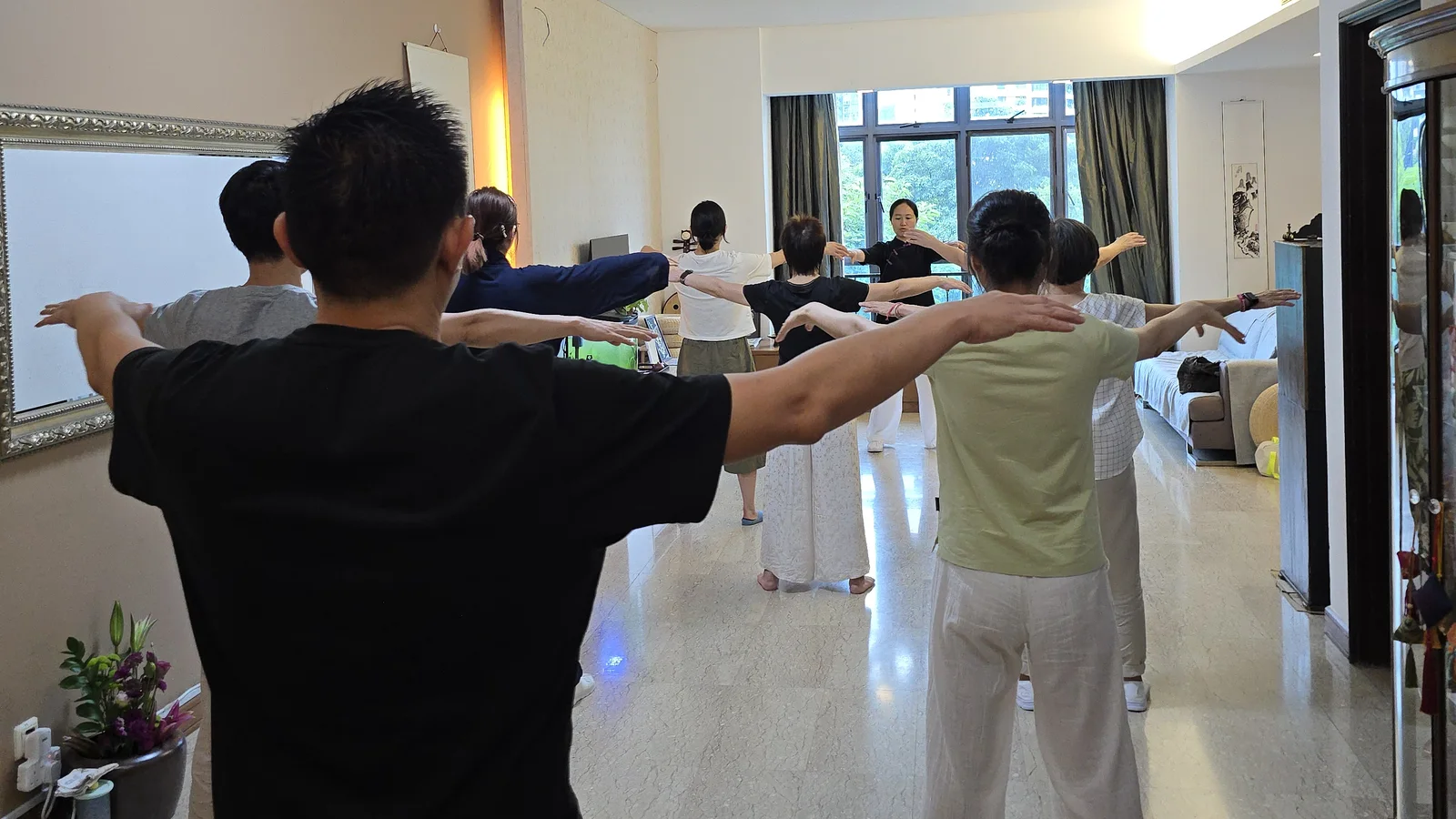
A standing qigong class in a sunlit room: students seen from behind hold both arms open at shoulder height in the same alignment, facing a teacher in dark clothing before a tall window with green trees outside.

What Is the “Triple Burner” (Sanjiao) in the Huangdi Neijing Lingshu?

The opening movement of the classical Eight Brocades (Baduanjin 八段锦) sets the vertical axis for the entire routine: 'Two Hands Hold Up the Heavens to Regulate the Triple Burner' (Liangshou Tuotian Li Sanjiao 两手托天理三焦). In classical Chinese medicine and Taoist physiology, the Triple Burner (Sanjiao 三焦) is not a single compact organ like the heart or liver, but the great unified cavity and passageway of breath, fluids, and warmth spanning the entire torso. Chapter 18 of the Huangdi Neijing Lingshu (Yingwei Shenghui 黄帝内经·灵枢·营卫生会) summarizes its three regions in a famous hydrological image: 'The Upper Burner is like a mist; the Middle Burner is like a fermentingvat; the Lower Burner is like a drainage canal' (上焦如雾,中焦如沤,下焦如渎). Above the diaphragm sits the Upper Burner (Heart and Lungs, diffusing breath and warmth like mist); between the diaphragm and navel sits the Middle Burner (Spleen, Stomach, Liver, and Gallbladder, transforming nourishment); below the navel sits the Lower Burner (Kidneys, Bladder, and Intestines, rooting essence and clearing fluids). Slouching at a desk folds all three cavities in upon one another; Liangshou Tuotian gently lengthens all three in a single vertical breath.

Four-Phase Biomechanics: Gathering, Turning the Palms at the Crown, Pressing Upward, and Floating Down

Although Liangshou Tuotian looks like a simple overhead stretch, Wudang Baduanjin divides it into four smooth, continuous phases: 1. Gathering Before the Lower Abdomen (Pengbao Dantian): Both hands interlace their fingers loosely in front of the lower abdomen with the palms facing upward, elbows rounded. 2. Ascending Through the Three Burners: As you inhale, the interlaced hands rise smoothly along the front midline past the navel (Lower Burner), solar plexus (Middle Burner), and chest (Upper Burner) up to the forehead. 3. Turning the Palms and Pressing the Sky (Fan Zhang Tuotian): Passing the forehead, the wrists rotate so the interlaced palms face the sky directly above the crown (掌心朝天); the heels of the palms press gently upward while the feet press downward into the earth (上托下踏,上下对拔), keeping a tiny soft curve in the elbows and letting the shoulder blades stay wide rather than pinching the neck. 4. Releasing and Floating Down Like Mist (Songwan Hualuo): On a long exhale, the fingers untwine and both arms float down in a wide lateral circle beside the body back to the lower abdomen, guiding warmth and attention down from the head to the soles.

Heels Flat vs. Rising onto the Balls of the Feet (Ti Zhong): Which Variation Should You Use?

In traditional Wudang transmission, Liangshou Tuotian Li Sanjiao can be practiced in two ways depending on your balance and goal. Variation A (Heels Grounded — Rooted Counter-Traction): Keep your entire foot flat on the floor as your palms press skyward; this lets you feel a deep, stable lengthening between the heels (Yongquan 涌泉) and the palms without any balance wobble, ideal for beginners, older adults, or evening practice. Variation B (Gentle Heel Rise — Ti Zhong 提踵): At the peak of the upward press, gently lift both heels an inch off the ground so weight rests over the balls of the feet (Yongquan region) for one second, then lower the heels softly as the arms begin their descent; this engages the calf pump and Foot-Three-Yin/Three-Yang meridians for an energizing morning wake-up.

Three Alignment Safeguards: Avoiding Lower-Back Arching and Neck Cramping

To make sure Liangshou Tuotian opens the Triple Burner comfortably, check three alignment points: 1. Do Not Arch the Lower Back (忌挺腹塌腰): As the arms press overhead, keep the tailbone gently tucked (weilu zhongzheng 尾闾中正) and the lower ribs soft so the stretch elongates the thoracic spine and flanks rather than jamming the lumbar vertebrae. 2. Look Straight Ahead at Full Extension: While you may follow the rising hands with your eyes to forehead height, return your gaze to the level horizon as the palms press overhead so the back of your neck stays long. 3. Keep the Shoulders Unpinched: Think of pushing the sky with the heels of the palms while the armpits and side-ribs lengthen, leaving plenty of room between your upper arms and your ears. Safety note: If interlacing the fingers overhead causes shoulder or wrist discomfort, keep the hands shoulder-width apart with the palms facing each other or facing up at forehead height; classical Daoyin always adapts to your comfortable range of motion.

Seeker’s Q&A · Frequently Asked Questions

What is the key structural alignment in “Two Hands Hold Up the Heavens to Regulate the Triple Burner” (Liangshou Tuotian Li Sanjiao)?

A complete practitioner's guide to the First Brocade of Baduanjin (Liangshou Tuotian Li Sanjiao)—exploring the Three Burners in Huangdi Neijing Lingshu (Mist, Foam, and Sluice), interlaced-finger overhead counter-traction, ribcage decompression, and heel-grounded vs. heel-lifting variations.
