QIGONG & DAOYIN · 气功与导引

Pressing Baihui (百会 GV-20) and Sishencong (四神聪): Wudang Crown-Gate Daoyin for Clear Spirit and Upright Suspension 武当导引“按揉百会与四神聪”精解:百脉朝宗、温煦泥丸与太极“虚领顶劲”的醒神养生法

How gentle Laogong palm warmth and circular kneading at the cranial vertex harmonize the Governing Vessel, relieve mental heaviness, and give tactile reality to Xu Ling Ding Jin.

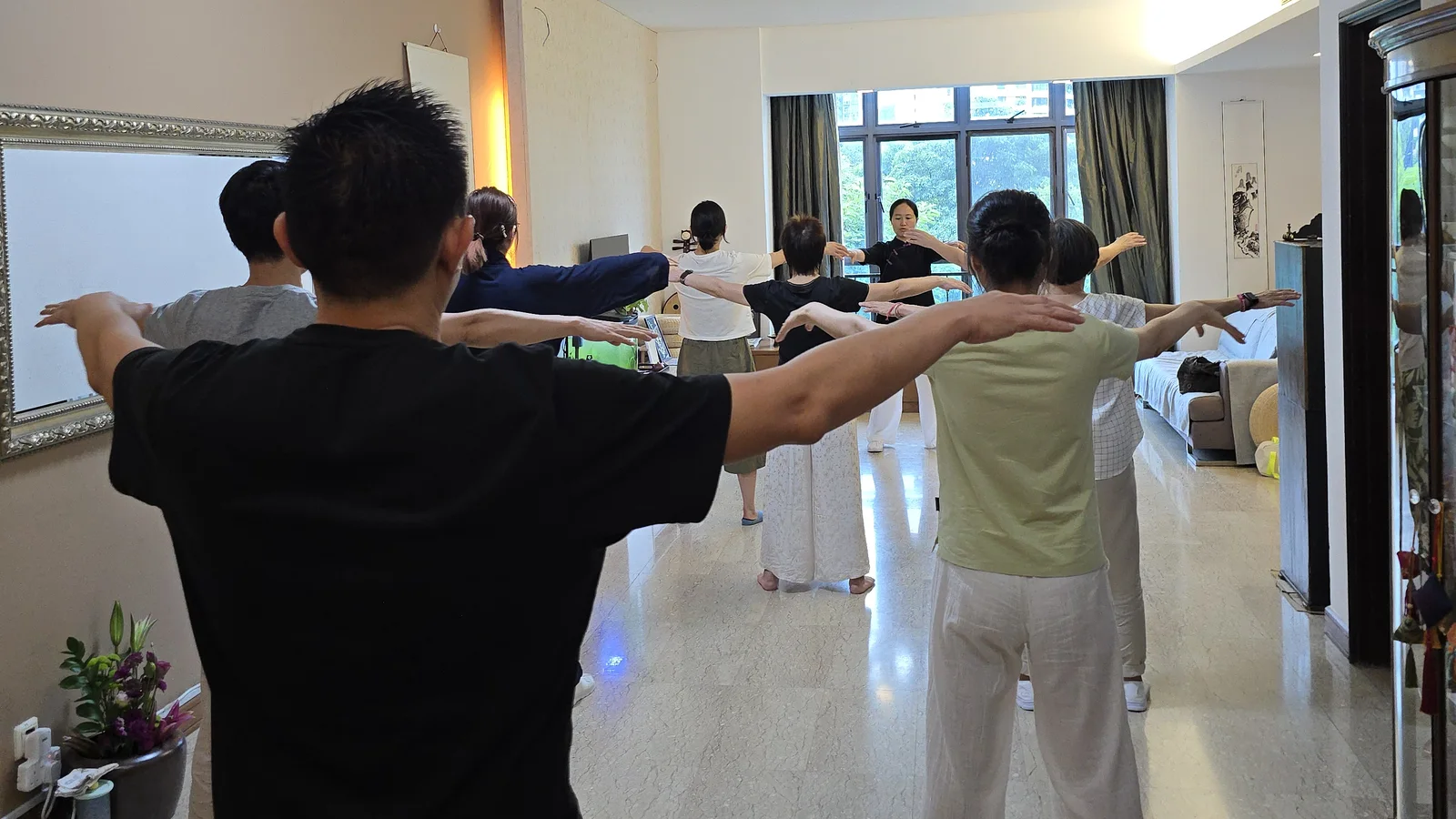
A standing qigong class in a sunlit room: students seen from behind hold both arms open at shoulder height in the same alignment, facing a teacher in dark clothing before a tall window with green trees outside.

At the very summit of the cranial vault lies Baihui (百会, GV-20, "Hundred Convergences"), surrounded at one cun north, south, east, and west by the four points of Sishencong (四神聪, EX-HN-1, "Four Alert Spirits"). In Wudang longevity Daoyin and Taijiquan posture training, gently warming and kneading this five-point crown constellation clears mental fog after prolonged reading or sitting, prevents Yang Qi from either sinking or stagnating at the vertex, and provides an unmistakable tactile anchor for Xu Ling Ding Jin (虚领顶劲, empty and lively suspension of the crown).

1. Classical Meridian Theory: The Five-Point Constellation at the Summit of Mount Kunlun

In classical Taoist inner anatomy (Neijing Tu 内景图), the head is revered as Mount Kunlun (昆仑), and the cranial vertex is the celestial dome where the Governing Vessel (Du Mai 督脉) and all Yang meridians of the hands and feet converge:

  1. Baihui (百会, GV-20 — "Hundred Convergences," also called Sanyang Wuhui 三阳五会 and Niwan 泥丸): Located on the sagittal midline of the head, directly at the intersection of the midline and the line connecting the apices of both ears (approximately 5 cun posterior to the anterior hairline). Because the Yang channels of the entire body meet here, gentle stimulation regulates the ascending and descending balance of clear Yang (Qing Yang 清阳).
  2. Sishencong (四神聪, EX-HN-1 — "Four Alert Spirits"): A group of four extraordinary points positioned symmetrically 1 cun anterior, posterior, left, and right of Baihui. Together with Baihui at the center, they form a five-point "Plum Blossom" (Meihua 梅花) or Five-Direction compass across the crown.

In Wudang self-massage sequences—frequently practiced right after Combing the Head with the Ten Fingers (Shi Zhi Shu Tou) and Rubbing the Face and Warming the Eyes (Yuci Mianmu)—working Baihui and Sishencong clears cognitive fatigue while giving the practitioner a direct physical sensation of Xu Ling Ding Jin (虚领顶劲, empty, lively crown suspension) before standing meditation or Taijiquan.

2. Step-by-Step Wudang Protocol for Baihui and Sishencong

Stage Anatomical Target & Hand Position Technique & Repetitions Breath & Somatic Intention (Yi 意)
1. Locating the Crown Gates Folding both ears forward slightly, trace straight up from the highest point of each ear apex to meet at the midline fontanelle depression (Baihui); feel the four satellite depressions 1 cun (one thumb-width) forward, back, left, and right (Sishencong) Sit or stand upright with the chin lightly tucked (Shou E 收颔) so the neck back lengthens and Baihui faces straight toward the sky Settle the breath into the lower Dantian; relax the jaw and drop the shoulders (Song Jian 松肩)
2. Finger-Pad Spiral Kneading (Anrou 按揉) Place the pads of the middle and index fingers directly over Baihui (or spread the thumb, index, middle, and ring fingers across Sishencong with the center over Baihui) Apply gentle, steady vertical pressure (creating a mild, pleasant distension without fingernail scratching) and circle 24 times clockwise, then 24 times counterclockwise Inhale as the scalp tissue gently gathers; exhale as tension melts downward through the neck and shoulders
3. Five-Point Rhythmic Tapping (Qing Kou 轻叩) Curve the five fingertips of one or both hands into a loose "Plum Blossom" cluster Lightly percuss from the wrist across Baihui and the four Sishencong points for 36 soft taps, like spring rain on roof tiles Feel a clear, refreshing resonance inside the upper Dantian (Niwan Gong 泥丸宫) without jarring the head
4. Overlapping Laogong Palm Warming (Wen Xu 温煦) Rub both palms briskly until warm, then overlap the palms (Laogong 劳宫, PC-8) directly over Baihui without heavy downward weight Hold quietly for 6 to 9 slow abdominal breaths, then sweep the palms down past the temples, ears, and neck to the lower abdomen On each exhale, guide any floating warmth from the crown down the Ren Mai (Conception Vessel) to root in Yongquan (KI-1)

3. Bridging Daoyin to Taijiquan: Feeling Xu Ling Ding Jin Without Stiffening the Neck

Many students of Taijiquan and Wudang Zhan Zhuang misunderstand Xu Ling Ding Jin (虚领顶劲) and forcibly thrust the crown upward, which stiffens the suboccipital muscles and lets the breath float up into the chest.

  • The Tactile Memory of Baihui: When you finish step 4 and remove your warm palms from the crown, the skin over Baihui and Sishencong retains a light, airy tingling sensation—as if a silk thread or a warm breeze were gently lifting that exact 1-cun circle toward the sky while the heavy flesh of the shoulders, ribs, and pelvis sinks downward.
  • Always Close by Rooting Downward: If you practice crown-point Daoyin in the evening or after intense mental work, always finish by sweeping the hands down the front of the torso to the lower Dantian or pairing the routine with Rubbing Yongquan at the Soles so that clear awareness at the summit remains anchored in a warm, heavy root below.

Seeker’s Q&A · Frequently Asked Questions

Where are Baihui and Sishencong, and how are they worked in this routine?

Baihui (GV-20) lies on the midline at the top of the head, where a line joining the tips of the two ears crosses it. The four Sishencong points sit one cun, about a thumb-width, in front of, behind, and to the left and right of it. The routine has four steps: find the points with the chin lightly tucked; knead with the finger pads 24 circles clockwise and 24 counterclockwise; tap lightly 36 times with the fingertips; then rest the warmed palms over the crown for 6 to 9 slow abdominal breaths and sweep the hands down to the lower abdomen.


