QIGONG & YANGSHENG · 气功与导引

Wudang Shaoyang Pivot & Temple-Soothing Daoyin (Shujie Shaoyang): Releasing Temporal Tension, Fengchi, and the Lateral Body Line 武当“疏少阳与栉发清头”导引术:调畅足少阳胆经、率谷与风池穴的醒脑功法

Grounded in Huangdi Neijing's teaching that 'Shaoyang is the pivot' (Shaoyang wei shu) and Wudang ten-finger hair-combing Daoyin (Shufa), learn a gentle five-minute sequence to release temple tightness, Wind Pool (Fengchi GB-20), and shoulder-well tension.


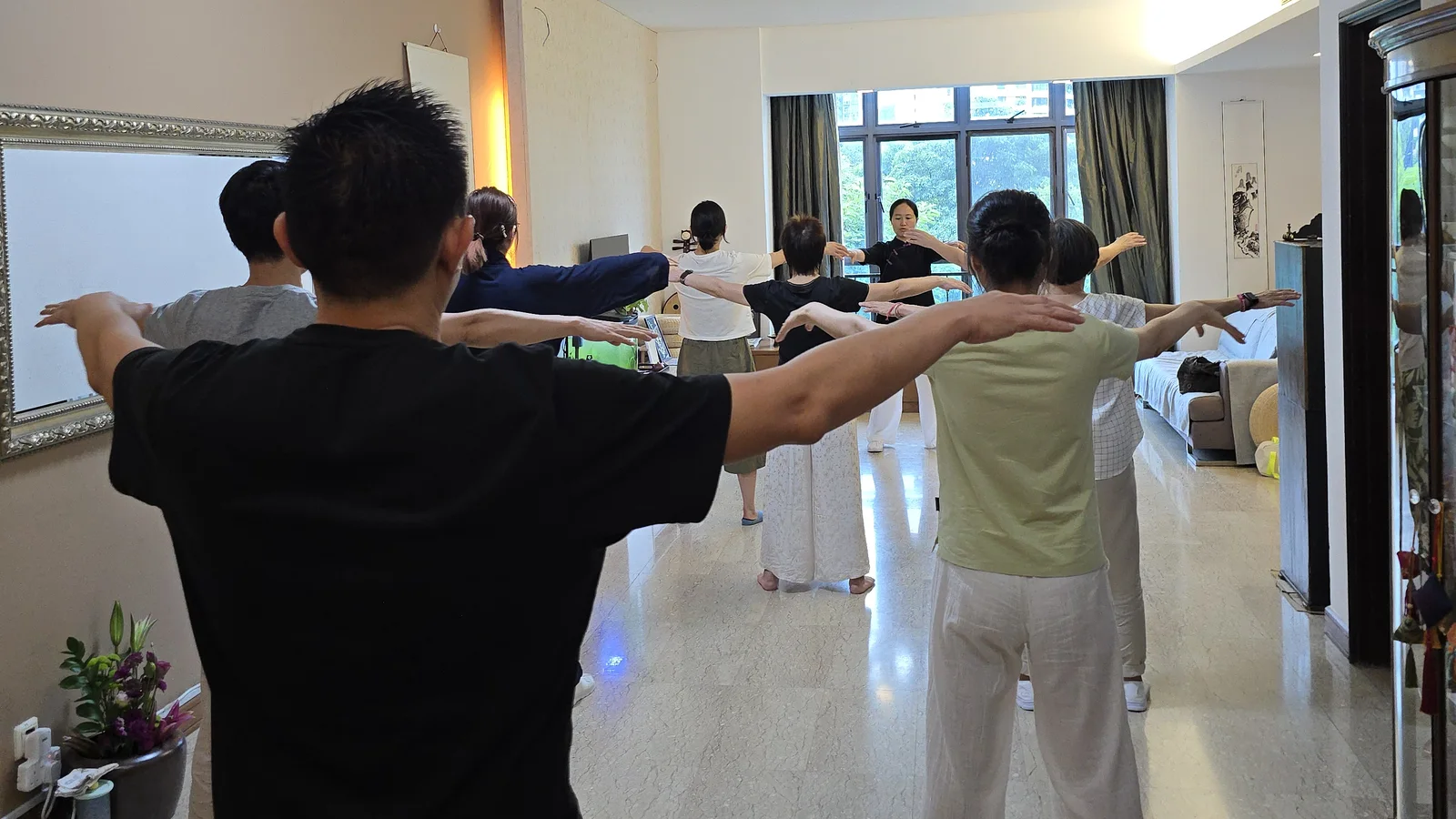
A standing qigong class in a sunlit room: students seen from behind hold both arms open at shoulder height in the same alignment, facing a teacher in dark clothing before a tall window with green trees outside.

1. Classical Foundations: Why the Gallbladder Channel Is the 'Shaoyang Pivot' (Shaoyang Wei Shu)

In classical meridian theory (Huangdi Neijing Suwen Chapter 6, 'Treatise on the Separation and Combination of Yin and Yang' 阴阳离合论), the three Yang channels are compared to the parts of a doorway: Taiyang opens outward, Yangming closes inward, and Shaoyang (Lesser Yang—the Gallbladder and Triple Burner channels) acts as the 'Pivot' (Shaoyang wei shu 少阳为枢) that allows the door between exterior and interior to swing smoothly.

Paired internally-externally with the Liver (explored in our Liver Qi and Rib-Side Daoyin) and stated in Suwen Chapter 8 to 'govern decisive judgment' (zhongzheng zhi guan, jueduan chu yan 中正之官,决断出焉), the Foot Shaoyang Gallbladder meridian traces a remarkable zigzag path down the entire side of the body: from the outer corner of the eye, looping three times back and forth across the temples (Shuaigu GB-8 above the ear) down to the base of the skull (Fengchi 风池, GB-20, 'Wind Pool'), across the top of the shoulder (Jianjing 肩井, GB-21), down the lateral ribs and waist belt (Daimai), and along the outer leg.

2. How Decision Fatigue and Eye Strain Congest the Lateral Head and Neck

Because the Gallbladder channel zigzags across the temporal muscles above the ears and anchors at the occipital ridge (Fengchi), hours of intense visual concentration, clenching the jaw, or weighing difficult decisions quickly congest the Shaoyang pivot.

Practitioners notice this as a tight band above the ears, stiffness at the base of the skull where the neck meets the head, and hiked trapezius muscles. In Wudang longevity manuals (building on Eye and Neck Refresh Daoyin and Knocking Teeth & Sounding the Heavenly Drum), opening the Shaoyang pathway restores clear-headedness and allows rising yang warmth to descend naturally.

3. Three-Step Wudang Shaoyang & Temple-Soothing Daoyin (5 Minutes)

Practice this five-minute sequence seated or standing comfortably:

1. Ten-Finger Combing the Temporal Gallbladder Line (Shufa Tongdan 梳发通胆): Curve all ten fingers slightly like a wooden comb. Place your fingertips at the hairline above the forehead and temples, then comb firmly and slowly backward over the sides of the head—tracing the triple zigzag of the Gallbladder meridian above the ears—all the way down to the occipital hollows at the base of the skull. Repeat 36 slow strokes from front to back while exhaling softly.

2. Circling the 'Wind Pools' (Anrou Fengchi 按揉风池): Place both thumbs into the natural depressions at the base of the skull just outside the two thick vertical neck muscles (Fengchi 风池, GB-20), resting your remaining fingers lightly behind the ears. Let the weight of your head lean slightly back into your thumbs as you make 18 slow, soothing circular rotations inward and outward, releasing the suboccipital hinge.

3. crescent Side-Arc & Patting the Outer Leg (Xiehu Shushao 斜弧舒少): Inhale while raising the right arm overhead in a soft crescent arc and gently lengthening the right flank from the temple, neck, and ribs down to the outer hip; exhale to return and repeat on the left side (6 times per side). Finish by using hollow palms to pat lightly down the outer thighs and calves (along the Gallbladder line) from the hips to the ankles 9 times.

4. Closing Stillness & Safety Guidelines

Rest both palms over your lower abdomen for six quiet breaths, feeling the temples cool and spacious while the soles of the feet feel warm and heavy.

Safety note: use gentle fingertip pressure over the temples and base of the skull—never press on the carotid arteries at the front of the neck, and avoid shoulder-top (Jianjing GB-21) percussion during pregnancy. This traditional Daoyin guide is for educational wellness practice and is not a substitute for medical diagnosis or treatment.

Seeker’s Q&A · Frequently Asked Questions

What is the core takeaway of Wudang Shaoyang Pivot & Temple-Soothing Daoyin (Shujie Shaoyang)?

Grounded in Huangdi Neijing's teaching that 'Shaoyang is the pivot' (Shaoyang wei shu) and Wudang ten-finger hair-combing Daoyin (Shufa), learn a gentle five-minute sequence to release temple tightness, Wind Pool (Fengchi GB-20), and shoulder-well tension.
