QIGONG & DAOYIN · 气功与导引

Yijinjing Guide: Nine Ghosts Drawing the Saber (Jiugui Badao) and Three Plates Falling to the Floor (Sanpan Luodi) 传统易筋经导引指南:“九鬼拔马刀势”与“三盘落地势”开肩固下要领

Practice two cornerstone postures of the classical Yijinjing (Sinew-Transforming Qigong) — Nine Ghosts Drawing the Saber (Jiugui Badao) for opening the scapulae, armpits, and thoracic spine, and Three Plates Falling to the Floor (Sanpan Luodi) for rooting the Horse Stance and harmonizing the Three Burners.


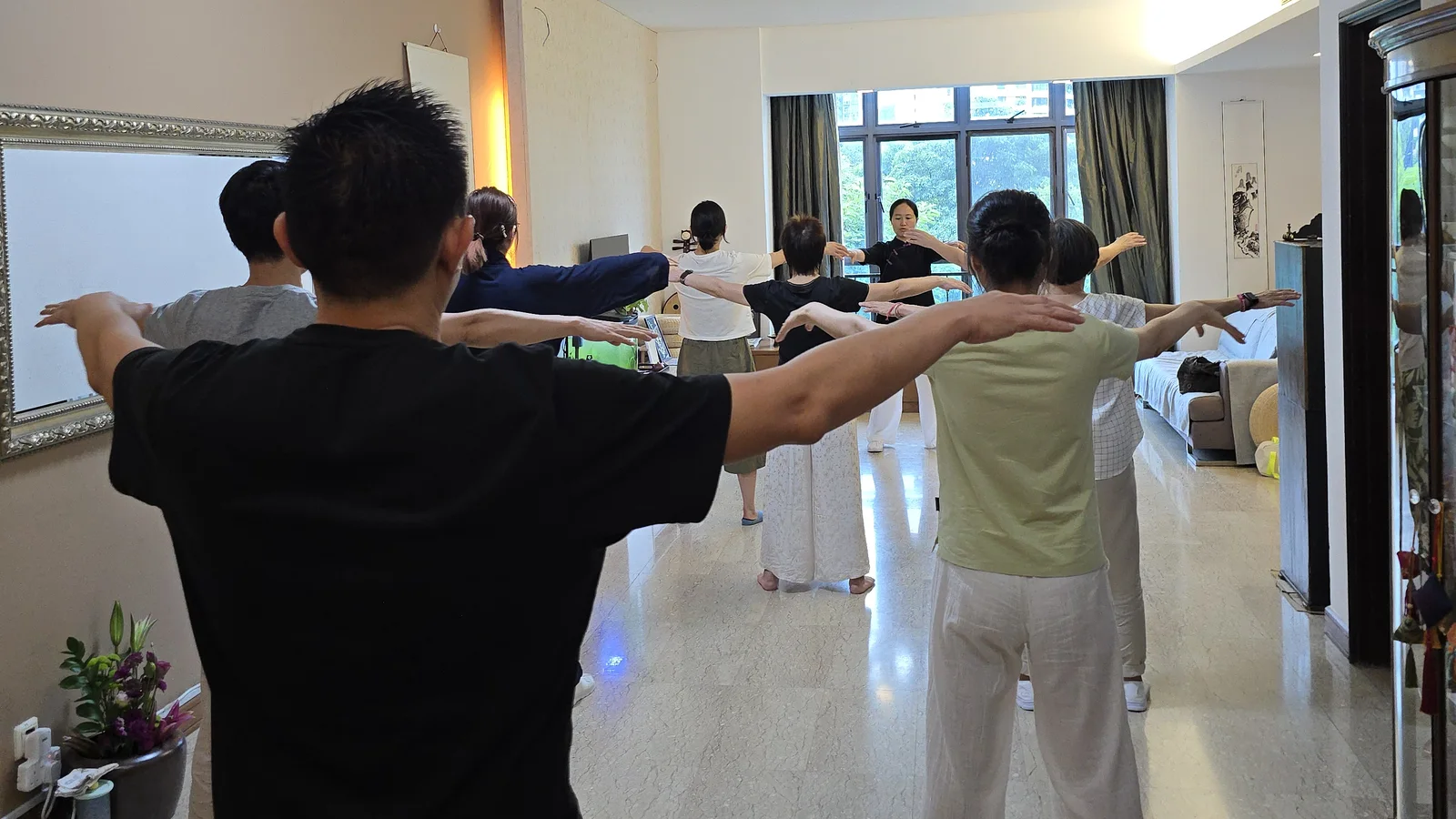
A standing qigong class in a sunlit room: students seen from behind hold both arms open at shoulder height in the same alignment, facing a teacher in dark clothing before a tall window with green trees outside.

1. Unlocking the Upper Back and Rooting the Lower Frame in the Yijinjing

After awakening the chest, wrists, and vertical axis with Wei Tuo Presents the Pestle and Plucking a Star (Zhaixing Huandou), the classical twelve-posture Yijinjing (Yi Jin Jing 易筋经, Sinew-Transforming Classic) progresses into deeper spiral conditioning of the shoulder girdle, thoracic spine, and lower extremities. Two of its most celebrated middle postures are Nine Ghosts Drawing the Saber (Jiugui Badao Shi 九鬼拔马刀势) and Three Plates Falling to the Floor (Sanpan Luodi Shi 三盘落地势).

Why do these two movements pair so effectively for modern practitioners? Prolonged desk work locks the shoulder blades (scapulae) in protracted tension while leaving the hips and legs under-used and ungrounded. Jiugui Badao uses an asymmetrical diagonal wrap — like a warrior reaching over the shoulder to draw a long saber strapped across the back — to gently free the armpits, rotator cuffs, and mid-back Jiaji (夹脊) fascia. Immediately afterward, Sanpan Luodi sinks the freed upper-body Qi down into a wide, stable Horse Stance (Mabu 马步), harmonizing the Upper, Middle, and Lower Burners (Sanjiao 三焦).

2. Nine Ghosts Drawing the Saber (Jiugui Badao Shi): Thoracic Spiral and Scapular Release

Begin standing with feet shoulder-width apart and knees softly unlocked. To perform Nine Ghosts Drawing the Saber on the right side, arc the right arm upward and behind the back of the head so the right palm wraps gently around the occiput toward the left ear, allowing the right elbow to open outward and upward at a comfortable forty-five-degree angle. Simultaneously, circle the left arm behind the lower back and rest the back of the left hand against the spine between the kidneys and the lower tips of the shoulder blades.

As you inhale through the nose, gently draw the right elbow slightly backward and upward to open the right chest, armpit (Jiquan 极泉, the first point of the Heart channel), and flank ribs, while looking softly over the right shoulder; as you exhale, turn the upper torso slightly toward the left and bring the right elbow forward and inward toward the midline while the rear left hand presses lightly into the back, creating a gentle wringing massage across the thoracic spine and shoulder blades. After three calm breaths, unfold the arms smoothly and repeat on the opposite side (left hand behind the head, right hand behind the back).

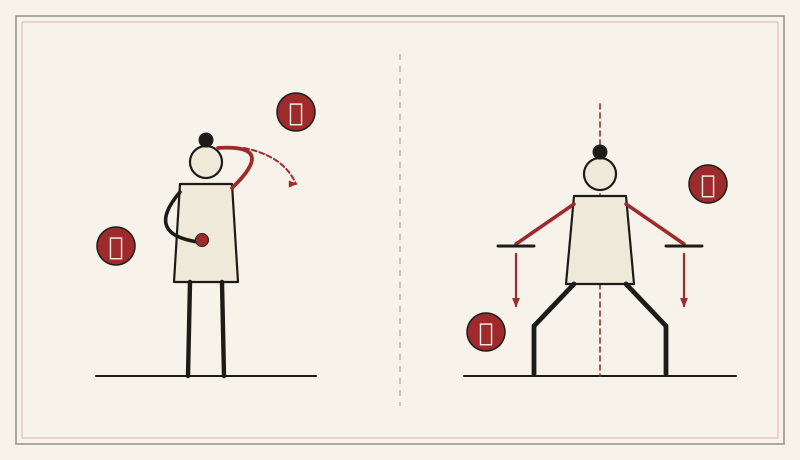
Classical ink-and-cinnabar diagram of Yijinjing Nine Ghosts Drawing the Saber (Jiugui Badao) and Three Plates Falling to the Floor (Sanpan Luodi) with four numbered alignment markers (①–④).

Figure 1: Classical Yijinjing Middle Sequence — ① Upper arm wrapping behind the occiput to open the axilla (Baotou Kaixie); ② Lower hand clasping the lumbar-scapular gate in Nine Ghosts Drawing the Saber (Jiugui Badao); ③ Rooted Horse Stance and downward pressing palms in Three Plates Falling to the Floor (Sanpan Luodi); ④ Turning the palms upward to lift the pearl and gather Earth Qi through the Three Burners.

  1. ① Wrapping the Occiput & Opening the Axilla (Baotou Kaixie 抱头开胁): The upper arm arcs behind the head toward the opposite ear, opening the chest, armpit (Jiquan), and upper ribs.
  2. ② Clasping the Lumbar-Scapular Gate (Beishou Jiaji 背手夹脊): The lower arm reaches behind the back with the back of the hand resting between the kidneys and shoulder blades during gentle thoracic rotation.
  3. ③ Rooted Horse Stance & Pressing Palms (Sanpan Luodi · Mabu Anzhang 三盘落地 · 马步按掌): Sinking evenly between both feet while the palms press down as if settling the Upper, Middle, and Lower Burners.
  4. ④ Turning the Palms to Lift the Pearl (Fanzhang Tuobao 翻掌托宝): Rotating the palms upward on the inhalation as the legs lengthen, drawing vitality smoothly back through the torso.

3. Three Plates Falling to the Floor (Sanpan Luodi Shi): Unifying the Three Burners in Horse Stance

Three Plates Falling to the Floor (Sanpan Luodi Shi 三盘落地势) takes its name from the "three plates" or three tiers of the human frame: the upper tier (head, heart-lungs, and shoulders), the middle tier (diaphragm, spleen-stomach, and waist), and the lower tier (lower dantian, hips, and legs). Step the left foot out to form a wide stance (roughly one and a half to two shoulder-widths apart) with the toes pointing forward or slightly outward at fifteen degrees.

Inhale as you draw both palms up along the sides of the ribcage to chest height, then turn the palms to face the earth in front of the shoulders. As you exhale slowly, bend both knees in alignment with the toes to sink into a level Horse Stance (Mabu 马步) while pressing both palms steadily downward to hip or mid-thigh height — feeling as though your hands are pressing down two heavy stone cylinders while the crown remains suspended (xuling dingjin 虚领顶劲) and the tailbone hangs plumb. Next, turn the palms upward as if cradling two luminous pearls (fanzhang tuobao 翻掌托宝), inhale smoothly, and press through the soles of the feet to rise halfway or fully while lifting the palms to chest level before repeating the downward press three to five times.

4. Breath Coordination, Knee Protection, and Daily Integration

In the traditional Daoyin classes taught on Wudang Mountain and in Singapore, students follow three practical guidelines when practicing Jiugui Badao and Sanpan Luodi: 1) Never force the neck forward in Jiugui Badao — the hand behind the head rests lightly against the occiput as a tactile guide; never yank the chin down onto the chest, and if shoulder mobility is limited, rest the upper fingertips lightly near the ear or neck rather than forcing the wrap; 2) Keep the knees tracking over the second toes in Sanpan Luodi — never let the knees cave inward during the Horse Stance, and choose a high or medium stance height where the lower back remains vertical rather than leaning forward; 3) Coordinate with calm abdominal breathing — pair the downward press of Sanpan Luodi with a long, unhurried exhalation (classical manuals mention resting the tongue near the palate to keep the throat relaxed, complementing Calming Heart Fire and Summer He-Breath Daoyin).

Combining Wei Tuo Presents the Pestle, Plucking a Star, Jiugui Badao, and Sanpan Luodi gives you a complete ten-minute classical Yijinjing sequence. Conclude with Standing Post Closing and Self-Massage (Shougong). Traditional Daoyin supports joint mobility, leg strength, and calm breathing and is never a substitute for medical diagnosis or clinical care.

Seeker’s Q&A · Frequently Asked Questions

What is the core takeaway of Yijinjing Guide?

Practice two cornerstone postures of the classical Yijinjing (Sinew-Transforming Qigong) — Nine Ghosts Drawing the Saber (Jiugui Badao) for opening the scapulae, armpits, and thoracic spine, and Three Plates Falling to the Floor (Sanpan Luodi) for rooting the Horse Stance and harmonizing the Three Burners.
