
QIGONG & DAOYIN · 气功与导引

Yijinjing Closing Guide: Bowing in Salutation (Dagong Shi) and Wagging the Tail (Diaowei Shi) for Governing Vessel Vitality 传统易筋经收束指南:“打躬势”与“掉尾势”鸣天鼓与通督脉要领

Complete the twelve-posture classical Yijinjing (Sinew-Transforming Qigong) with Bowing in Salutation (Dagong Shi) and Wagging the Tail (Diaowei Shi) — combining the Heavenly Drum (Mingtiangu), segmental spinal curling along the Governing Vessel, and lateral lumbar-sacral release.


A standing qigong class in a sunlit room: students seen from behind hold both arms open at shoulder height in the same alignment, facing a teacher in dark clothing before a tall window with green trees outside.

1. Completing the Twelve-Posture Yijinjing Cycle: Why the Spine Comes Last

Across our four-part exploration of the classical twelve-posture Yijinjing (Yi Jin Jing 易筋经, Sinew-Transforming Classic) — beginning with Wei Tuo Presents the Pestle and Plucking a Star, continuing through Nine Ghosts Drawing the Saber and Three Plates Falling to the Floor, and advancing into Green Dragon Stretches Its Claws and Crouching Tiger Pounces on Its Prey — the sequence systematically opens the chest, shoulder blades, flanks, and legs before arriving at its grand finale: the eleventh posture, Bowing in Salutation (Dagong Shi 打躬势), and the twelfth posture, Wagging the Tail (Diaowei Shi 掉尾势).

Why do classical Daoyin masters place these two deep posterior-chain postures at the very end of the set? Because the Governing Vessel (Dumai 督脉, running up the midline of the spine) and the Foot-Taiyang Bladder sinew channel (running along both sides of the spine and down the backs of the legs) are the structural "ridgepole" of the human body. Only after the shoulders, ribs, and hips have been warmed and softened can the spine articulate segmentally like a string of pearls without strain.

2. Bowing in Salutation (Dagong Shi): Sealing the Ears and Rolling the Spine Like a Scroll

Stand with feet shoulder-width apart and knees softly unlocked. Raise both hands to the sides of the head, cover both ear openings snugly with the centers of the palms (Laogong 劳宫) so you hear a quiet internal ocean hum, and rest the fingers across the occipital ridge at the back of the skull (just as in Knocking the Teeth and Regulating the Ears, Kouchi Mingtiangu).

Inhale deeply at the top; as you exhale, gently tuck the chin and curl the spine forward and downward one vertebra at a time — first the neck, then the upper thoracic spine between the shoulder blades, then the mid-back, and finally the lumbar spine — as if rolling up a bamboo scroll from top to bottom, stopping at a comfortable forward bow where the elbows point toward the knees. While paused in the bow (or once returned upright if you prefer not to invert), lightly tap the back of the occiput seven to twelve times with the index fingers snapping off the middle fingers (Mingtiangu 鸣天鼓 — Sounding the Heavenly Drum). Then inhale, press through the soles of the feet, and unroll the spine from the tailbone up to the crown.

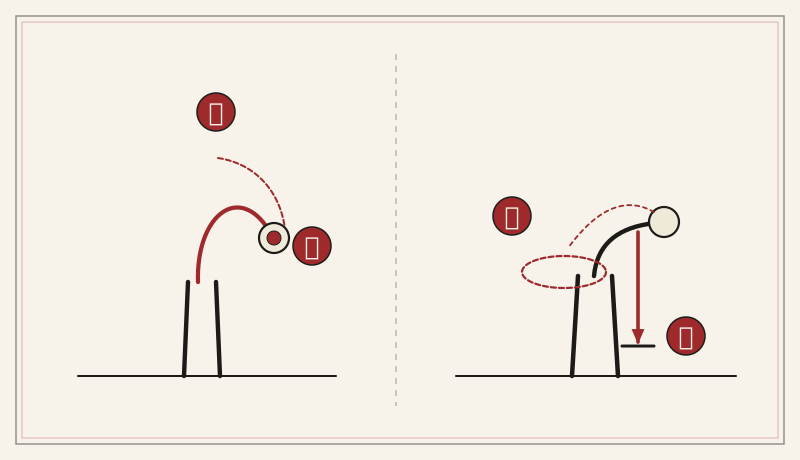
Classical ink-and-cinnabar diagram of Yijinjing Bowing in Salutation (Dagong Shi) and Wagging the Tail (Diaowei Shi) with four numbered alignment markers (①–④).

Figure 1: Classical Yijinjing Closing Postures (Postures 11 & 12) — ① Covering the ears with both palms and tapping the occiput (Yaner Mingtiangu); ② Segmental vertebra-by-vertebra spinal roll down and up along the Governing Vessel (Juanji Dagong); ③ Interlaced palms pressing downward in front of the toes (Shizhi Jiaochu Xiatui); ④ Lateral hip-and-head turn gazing toward the tailbone in Wagging the Tail (Diaowei Shi).

  1. ① Covering the Ears & Sounding the Heavenly Drum (Yaner Mingtiangu 掩耳鸣天鼓): Both palms seal the ears while the index and middle fingers tap the occipital ridge to quiet the mind.
  2. ② Segmental Spinal Roll (Juanji Dagong 卷脊打躬): Curling the spine downward vertebra by vertebra from the cervical spine to the lumbar gate, then uncurling from the tailbone up.
  3. ③ Interlaced Palms Pressing Toward the Earth (Jiaochu Xiatui 交杵下推): Pressing the interlaced hands downward to lengthen the posterior Bladder and Governing Vessel sinew line.
  4. ④ Lateral Tail-Wagging Release (Diaowei Zuoyou 掉尾左右): Gently swaying the tailbone and turning the head to look back toward the coccyx on each side.

3. Wagging the Tail (Diaowei Shi): Releasing the Lumbosacral Gate

The twelfth and final posture, Wagging the Tail (Diaowei Shi 掉尾势), releases any residual tension in the lower back, sacrum, and hamstrings. Interlace the fingers of both hands in front of the chest, turn the palms downward, and hinge forward from the hips with a long, flat or gently curved back until the palms press downward toward the floor (or rest on a low bench or your shins, depending on hamstring flexibility) while keeping the knees comfortably soft.

From this hinged position, exhale as you gently sway the pelvis and tailbone slightly to the left while turning your head and neck to look back over your left shoulder toward the tailbone (as if a fish or dragon were softly wagging its tail and looking back at it, echoing "Swallowing the Tail" in the Eight Brocades); inhale back to the center, and exhale as you sway the tailbone slightly to the right while looking back over the right shoulder. After repeating two to three times on each side, bend the knees generously, unroll the torso smoothly back to upright standing, and let the arms float down to the sides.

4. Gentle Modifications and Closing Consolidation (Shougong)

In the daily wellness classes taught on Wudang Mountain and in Singapore, we emphasize three essential safety rules for Dagong Shi and Diaowei Shi: 1) Never drop the head below the heart if you experience high blood pressure, glaucoma, or vertigo — perform the Mingtiangu ear-drum tapping while standing upright or with a gentle twenty-degree nod of the upper back rather than a deep forward fold; 2) Keep the knees softly bent during spinal rolls and tail-wagging — locking the knees pulls harshly on the sciatic nerve and lower lumbar discs; a ten-degree knee bend allows the pelvis and sacrum to move freely; 3) Always unroll from the bottom up — press the feet into the floor and stack the lumbar vertebrae first before lifting the head.

Complete your twelve-posture Yijinjing practice with seven gentle repetitions of Heel-Drop Vibration (Beidian) and two minutes of Standing Post Closing and Self-Massage (Shougong). Traditional Wudang Daoyin nurtures spinal suppleness and calm vitality and never replaces professional medical care.

Seeker’s Q&A · Frequently Asked Questions

What is the core takeaway of Yijinjing Closing Guide?

Complete the twelve-posture classical Yijinjing (Sinew-Transforming Qigong) with Bowing in Salutation (Dagong Shi) and Wagging the Tail (Diaowei Shi) — combining the Heavenly Drum (Mingtiangu), segmental spinal curling along the Governing Vessel, and lateral lumbar-sacral release.
