QIGONG & DAOYIN · 气功与导引

“Looking Back to Release the Five Fatigues” (Wulao Qishang Wanghou Qiao): Classical Wudang Neck-Spiral, Scapular & Eye-Gaze Daoyin Guide 武当八段锦「五劳七伤往后瞧」单式深修:《素问》久视久坐调摄、旋臂夹背与极目导引指南

A deep dive into the Fourth Brocade of Baduanjin (Wulao Qishang Wanghou Qiao) and the Five Over-Exertions in Huangdi Neijing Suwen—coordinating gentle cervical rotation, forearm external supination, scapular adduction, and diagonal far-gazing to relieve screen and desk fatigue.


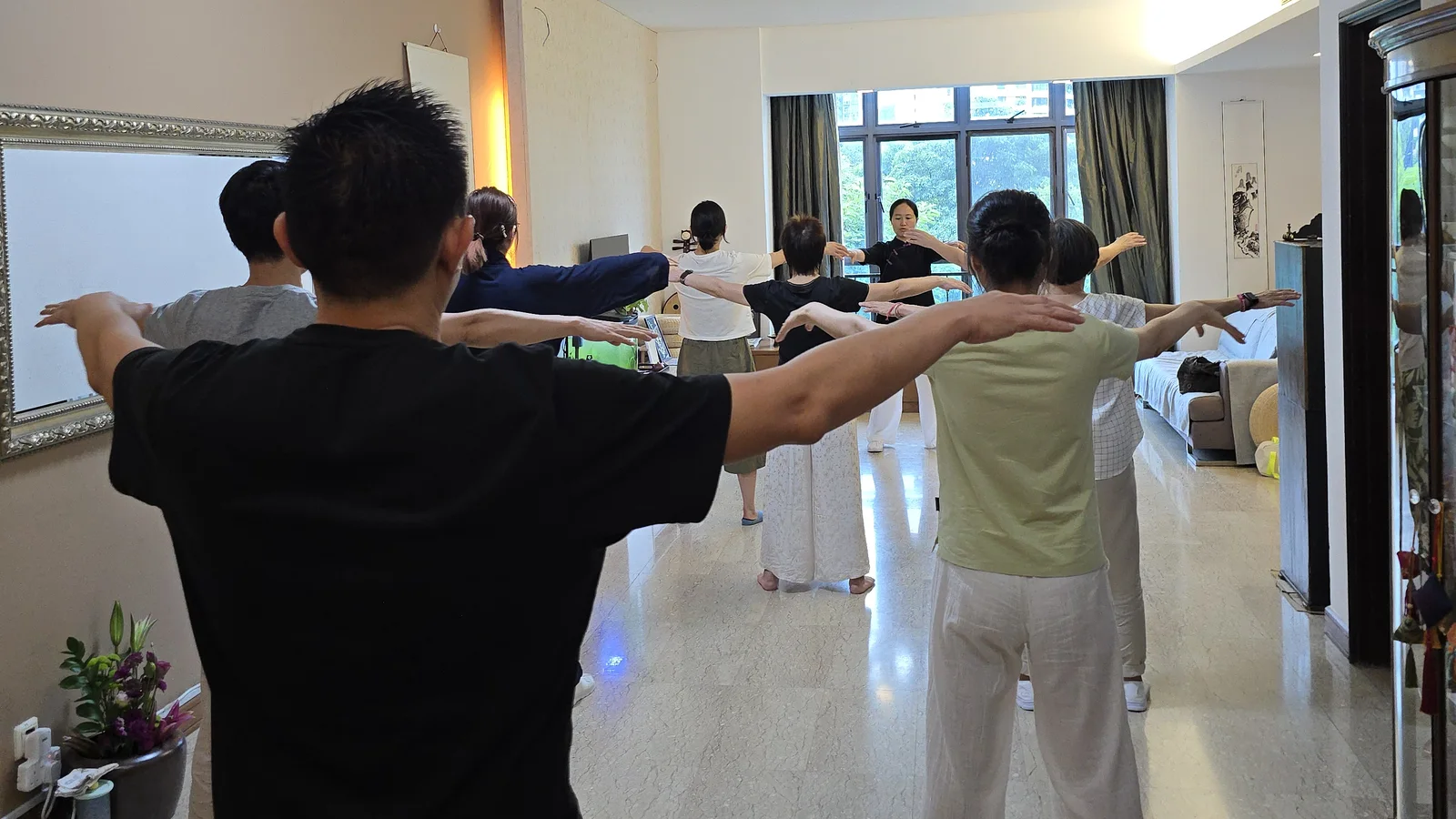
A standing qigong class in a sunlit room: students seen from behind hold both arms open at shoulder height in the same alignment, facing a teacher in dark clothing before a tall window with green trees outside.

What Are the “Five Fatigues” (Wulao) in the Huangdi Neijing Suwen?

The fourth movement of the classical Eight Brocades (Baduanjin 八段锦) bears one of the most evocative names in the Qigong canon: 'Looking Back at the Five Fatigues and Seven Injuries' (Wulao Qishang Wanghou Qiao 五劳七伤往后瞧). Rather than a vague poetic phrase, the 'Five Fatigues' (Wulao 五劳) come directly from Chapter 23 of the Huangdi Neijing Suwen (Xuanming Wuqi Pian 黄帝内经·素问·宣明五气篇): 'Prolonged staring injures the blood; prolonged lying down injures the breath (qi); prolonged sitting injures the flesh; prolonged standing injures the bones; prolonged walking injures the sinews—these are called the injuries of the Five Over-Exertions' (久视伤血,久卧伤气,久坐伤肉,久立伤骨,久行伤筋,是谓五劳所伤). Notice how modern screen work combines two of these five fatigues simultaneously—prolonged staring (jiushi 久视) at a close monitor and prolonged sitting (jiuzuo 久坐) with rounded shoulders—while the 'Seven Injuries' (Qishang 七伤) refer in classical texts to emotional and digestive overstrain.

Why Turning the Head Alone Is Only Half the Movement: Uniting Neck, Arms, and Eyes

When beginners practice Wulao Qishang Wanghou Qiao, they often keep their arms limp at their sides and simply turn the chin left and right. In Wudang Baduanjin pedagogy, three coordinated spirals work together while the pelvis and hips remain squarely facing forward: 1. Cervical Rotation with Crown Suspension (Xuling Dingjing): The head turns slowly around a vertical axis as if the crown were suspended by a thread, never tilting the chin up or dropping the ear toward the shoulder. 2. External Forearm Spiral (Xuanbi Zhanzhang): As the head turns left, both forearms rotate outward (supinate) so the palms turn from facing the thighs to facing forward and slightly outward, gently drawing the shoulder blades toward the spine (jiabei 夹背) and opening the chest. 3. Corner-of-the-Eye Far Gaze (Jimu Yuanwang 极目远望): At the end of the neck turn, the eyes softly look diagonally backward toward the distant horizon for one calm beat, stretching the extraocular muscles after hours of close-up screen focus.

Step-by-Step Practice: Standing or Seated at Your Desk

You can practice Wulao Qishang Wanghou Qiao either standing in a shoulder-width Wuji stance or sitting tall on the front half of a chair with both feet flat on the floor. Let your arms hang naturally beside your hips with the fingers softly extended and palms facing inward toward the thighs. Inhale Phase (Turning and Opening): As you breathe in slowly through the nose, draw the crown upward, turn your head smoothly to the left while keeping your hips and breastbone facing straight ahead, and simultaneously spiral both forearms outward so the palms face forward-outward and the space between your shoulder blades gently firms. At the comfortable end of the turn, let your eyes gaze softly to the far left-rear corner for one second without holding your breath. Exhale Phase (Returning to Center): On a long nasal exhale, let your eyes, head, and forearms unwind smoothly back to the center as the shoulders sink heavy. Repeat to the right side, completing 4 to 8 alternating rounds.

Key Alignment Safeguards: Protecting the Cervical Spine and Keeping the Pelvis Quiet

Because the cervical spine is delicate, classical Wudang instruction emphasizes three safeguards during Wanghou Qiao. First, keep the hips and torso facing forward—if your waist and shoulders twist along with your head, the gentle rotational stretch across the upper trapezius and neck is lost. Second, always stay well inside the comfortable range of motion; let the eyes complete the final degrees of looking back rather than wrenching the chin. Third, keep the jaw unclenched and the shoulders dropped away from the ears throughout the outward arm spiral. Safety note: If you experience dizziness, vertigo, or cervical disc pain when turning the head, reduce the rotation to 45 degrees, move at half speed with your eyes focused softly at a middle distance, and treat this traditional Daoyin as gentle daily mobility care rather than medical therapy.

Seeker’s Q&A · Frequently Asked Questions

What is the key structural alignment in “Looking Back to Release the Five Fatigues” (Wulao Qishang Wanghou Qiao)?

A deep dive into the Fourth Brocade of Baduanjin (Wulao Qishang Wanghou Qiao) and the Five Over-Exertions in Huangdi Neijing Suwen—coordinating gentle cervical rotation, forearm external supination, scapular adduction, and diagonal far-gazing to relieve screen and desk fatigue.
