QIGONG & YANGSHENG · 气功与导引

Wudang Chest-Opening & Rib-Soothing Daoyin (Kuoxiong Shuxie): Releasing Stagnant Breath Along the Flanks and Diaphragm 武当“开胸顺气”与“抚胁舒肝”导引指南:疏通两胁气机、松解横膈郁结的温和功法

Learn how traditional Wudang rib-stroking and chest-opening Daoyin releases shallow breathing, tight intercostal muscles, and desk-bound slouching so the breath settles naturally into the lower abdomen.

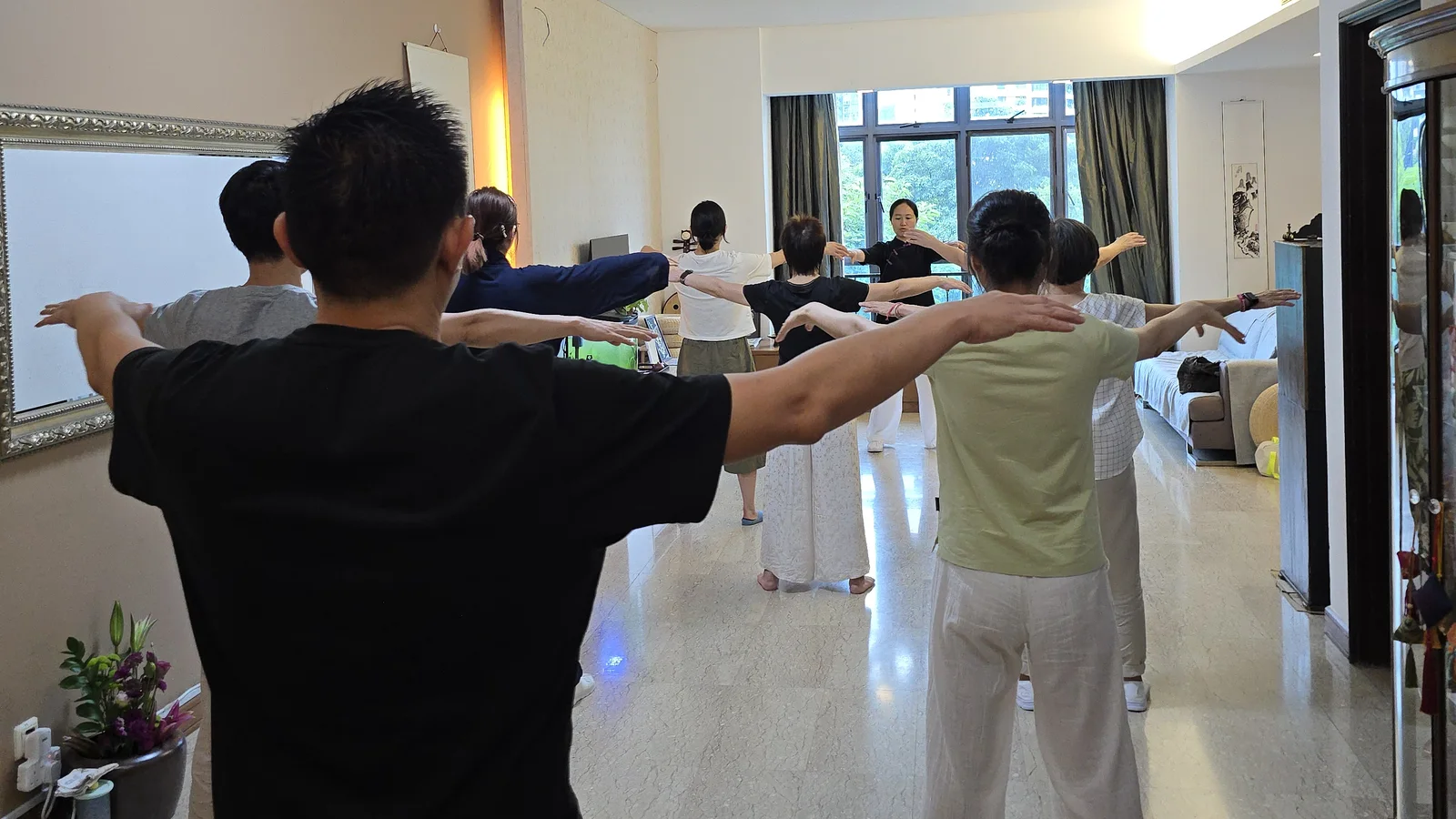
A standing qigong class in a sunlit room: students seen from behind hold both arms open at shoulder height in the same alignment, facing a teacher in dark clothing before a tall window with green trees outside.

1. Classical Foundations: Why the Chest Center and Rib Flanks Govern Smooth Breath

When a beginning student tries to practice natural abdominal breathing or Zhan Zhuang standing meditation after a stressful day at a desk, they often notice that the breath catches high in the breastbone or feels tight along the lower ribs. In classical Taoist physiology—recorded in the Huangting Jing (Yellow Court Classic), Chao Yuanfang’s 610 CE Zhubing Yuanhou Lun (《诸病源候论》), and Gao Lian’s 1591 Zunsheng Bajian (《遵生八笺》)—two regions govern the smooth descent of breath from the upper chest to the lower Dantian:

  • The Central Chest Sea of Qi (Shanzhong 膻中): Located at the center of the sternum, Shanzhong is the gathering pivot of upper-burner respiratory Qi. When posture slumps forward over a keyboard, the sternum compresses and breath becomes shallow.
  • The Two Rib Flanks (Liangxie 两胁): In traditional meridian theory, the lateral ribcage is the pathway of the Liver and Gallbladder channels (Wood phase). Mental pressure, unexpressed frustration, or hours of immobile sitting tighten the intercostal muscles and costal arch, preventing the diaphragm from descending freely.

2. How Chest-Opening and Rib-Stroking Complement Six Healing Sounds (Liuzijue)

In Wudang Qigong and Daoyin, physical soothing of the sternum and ribs (Kuoxiong Shuxie 扩胸疏胁, “Opening the Chest and Soothing the Flanks”) is traditionally paired with the silent long exhalations of the Six Healing Sounds (Liuzijue)—specifically the Xu (嘘) breath associated with the Wood/Liver phase and the Si (呬) breath associated with the Metal/Lung phase.

By gently expanding the ribcage on the inhalation and stroking downward along the sternum and lateral ribs during a slow, silent exhalation, you release mechanical stiffness in the rib joints and allow the shoulders to settle into Sunk Shoulders and Dropped Elbows (Chenjian Zhuizhou).

3. Step-by-Step 6-Minute Wudang Chest & Rib-Soothing Routine

Practice standing with feet shoulder-width apart or seated upright on the front edge of a chair:

  1. Stroking Down the Sternum (抚摩膻中 · 1.5 Minutes): Warm both palms by rubbing them together. Place the overlapping palms at the upper sternum just below the collarbones; as you exhale slowly and silently through the nose or slightly parted lips, glide the palms smoothly downward along the breastbone to the soft hollow above the navel. Inhale as the hands return lightly to the top, repeating 18 slow strokes.
  2. Horizontal Wing Opening and Hugging the Tree (开合胸背 · 1.5 Minutes): Inhale as both arms open outward to the sides at shoulder height with the palms facing forward—gently lengthening the front of the chest without overarching the lower back; exhale as the arms curve forward into a soft embrace (Baoqiu), hollowing the chest (Hanxiong 含胸) and widening the space between the shoulder blades. Repeat nine times.
  3. Soothing the Lateral Rib Flanks (推搓两胁 · 2 Minutes): Place both warm palms high on the sides of the ribcage beneath the armpits, fingers pointing forward-downward along the slope of the ribs. Exhale slowly (optionally forming a silent, whisper-soft Xu 嘘 mouth shape) as you stroke firmly yet gently diagonally downward along the ribs toward the waist and lower abdomen. Repeat 24 times until the sides of the ribs feel warm and unconstructed.
  4. Resting at the Lower Dantian (归元收功 · 1 Minute): Fold both palms over the lower abdomen and take six natural breaths, noticing how effortlessly the inhalation now reaches the belly.

4. Daily Desk Relief in Singapore & Safety Notes

Whenever you catch yourself holding your breath or sighing while working at a computer on Wudang Mountain or in Singapore, pause for three minutes to stroke down the sternum and rib flanks. Never press forcefully onto thefloating lower ribs or the xiphoid process at the tip of the breastbone—use broad, warm palm contact that follows the natural diagonal angle of the ribs. Safety note: this traditional Daoyin practice is for gentle muscular and respiratory relaxation; if you experience chest pain, shortness of breath, rib injury, or cardiovascular symptoms, stop immediately and seek professional medical care.

Seeker’s Q&A · Frequently Asked Questions

Why does soothing the rib flanks (Shuxie) help natural abdominal breathing feel deeper?

Warm palm strokes along the lateral ribs release tension in the intercostal muscles and the lower costal arch while encouraging Liver-Wood Qi to flow smoothly, allowing the diaphragm and lower ribs to expand and settle without constriction.


