QIGONG & DAOYIN · 气功与导引

Wudang Heart-Calming & Spirit-Settling Daoyin (Qingxin Anshen): Kneading Laogong, Shenmen & the Silent “He” Breath 武当清心安神与降心火导引法:按揉劳宫神门、摇头摆尾与六字诀“呵”字功课

Why mental overstimulation leaves the tongue dry and the mind restless at night—and how an 8-minute Wudang sequence cools floating Heart Fire into the calm clarity of the Qingjing Jing.

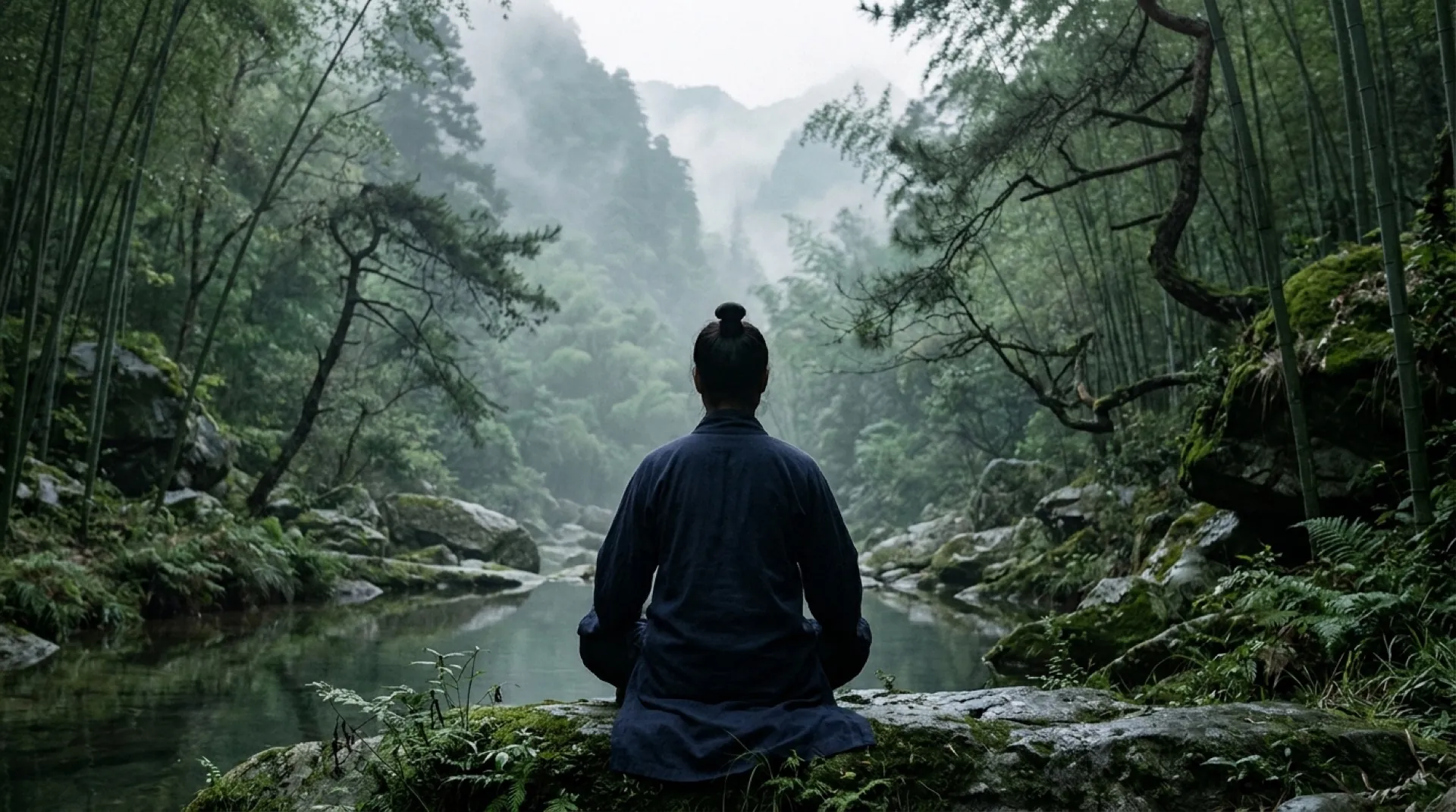
A figure in a dark robe with hair in a topknot, seen from behind, seated cross-legged on a mossy rock beside a still pool in a misty bamboo ravine.

In the Huangdi Neijing (《黄帝内经》), the Heart is honoured as “the Sovereign Official, from whom clear spirit and insight shine forth” (心者,君主之官,神明出焉). When the Sovereign is quiet and cool, the entire body functions in effortless harmony (“the spirit is whole,” 其神全也). Yet when nonstop notifications, late-night screen glare, or tropical heat agitate the mind, classical wellness describes the state as “Heart Fire flaring upward” (心火上炎)—leaving the tip of the tongue dry, the chest restless, and sleep shallow.

Drawing on the Qingjing Jing, Liuzijue (Six Healing Sounds), and Water-and-Fire (Kan and Li) harmony, this 8-minute Wudang Qingxin Anshen (清心安神) routine guides floating heat gently downward to meet Kidney Water.

1. Why the Palms and Wrists Hold the Keys to Calming the Heart

  • Laogong (劳宫穴, PC-8, “Palace of Toil”): When you curl your fingers into a soft fist, the tip of your middle finger touches the center of your palm—Laogong on the Hand Jueyin Pericardium meridian. In classical Daoyin, the Pericardium acts as the outer ambassador protecting the Heart; massaging Laogong releases mental overwork directly through the hands.
  • Shenmen (神门穴, HT-7, “Spirit Gate”): Located at the ulnar (little-finger) end of the transverse wrist crease, Shenmen is the source point of the Hand Shaoyin Heart meridian, revered for settling an overactive mind before rest (Evening Wind-Down Qigong).

2. An 8-Minute Wudang “Qingxin Anshen” Daily Routine

Practise sitting or standing in a quiet room in the afternoon or evening (or during warm weather):

  1. Minutes 1–3 — Stroking the Pericardium Channel & Kneading Laogong and Shenmen (推摩心包经 · 按揉劳宫神门): Sit upright with shoulders soft (Chenjian Zhuizhou). Use your right thumb to stroke smoothly down the midline of your inner left forearm (from the inner elbow crease down to the palm) 18 times; then press and circle gently into the center of the left palm (Laogong) for 30 seconds and into the inner wrist crease (Shenmen) for 30 seconds. Switch hands and repeat on the right arm.
  2. Minutes 4–6 — The Silent “He” Exhalation to Guide Heart Fire Downward (呵字清心 · 引火归元): From Liuzijue, inhale quietly through the nose as both palms float up before the chest; as you exhale, open your mouth slightly with the tongue resting softly near the lower teeth and release a long, voiceless, warm “He” (呵 / huh-) breath for six to eight seconds while both palms press slowly down to the navel (Natural Abdominal Breathing). Imagine warm summer haze in the chest settling down into the cool spring of the Lower Dantian (uniting Heart Fire and Kidney Water). Repeat six times.
  3. Minutes 7–8 — Swirling Jade Fluid & Resting in Clear Stillness (玉液润心 · 常清常静): Close the lips, circle the tongue slowly to gather sweet saliva (because in classical theory “the tongue is the sprout of the Heart,” 舌为心之苗), swallow in three calm gulps, and sit quietly with hands over the lower abdomen for one minute (Neiguan).

3. Pairing With Movement When You Feel Restless

If your upper body feels too restless to sit still right away, precede this routine with three slow rounds of Baduanjin Section 5 (“Sway the Head and Shake the Tail to Clear Heart Fire,” 摇头摆尾去心火) and seven gentle heel drops to draw energy down into your legs first.

4. Cultivating Inner Coolness Between Wudang Mountain and Singapore

Whether amidst the cool mountain breezes near Wudang Mountain’s UNESCO World Heritage ancient Taoist temples or in tropical Singapore’s year-round warmth, Wudang.Org helps practitioners maintain an unhurried, tranquil heart. Compare our four foundational sets in Choosing Your First Qigong Set or visit Start Here.

Safety note: Keep the “He” exhalation soft and unforced so your throat stays moist, and seek medical care for any palpitations, dizziness, or chest discomfort; traditional Qigong is a cultural wellness practice and does not replace medical care.

Seeker’s Q&A · Frequently Asked Questions

How do I find the “Laogong” (劳宫穴) and “Shenmen” (神门穴) points on my hand and wrist?

For Laogong, bend your fingers into a soft fist: the spot where the tip of your middle finger touches the center crease of the palm is Laogong. For Shenmen, look at your inner wrist crease on the little-finger side and feel the small hollow just inside the tendon.


How is the “He” (呵) breath shaped in Liuzijue to calm Heart Fire?

Part the lips gently with the tongue relaxed and flat near the lower teeth, and exhale a slow, silent, warm “He” breath for six to eight seconds while guiding your palms and awareness down from the chest to the lower abdomen.

Why does traditional Taoist Daoyin finish Heart-calming practice with swirling the tongue and swallowing saliva?

In classical Chinese medicine, “the tongue is the sprout of the Heart.” Gently swirling the tongue to generate cool, sweet saliva (“Jade Fluid”) and swallowing it downward directly moistens Heart dryness and unifies Water and Fire.
