QIGONG & DAOYIN · 气功与导引

Wudang Spinal Wave & Crane-Neck Daoyin (Hejing Longyao): Gentle Cervical and Thoracic Undulation for Postural Elasticity 武当“鹤颈龙腰”脊柱导引术:温养颈椎与胸腰椎的节节贯穿练习

Learn the traditional Wudang Crane-Neck (Hejing) and Dragon-Waist (Longyao) spinal wave Daoyin exercises grounded in Zhuangzi Chapter 15 and Tao Hongjing's Yangxing Yanming Lu to gently mobilize stiff cervical and thoracic joints.


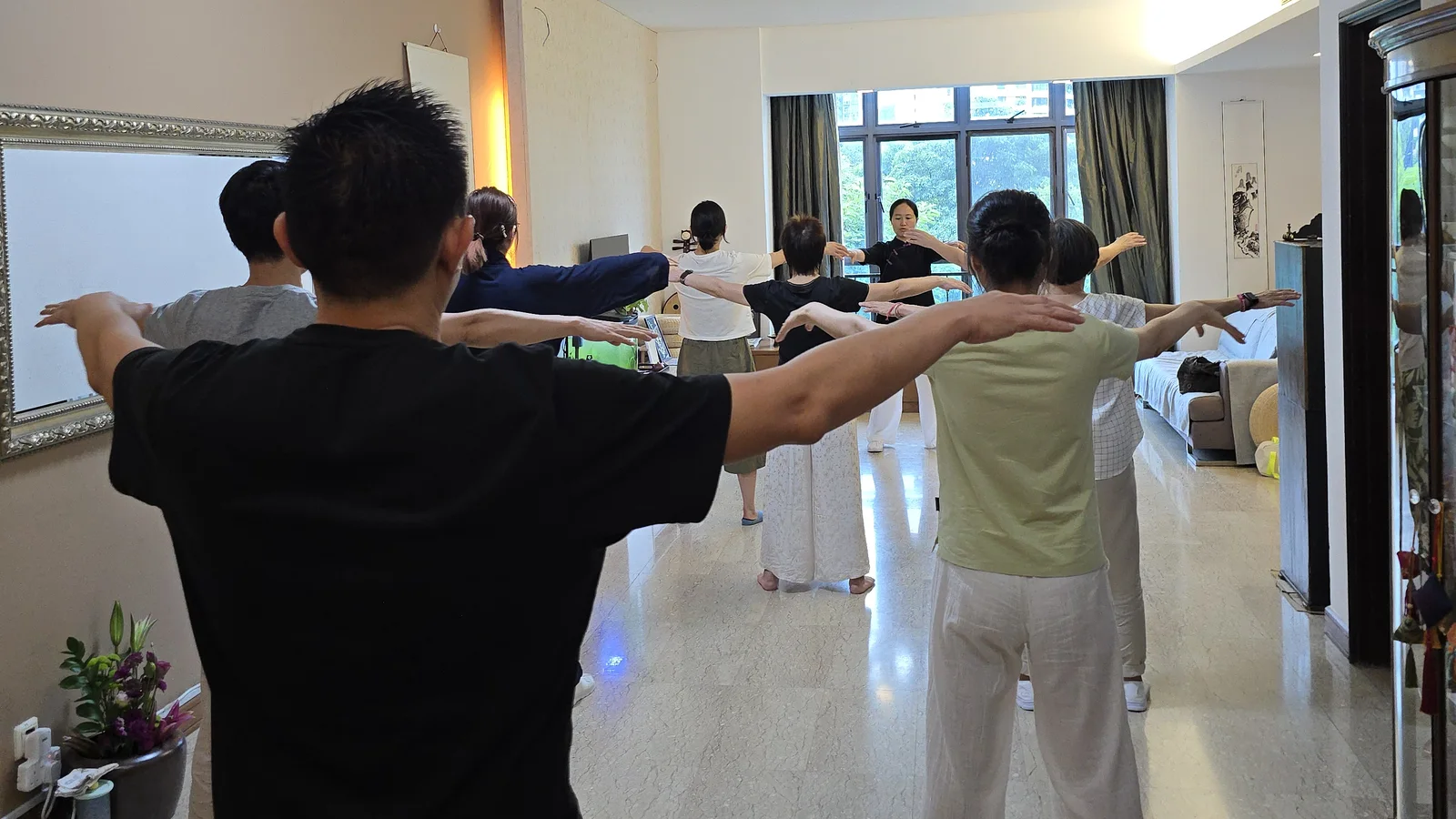
A standing qigong class in a sunlit room: students seen from behind hold both arms open at shoulder height in the same alignment, facing a teacher in dark clothing before a tall window with green trees outside.

1. Classical Roots: 'Stretching Like a Bird' in Zhuangzi and the Daoyin Manuals

In Chinese internal cultivation, a supple spine is considered the central conduit connecting the lower abdomen, the ribcage, and the crown of the head. As early as Zhuangzi Chapter 15 (Keyi 刻意), practitioners of nourishing life (Yangsheng) are described as practicing 'hanging like a bear and stretching like a bird' (Xiongjing Niaoshen 熊经鸟申) to keep the joints and vessels unobstructed. In the Eastern Han dynasty, Hua Tuo explained to his disciple Wu Pu in the Hou Hanshu (Book of the Later Han) that 'a door hinge that turns does not rot,' and Tao Hongjing's Yangxing Yanming Lu (Records on Nourishing Nature and Extending Life) preserved specific bird-stretching movements that gently lengthen the neck and upper spine.

In Wudang Qigong and Daoyin training, these classical principles are distilled into two paired spinal-wave movements known as Hejing (鹤颈, Crane Neck—often practiced as 'White Crane Drinks Water' and 'Crane Looks Back at the Moon') and Longyao (龙腰, Dragon Waist). Together with the Five Animal Frolics crane and deer practices, they teach the spine to move vertebra by vertebra rather than as a rigid block.

2. Crane-Neck Daoyin (Hejing): Gentle Arcs to Release Forward-Head Stiffness

Hours spent reading or working at a desk pull the chin forward and compress the back of the neck. Forceful neck rolling can pinch already tight cervical joints, which is why Wudang Hejing (Crane Neck) uses a slow, supported vertical wave rather than fast circles. Stand or sit tall with the shoulders sunk (Chenjian) and the tongue resting lightly against the upper palate.

In the forward-wave variation ('Crane Drinks Water' 仙鹤饮水), first tuck the chin gently toward the throat so the back of the neck lengthens upward; next, let the chin glide softly downward and forward by just a few centimeters as if skimming clear water; then draw the chin slightly inward and stack the cervical vertebrae up from the base of the neck (near Dazhui) back to the crown (Baihui), finishing with the head upright and suspended. Repeat this small, smooth loop six times in each direction, keeping the motion slow, fluid, and under 50 percent of your maximum range.

3. Dragon-Waist Spinal Wave (Longyao): Segmental Mobilization from Tailbone to Thoracic Spine

While Hejing frees the upper cervical hinge, Longyao (Dragon Waist) restores gentle lateral and sagittal suppleness across the lumbar and thoracic spine. Stand with your feet shoulder-width apart, knees softly unlocked, and palms resting lightly on the lower ribs or floating beside the hips as in our morning Wudang Daoyin warm-up.

Initiate the movement at the pelvis and tailbone (Weilu) rather than the shoulders: allow the tailbone to tuck and release slightly as a gentle wave travels up through the lumbar waist (Mingmen), between the shoulder blades, and up to the base of the neck—like a ribbon undulating in water. Then practice the lateral 'Dragon Winding Pillar' variation: shift weight softly from left foot to right foot while letting the lower waist, middle ribs, and shoulders coil and uncoil sequentially around your vertical axis, keeping the knees aligned with the toes.

4. Integrating Breath, Pace, and Cervical Safety Guidelines

In both Hejing and Longyao, breath accompanies the wave without forcing: inhale naturally as the spine gathers and lengthens upward toward the crown, and exhale softly as the chest and shoulders settle down toward the lower abdomen. Six to nine repetitions of each movement take less than five minutes and pair naturally with desk neck and shoulder Daoyin relief or eye and neck refresh exercises.

Safety note: never tilt the head sharply backward or force the neck into extreme extension, especially if you experience dizziness, vertigo, radiating arm numbness, or cervical disc conditions. Keep all movements small, slow, and pain-free; this traditional Daoyin guide is for educational wellness practice and is not a substitute for medical diagnosis or physical therapy.

Seeker’s Q&A · Frequently Asked Questions

What is the core takeaway of Wudang Spinal Wave & Crane-Neck Daoyin (Hejing Longyao)?

Learn the traditional Wudang Crane-Neck (Hejing) and Dragon-Waist (Longyao) spinal wave Daoyin exercises grounded in Zhuangzi Chapter 15 and Tao Hongjing's Yangxing Yanming Lu to gently mobilize stiff cervical and thoracic joints.
