QIGONG & YANGSHENG · 气功与导引

Wudang Scapular-Wave & Cloud-Gate Opening Daoyin (Zhuanjian Kai Yunmen): Releasing Collarbone, Acromion, and Upper-Back Stiffness 武当“转肩活胛、开云门”松肩导引指南:疏通锁骨云门、肩井与肩胛缝的传统活肩法

Learn the classical Wudang shoulder-loosening routine practiced before Taijiquan and standing meditation—how figure-eight scapular gliding opens the Lung-meridian Cloud Gates (Yunmen) and melts upper-trapezius tension.

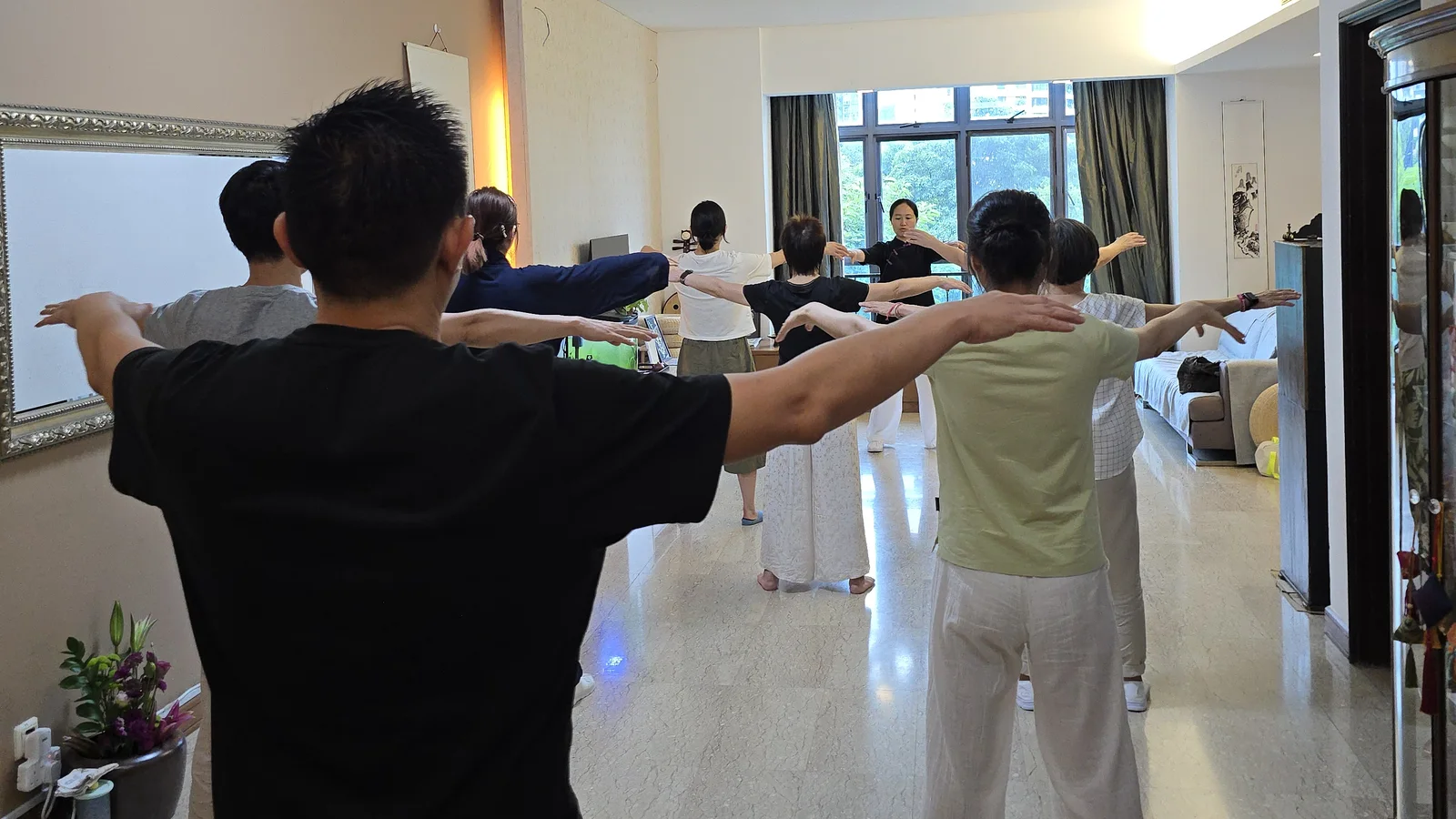
A standing qigong class in a sunlit room: students seen from behind hold both arms open at shoulder height in the same alignment, facing a teacher in dark clothing before a tall window with green trees outside.

1. Why “Loosening the Shoulders” Begins in the Collarbones and Shoulder Blades

In both Wudang Taijiquan and Zhan Zhuang standing meditation, one of the Ten Essentials is “Sink the Shoulders and Drop the Elbows” (Chenjian Zhuizhou 沉肩坠肘). Yet when students try to “drop their shoulders” by pressing them straight down, they often lock the collarbones and pinch the upper back. Traditional Wudang Daoyin—taught on Wudang Mountain and in our Singapore classes—takes the opposite approach: before standing still, you first mobilize the entire shoulder girdle like a well-oiled wooden pulley (Lulu Zhuanjian 辘轳转肩) so the joints settle into place naturally without muscular gripping.

Anatomically and energetically, this routine frees three interconnected gateways:

  • The Anterior Collarbone Hollows (Yunmen 云门 LU-2 & Zhongfu 中府 LU-1): Located in the subclavicular depression just below the outer end of the collarbone (see our Upper-Limb Meridian Patting guide). Rounded desk posture shortens the pectoral fascia here, pulling the shoulders forward.
  • The Crest of the Shoulder (Jianjing 肩井 GB-21, “Shoulder Well”): Situated midway between the base of the neck and the tip of the shoulder where mental stress and screen work cause the upper trapezius to hike upward.
  • The Scapular Seam (Jianjiafeng 肩胛缝 & Jiaji 夹脊): The muscular glider plane between the medial borders of the shoulder blades and the thoracic spine (trained vertically in Ba Duan Jin).

2. Step-by-Step 5-Minute Wudang “Zhuanjian Kai Yunmen” Daoyin Routine

Practice standing with feet shoulder-width apart or seated tall at the front edge of your chair, letting the arms hang softly or resting the fingertips lightly on top of the shoulders:

  1. Inhale to Open the Cloud Gates, Exhale to Round the Back (开合云门活夹脊 · 1.5 Minutes): Bend the elbows softly so the fingertips touch the front of the shoulders. As you inhale through the nose, draw the elbows gently backward and outward so the collarbones widen and the Yunmen hollows open comfortably; as you exhale, bring the elbows forward toward each other in front of the chest so the space between the shoulder blades opens wide. Repeat nine slow breaths without arching the lower back.
  2. Pulley-Wheel Scapular Circles Backward and Forward (辘轳转肩前九后九 · 2 Minutes): Let the arms hang heavy like silk ropes with a lead weight at each elbow tip. Initiating the motion from the shoulder blades rather than the hands, roll both shoulders forward, upward, backward, and smoothly down in nine slow, spacious circles (coordinating the upward-and-back half with the inhale and the long downward slide of the shoulder blades with the exhale); then reverse direction for nine slow circles.
  3. Alternating Figure-Eight Silk-Reeling Wave (左右云肩交错行 · 1 Minute): Roll the left shoulder backward in a smooth circle while the right shoulder glides forward, letting the upper thoracic spine and ribcage undulate gently like Cloud Hands (Yunshou).
  4. Warm-Palm Brushing Over Jianjing to the Elbows (温抚肩井引气下行 · 30 Seconds): Cup the right palm over the left Jianjing (“Shoulder Well”) and brush smoothly down the outer arm to the elbow and fingertips six times, then switch sides.

3. How Scapular Mobility Transforms Your Taijiquan and Desk Posture

Once the collarbones and shoulder blades glide freely over the ribcage, “sinking the shoulders” in Zhan Zhuang requires zero effort—the shoulder blades simply drape downward by gravity while the armpits stay hollow as if holding a small sphere. For office workers in Singapore, many people find that a slow five-minute sequence mid-afternoon helps ease neck-and-shoulder tightness (pair it with Crane-Neck Cervical Daoyin for more upper-body release). It is not a treatment for headaches: if you get frequent or severe headaches, see a doctor.

4. Daily Practice Rhythm & Shoulder Safety Notes

Keep all circles within 70% of your maximum range—smooth, slow, and completely pain-free. Never shrug the shoulders forcefully into the ears or jam the shoulder blades together with sharp muscular contraction. Safety note: if you have an acute rotator-cuff tear, frozen shoulder (adhesive capsulitis), recent collarbone or shoulder dislocation, or radiating arm numbness, keep the movements micro-sized with arms hanging down and consult a qualified physician or physical therapist.

Seeker’s Q&A · Frequently Asked Questions

Where is the Cloud Gate (Yunmen) point and why is it important in Wudang shoulder Daoyin?

Yunmen (LU-2, “Cloud Gate”) lies in the hollow just below the outer third of the collarbone inside the coracoid process; gently opening and softening this area releases anterior chest tightness so the shoulder blades can settle smoothly down the back.


