QIGONG & DAOYIN · 气功与导引

Massaging the Auricles and Pulling the Ear Apex (Mo Erlun): Wudang Ear Daoyin for Kidney-Ear Harmony 摩耳轮与提耳尖垂珠:武当传统导引的“修其城郭以补肾气”与聪耳宁神要法

A classical Wudang Daoyin guide to Mo Erlun (摩耳轮固肾聪耳法), detailing the Kidney-Ear correspondence in the Huangdi Neijing, Zunsheng Bajian's 'repairing the city walls' method, and three-part auricular friction.


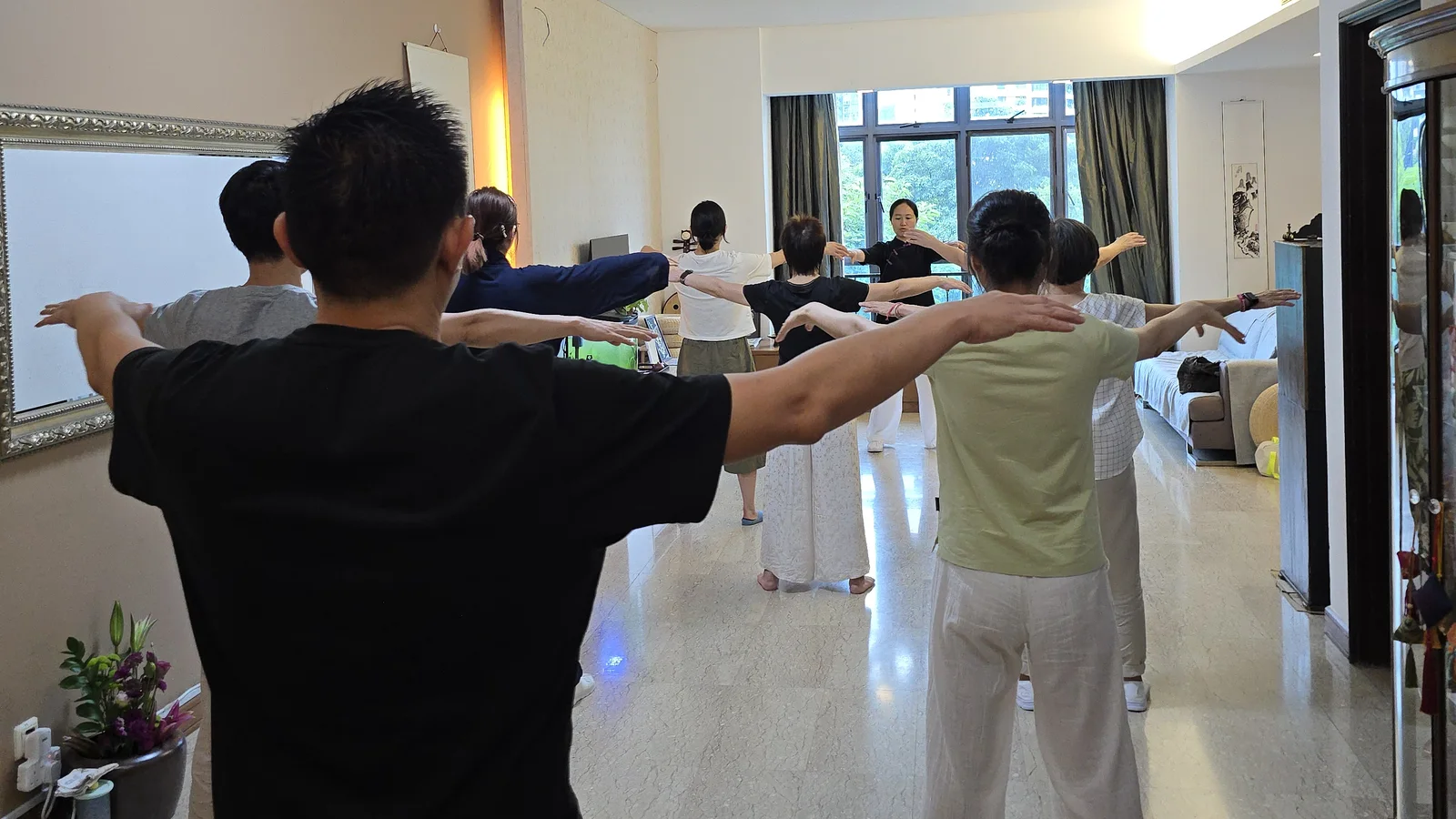
A standing qigong class in a sunlit room: students seen from behind hold both arms open at shoulder height in the same alignment, facing a teacher in dark clothing before a tall window with green trees outside.

Repairing the City Walls to Replenish Kidney Qi: Classical Foundations

In the Huangdi Neijing (黄帝内经, studied under Taoist Classics), the Kidneys store vital essence and open into the ears: 'Kidney Qi communicates with the ears; when the Kidneys are in harmony, the ears can hear the five tones' (肾气通于耳,肾和则耳能闻五音矣). Building upon this physiological link, Ming-dynasty longevity scholar Gao Lian wrote a famous passage in the Zunsheng Bajian (遵生八笺): 'Rub the rims of the ears with the hands without fixed limit to the number of times; this is called repairing the city walls in order to replenish Kidney Qi' (以手摩耳轮,不拘遍数,所谓修其城郭,以补肾气). In the daily self-cultivation sequence of Wudang Qigong & Daoyin, auricular massage (Mo Erlun, 摩耳轮) naturally follows Sounding the Heavenly Drum (Ming Tiangu) and Warming the Orbits (Yunyan).

Step One: Forked-Finger Friction Along the Anterior and Posterior Ear Roots

Sitting or standing with relaxed shoulders, warm both palms first, then form a 'scissors' or V-shape between the index and middle fingers of each hand. Place the middle fingers in front of the ears (over the Ermen, 耳门, TE-21, Tinggong, 听宫, SI-19, and Tinghui, 听会, GB-2 acupoints) and the index fingers behind the ears over the mastoid groove (Yifeng, 翳风, TE-17). Rub smoothly up and down twenty-four to thirty-six times until the entire base of the external ear—the 'city wall foundation' where the Hand and Foot Shaoyang meridians encircle the ear—radiates a pleasant warmth.

Step Two: Pinching the Helix (Erlun), Pulling the Apex (Erjian), and Kneading the Lobes

Next, use the pads of the thumbs and index fingers to trace and knead along the curved outer rim of the ear (Erlun, 耳轮) from top to bottom and back up eighteen times. Then pinch the topmost tip of the auricle (Erjian, 耳尖) and pull gently upward nine times while inhaling calmly, followed by pinching the fleshy earlobes (Chuizhu, 垂珠) and drawing them gently downward nine times on an exhalation. Finally, fold the outer ear flaps gently forward to cover the ear canals for a brief beat and release—a classical movement known as 'Fanning the Drums' (Shan Gu, 扇鼓).

Pairing Mo Erlun with Lumbar Friction for Whole-Body Kidney Support

As taught in the Wudang Mountain tradition and our Start Here guide, because the ears are the upper aperture of the Kidneys and the waist is the lower mansion of the Kidneys (Rubbing the Kidney Shu Points and Warming Mingmen), practicing Mo Erlun alongside Ca Yaoyan harmonizes the upper and lower ends of the Kidney-Bladder and Shaoyang axes in just three minutes of quiet daily care.

Seeker’s Q&A · Frequently Asked Questions

What is the key structural alignment in Massaging the Auricles and Pulling the Ear Apex (Mo Erlun)?

A classical Wudang Daoyin guide to Mo Erlun (摩耳轮固肾聪耳法), detailing the Kidney-Ear correspondence in the Huangdi Neijing, Zunsheng Bajian's 'repairing the city walls' method, and three-part auricular friction.
