QIGONG & DAOYIN · 气功与导引

Wudang Rib-Side Opening & Liver-Soothing Daoyin (Shugan Liqi): Releasing Chest Oppression, Frequent Sighing and Intercostal Tension 武当疏肝理气与开胁导引法:缓解胸胁胀闷、爱叹气与久坐情绪郁结的八分钟功课

Why mental pressure and slouched desk posture lock the lateral ribcage—and how side-rib stretching, gentle palm-stroking along the flanks, and the soft “Xu” breath restore spacious ease.

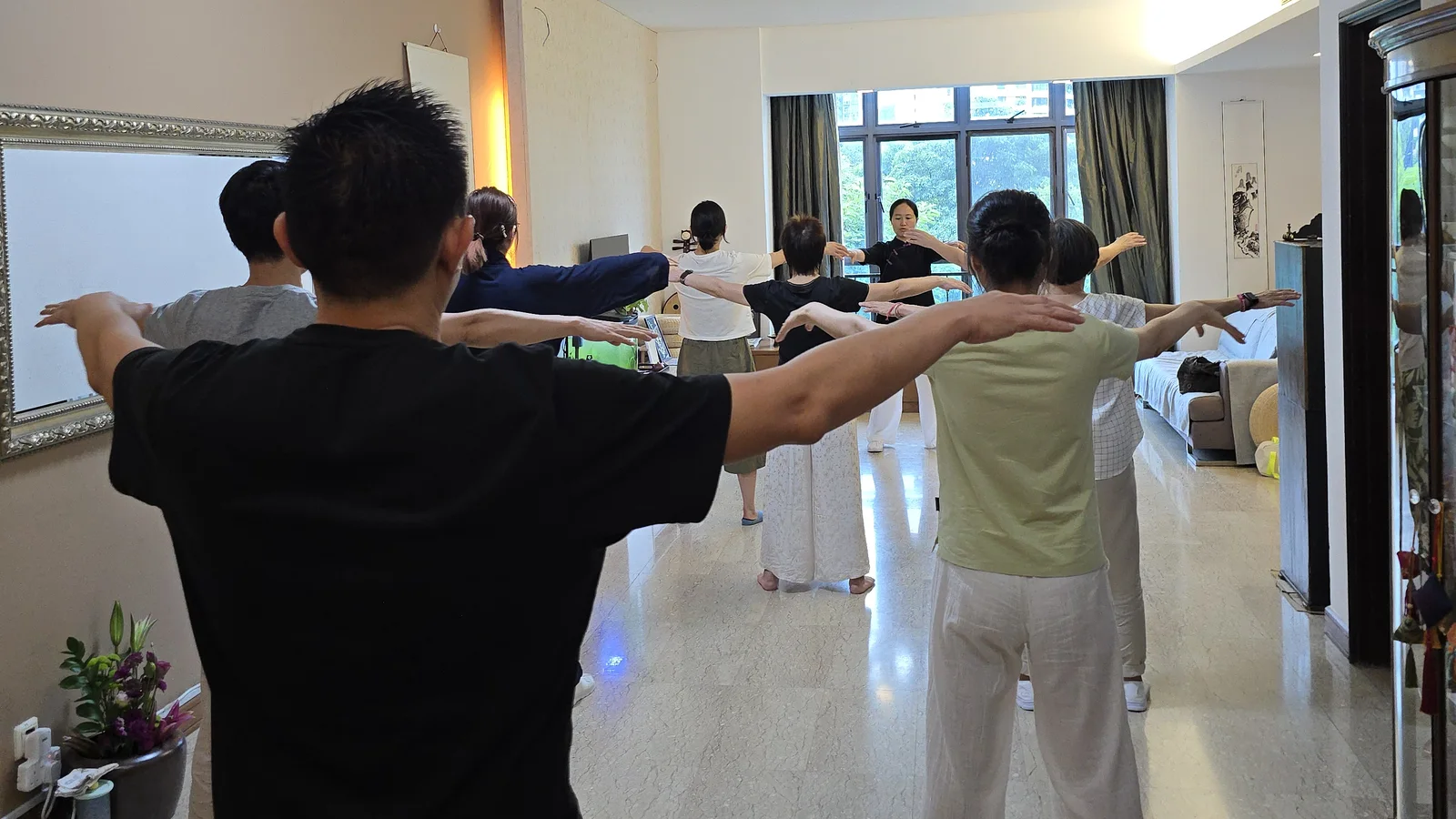
A standing qigong class in a sunlit room: students seen from behind hold both arms open at shoulder height in the same alignment, facing a teacher in dark clothing before a tall window with green trees outside.

Have you ever noticed yourself letting out a spontaneous, involuntary sigh in the middle of a busy afternoon? When we sit hunched over a laptop under deadline pressure, two things happen at once: our shoulders roll forward to compress the sides of the ribcage, and our breathing becomes shallow and hesitant. That spontaneous sigh (known in classical Chinese medicine as Shantai Xi 善太息) is your body’s natural attempt to stretch the locked intercostal muscles and release stagnating breath in the chest and flanks.

In classical Taoist Qigong and Daoyin, the two sides of the ribcage below the armpits (Xielei 胁肋) are the highway of the Liver and Gallbladder meridians, which govern the smooth, uninhibited flow of Qi throughout the body (肝主疏泄). By combining lateral rib-opening stretches with palm friction and the soft “Xu” (嘘) exhalation from Liuzijue (Six Healing Sounds), this 8-minute Wudang routine restores spacious, unhurried breathing (like minnows swimming at ease).

1. Why Emotional Stress and Desk Slouching Lock the Rib-Sides (两胁)

  • The Meridian Highway of the Flanks: In the Huangdi Neijing (《黄帝内经》), the Foot Jueyin Liver meridian and Foot Shaoyang Gallbladder meridian wind through the lateral ribcage. When we suppress frustration or sit frozen for hours, the intercostal fascia between the ribs tightens like a narrow cage, preventing the diaphragm from descending smoothly (Natural Abdominal Breathing).
  • Softness as the Sign of Vitality: As Chapter 76 of the Tao Te Ching (Dao De Jing) reminds us, “When a person is born, they are supple and soft” (Softness, Vitality, and Longevity). Restoring elasticity to the lateral ribs immediately frees both physical breath and emotional composure.

2. An 8-Minute Wudang “Shugan Kaixie” (疏肝开胁) Daily Routine

Practise this three-step sequence standing or sitting in a well-ventilated room:

  1. Minutes 1–3 — “Separating Heaven and Earth” to Open the Lateral Ribs (单举开胁 · 对拉舒肝): Inspired by Section 3 of Baduanjin (“Raise a Single Hand to Regulate Spleen and Stomach”), stand with feet shoulder-width apart. Inhale through the nose as both hands gather before the abdomen; exhale slowly as your left palm spirals upward above the head (palm facing the sky, fingers pointing right) while your right palm presses downward beside the right hip—gently lengthening every rib space along your left flank. Pause for one calm breath at full extension without shrugging (Chenjian Zhuizhou), inhale as the hands return to center, and exhale to stretch the right flank. Repeat six times per side.
  2. Minutes 4–6 — Paired with the Silent “Xu” Exhalation (嘘字平肝 · 目视远方): From Liuzijue, combine a gentle side-bend arc with the voiceless “Xu” (嘘) breath. Inhale quietly through the nose; as you exhale, part the lips slightly with the corners of the mouth drawn softly back and release a long, silent, warm breath (“chuto sound without audible voice,” 出声不出音) while gazing calmly toward the distant horizon (Mingmu Yunjing). Perform six breaths, feeling stale tension in the chest and rib-sides dissolve into the air.
  3. Minutes 7–8 — Briskly Stroking the Flanks (推搓两胁 · 期门至章门): Rub your two palms together until warm, then place both palms under your armpits on the sides of your ribcage. Stroke smoothly and obliquely downward-and-forward along the ribs from the sides of the chest (around Qimen 期门) down to the floating ribs at the waist (around Zhangmen 章门) thirty-six times while breathing naturally. Finish by resting both hands over the lower Dantian for one minute (Shouyi & tongue resting lightly on the palate).

3. When to Use This Routine

  • Whenever you catch yourself sighing repeatedly or feeling tight across the solar plexus during a busy workday.
  • In the spring season (when Wood/Liver Qi rises naturally) or before evening meditation (Evening Wind-Down) so the mind can settle without restlessness.

4. Cultivating Spacious Breath Between Wudang Mountain and Singapore

Connecting the contemplative heritage near Wudang Mountain’s UNESCO World Heritage ancient Taoist temples with our regular classes in Singapore, Wudang.Org helps seekers integrate classical Daoyin into modern life. Compare our four classic sets in Choosing Your First Qigong Set, visit Start Here, or join our Singapore Baduanjin workshop.

Safety note: Stroke the rib-sides with gentle warmth rather than heavy pressure, and seek prompt medical evaluation for any sudden, sharp, or radiating chest pain; traditional Qigong is a cultural wellness practice and does not replace medical care.

Seeker’s Q&A · Frequently Asked Questions

Why does traditional Chinese wellness link frequent sighing (Shantai Xi 善太息) with the rib-sides and Liver Qi?

Because the Liver and Gallbladder meridians run along the two sides of the ribcage (xielei). When stress or slouched posture tightens the intercostal muscles and constrains Qi flow in the chest, the body automatically triggers a deep sigh to expand the ribs.


How should I produce the “Xu” (嘘) breath in Step 2 without straining my throat?

Follow the classical Liuzijue rule of “shaping the breath without audible vocal-cord vibration” (chu sheng bu chu yin): gently draw the corners of the mouth back and let a long, warm, whisper-soft stream of air glide out over six to eight seconds.

In which direction should I stroke the rib-sides during “Cuo Xie” (推搓两胁)?

Place your warm palms on the sides of the ribcage below the armpits and stroke obliquely downward and forward along the natural slope of the ribs toward the sides of the abdomen (from Qimen toward Zhangmen), guiding stagnant breath gently downward.
