QIGONG & DAOYIN · 气功与导引

Kneading Weizhong (委中 BL-40) and Chengshan (承山 BL-57): Wudang Posterior-Leg Daoyin for Lumbar Ease and Post-Standing Recovery 武当导引“按揉委中与承山”精解:“腰背委中求”与舒缓站桩小腿紧绷的足太阳经养生法

Why the classical Four Command Points song declares "For the lower back and dorsal spine, seek Weizhong," and how pairing the popliteal hollow with "Supporting the Mountain" refreshes the legs after practice.

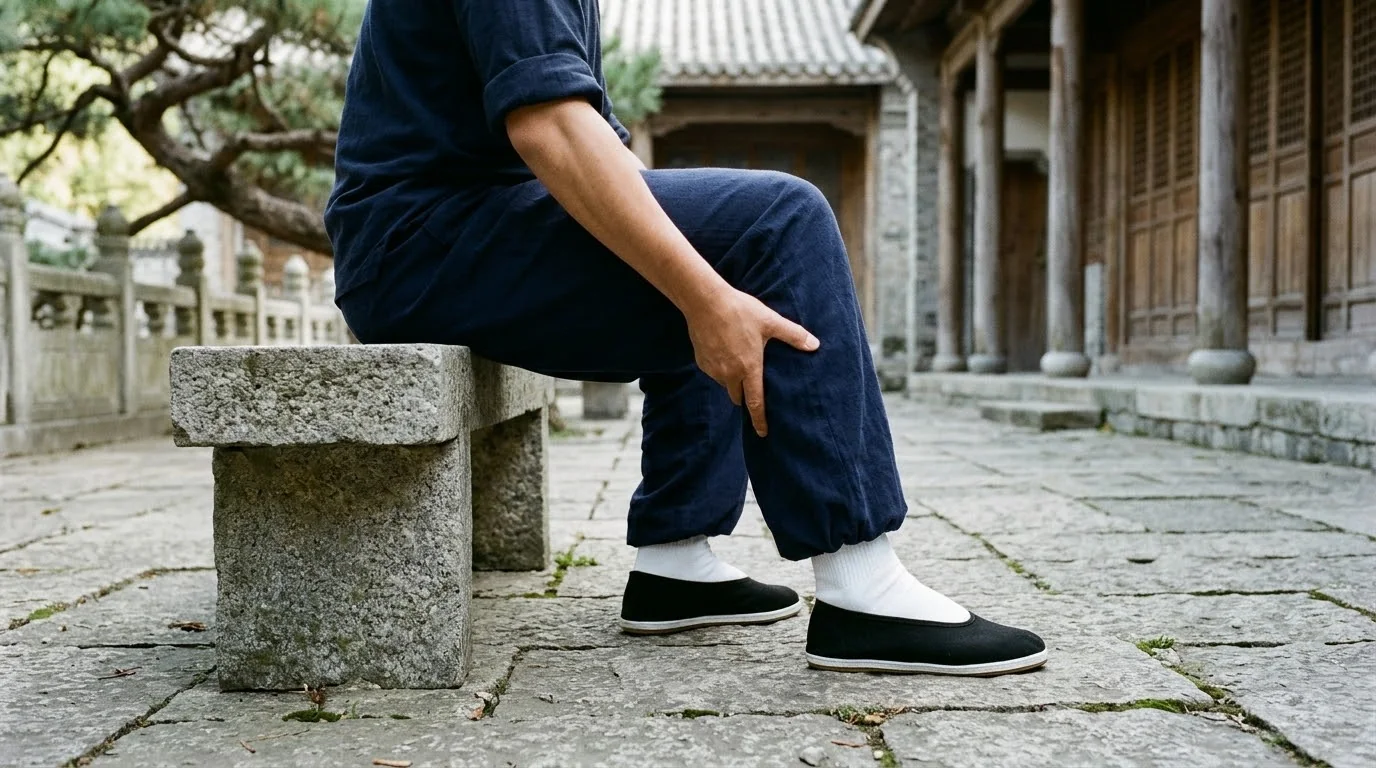
Editorial illustration of a practitioner in indigo cotton training clothes and black cloth shoes, seated on a granite bench in a stone-paved temple courtyard, one hand holding the upper calf just below the knee; a pine, a carved stone balustrade and a timber hall stand behind.

Along the posterior kinetic chain of the human body runs the Foot-Taiyang Bladder meridian, descending from the paraspinal muscles and lower back through the center of the knee crease at Weizhong (委中, BL-40, "Middle of the Bend") and the junction of the gastrocnemius muscle bellies at Chengshan (承山, BL-57, "Supporting the Mountain"). In Wudang Qigong and Taijiquan post-practice recovery, gently warming and kneading these two gates relieves lumbar stiffness and calf heaviness while teaching the knees to remain buoyant ("Song Xi" 松膝) rather than locked.

1. Classical Meridian Theory: Why "The Lower Back and Spine Are Sought at Weizhong" (腰背委中求)

Just as Pressing Hegu (LI-4) and Warming Zusanli (ST-36) anchor two verses of the Ming-dynasty Song of the Four Command Points (Si Zong Xue Ge 四总穴歌), the second line of that classical mnemonic declares: "For the lumbar region and dorsal back, seek Weizhong" (腰背委中求).

  1. Weizhong (委中, BL-40 — "Middle of the Bend," He-Sea Point of the Foot-Taiyang Bladder Channel): Located exactly at the midpoint of the transverse crease of the popliteal fossa (the hollow behind the knee), between the tendons of the biceps femoris and semitendinosus. The two paraspinal branches of the Foot-Taiyang Bladder meridian descend down both sides of the spine, pass through the gluteal and hamstring region, and converge directly at Weizhong. When the popliteal hollow behind the knee is locked or congested, the entire lower back and hamstring fascia tighten; when Weizhong softens and opens, lumbar tension releases downward.
  2. Chengshan (承山, BL-57 — "Supporting the Mountain"): Located on the posterior midline of the lower leg, directly in the lambda-shaped (人-shaped) depression formed beneath the two muscle bellies of the gastrocnemius when the heel is lifted or the toes are pointed (approximately halfway between Weizhong and the level of the heel tendon). Named "Supporting the Mountain" because the calf muscles bear the entire weight of the upper body during standing post meditation (Zhan Zhuang) and mountain climbing, Chengshan is the primary gate for releasing calf tightness and cramping after practice.

2. Step-by-Step Wudang Protocol for Weizhong and Chengshan

Step Posture & Anatomical Location Gentle Daoyin Technique Breath & Somatic Intention (Yi 意)
1. Bending the Knee to Open the Hollow (Qu Xi Xun Xue 屈膝寻穴) Sit on the edge of a chair or bench with the knee bent at roughly 90–110° so the popliteal tendons relax completely (never press Weizhong with a stiff, hyperextended knee) Place both thumbs on the front kneecap or shin while curling the index and middle finger pads of both hands into the exact center of the rear knee crease (Weizhong) Inhale into the lower back (Mingmen); let the back of the knee feel soft and hollow
2. Gentle Finger-Pad Kneading at Weizhong (Qing Rou Weizhong 轻揉委中) Keep finger pads flat and soft (because nerves and blood vessels pass through the popliteal fossa, never jab deeply or use fingernails) Gently knead in small circles 24 times, then lightly tap the back of the knee crease 18 times with loose, cupped palms (Kongxin Zhang 空心掌) Exhale slowly; feel warmth radiating upward along the hamstrings into the lower back and downward into the calves
3. Locating and Kneading Chengshan (Anrou Chengshan 按揉承山) Lightly lift the heel to see the inverted 人-shaped groove at the lower border of the gastrocnemius belly, then set the heel back down so the calf muscle is completely soft before pressing Wrap the fingers around the shin and press the overlapping thumb pads into Chengshan on each exhale for 3 seconds, circling 24 times per leg Exhale any heavy, stagnant fatigue out through the Achilles tendon and sole (Yongquan KI-1)
4. Downward Taiyang Sweeping (Shun Jing Mo Yun 顺经摩运) Place both warm palms over the lower back (Shenshu BL-23) Sweep the palms firmly down the backs of the thighs, through Weizhong, down over Chengshan, to the ankles 9 times Guide Qi smoothly from the lumbar spine all the way to the earth

3. Bridging Daoyin to Taijiquan: Keeping the Knee Crease Soft (Wei Wo Song Huo 委窝松活)

In Wudang Taijiquan and Zhan Zhuang posture troubleshooting, one of the most common causes of lower-back arching and knee strain is locking the knee backward (Deng Xi 蹬膝), which pinches Weizhong shut.

  • The Feeling of a Soft Popliteal Hollow: After warming Weizhong and Chengshan, stand upright in Wuji and unlock your knees by just two millimeters. Feel as though a small, warm cotton ball rests comfortably inside the crease of Weizhong behind each knee—this keeps the Foot-Taiyang channel open from the lower back to the heels during Kneading the Knees (Moxi Jianbu) and slow stepping.
  • Safety Note: The popliteal fossa behind the knee (Weizhong) contains superficial vessels and nerves; always use gentle, broad finger-pad warmth or soft cupped-palm patting rather than sharp, forceful poking, and avoid pressing over varicose veins or acute swelling.

Seeker’s Q&A · Frequently Asked Questions

Where are Weizhong and Chengshan, and how firmly should you press them?

Weizhong (BL-40) is at the midpoint of the crease behind the knee. Chengshan (BL-57) is on the back of the calf, in the 人-shaped hollow that appears below the two calf muscles when you lift the heel. Bend the knee so the muscles are soft, and knead gently with the flat pads of the fingers: nerves and blood vessels run behind the knee, so never jab deeply or use the fingernails. Do not press over varicose veins or an area that is swollen, hot or painful.


