
QIGONG & DAOYIN · 气功与导引

Yijinjing Guide: Green Dragon Stretches Its Claws (Qinglong Tanzhao) and Crouching Tiger Pounces on Its Prey (Wohu Pushi) 传统易筋经导引指南:“青龙探爪势”与“卧虎扑食势”疏肝强脊要领

Practice two dynamic postures from the second half of the classical Yijinjing (Sinew-Transforming Qigong) — Green Dragon Stretches Its Claws (Qinglong Tanzhao) for opening the lateral Gallbladder/Liver sinew line, and Crouching Tiger Pounces on Its Prey (Wohu Pushi) for spinal undulation and Ren-Du vessel vitality.


A standing qigong class in a sunlit room: students seen from behind hold both arms open at shoulder height in the same alignment, facing a teacher in dark clothing before a tall window with green trees outside.

1. Dragon Suppleness and Tiger Sinew Power in the Second Half of the Yijinjing

Having opened the chest, wrists, and Three Burners with Wei Tuo Presents the Pestle and Plucking a Star and freed the shoulder blades and hips with Nine Ghosts Drawing the Saber and Three Plates Falling to the Floor, the second half of the twelve-posture Yijinjing (Yi Jin Jing 易筋经, Sinew-Transforming Classic) introduces two biomimetic postures inspired by classical Taoist animal imagery: Green Dragon Stretches Its Claws (Qinglong Tanzhao Shi 青龙探爪势) and Crouching Tiger Pounces on Its Prey (Wohu Pushi Shi 卧虎扑食势, also called Ehu Pushi).

In traditional Chinese internal conditioning (complementing the Five Animal Frolics Tiger, Bear, and Ape), the Dragon embodies coiling, lateral spiraling, and ribcage suppleness associated with Liver and Gallbladder Wood Qi (see Soothing Liver Qi and Rib-Side Daoyin), whereas the Tiger embodies sinew resilience (guwei jingang 骨威筋刚) and anterior-posterior spinal wave power along the Conception Vessel (Renmai 任脉) and Governing Vessel (Dumai 督脉).

2. Green Dragon Stretches Its Claws (Qinglong Tanzhao Shi): Lateral Spiral and Waist Folding

Stand with feet shoulder-width apart and place both hands in loose fists at the sides of the waist (Zhangmen 章门 area) with the knuckles facing down. To perform Green Dragon Stretches Its Claws on the right side, open the right fist into a "dragon claw" (fingers spread with the first and second knuckles softly curved) and inhale as you sweep the right arm out to the right, up overhead, and across toward the left side of the crown — lengthening the entire right lateral ribcage and Shaoyang Gallbladder sinew line.

As you exhale, turn the torso slightly to the left, hinge smoothly from the hips, and reach the right palm diagonally downward toward the outside of the left knee, shin, or instep (adapting the depth to your hamstring and lumbar comfort while keeping the knees softly unlocked), while the left fist remains anchored at the left waist. On the next inhalation, press through both feet, uncoil the spine vertebra by vertebra, and circle the right arm back up and return it to the right waist before repeating on the left side.

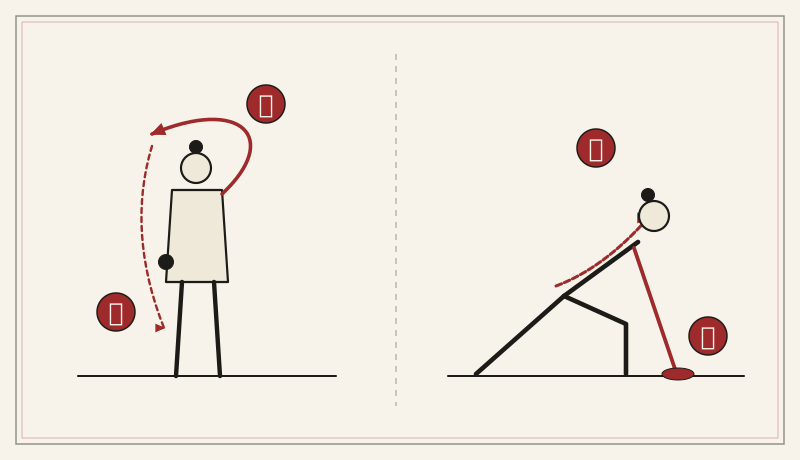
Classical ink-and-cinnabar diagram of Yijinjing Green Dragon Stretches Its Claws (Qinglong Tanzhao) and Crouching Tiger Pounces on Its Prey (Wohu Pushi) with four numbered alignment markers (①–④).

Figure 1: Classical Yijinjing Dragon and Tiger Postures — ① Overhead lateral dragon-claw arc opening the Shaoyang ribcage line (Qinglong Tanzhao); ② Diagonal forward-downward reach toward the opposite knee or instep; ③ Deep bow-lunging tiger stance with arched finger support (Wohu Pushi); ④ Spinal wave extension lifting the chest and crown along the Conception and Governing Vessels.

  1. ① Overhead Lateral Dragon Arc (Qinglong Tanzhao · Shangzhan 青龙探爪 · 上展): Sweeping the extended palm overhead and laterally to lengthen the flank ribs and Gallbladder sinew channel.
  2. ② Diagonal Reach to Opposite Knee/Instep (Xietan Duixi 斜探对膝): Folding from the waist to reach the dragon palm across toward the opposite knee or foot while the other fist anchors at the waist.
  3. ③ Rooted Tiger Pounce Stance (Wohu Pushi · Gongbu 卧虎扑食 · 弓步虎爪): Stepping into a long Bow Stance with tiger-claw fingertips supporting on the thighs, bench, or floor.
  4. ④ Undulating Spinal Wave (Bayao Angshou 拔腰昂首): Coiling the tailbone and rippling through the spine to lift the chest and gaze like a tiger surveying the mountain.

3. Crouching Tiger Pounces on Its Prey (Wohu Pushi Shi): Spinal Wave and Ren-Du Opening

To perform Crouching Tiger Pounces on Its Prey (Wohu Pushi Shi 卧虎扑食势), step the right foot forward into a generous Bow Stance (Gongbu 弓步). Form both hands into rounded "tiger claws" (huzhao 虎爪 — fingertips arched and firm) and circle the palms forward and downward in a pouncing arc.

  • Accessible Standing / High Variation (Recommended for Most Practitioners): Rest both tiger-claw palms on the upper right thigh just above the knee, draw the tailbone and abdomen inward on the exhalation to round the back like a coiling tiger, then inhale as you ripple the spine forward and upward — pressing the chest gently open and lifting the chin slightly to gaze forward.
  • Classical Low Variation: Place the ten tiger-claw fingertips on the floor (or on two sturdy wooden blocks) on either side of the front foot, let the rear heel lift, and undulate the spine forward and backward in a smooth wave from tailbone to crown for three breaths before stepping back and switching legs.

4. Safe Adaptation for the Lower Back, Wrists, and Blood Pressure

In the daily wellness training on Wudang Mountain and in our Singapore classes, we emphasize three safety adaptations for Qinglong Tanzhao and Wohu Pushi: 1) Keep the head above the heart if you have blood-pressure or dizziness concerns — in Qinglong Tanzhao, reach the dragon claw across to the opposite thigh or knee rather than folding all the way to the floor; 2) Use thigh or chair support in Wohu Pushi — placing the hands on the front thigh or a sturdy bench gives the exact same beneficial spinal wave through the Ren and Du vessels without overloading the wrists or lumbar discs; 3) Move with the breath rather than momentum — let every lateral reach and spinal arch unfold smoothly over four to five seconds.

Conclude your Yijinjing practice with Heel-Drop Vibration (Beidian) and Standing Post Closing and Self-Massage (Shougong). Traditional Daoyin supports spinal suppleness, ribcage mobility, and calm vitality and never replaces professional medical care.

Seeker’s Q&A · Frequently Asked Questions

What is the core takeaway of Yijinjing Guide?

Practice two dynamic postures from the second half of the classical Yijinjing (Sinew-Transforming Qigong) — Green Dragon Stretches Its Claws (Qinglong Tanzhao) for opening the lateral Gallbladder/Liver sinew line, and Crouching Tiger Pounces on Its Prey (Wohu Pushi) for spinal undulation and Ren-Du vessel vitality.
