QIGONG & YANGSHENG · 气功与导引

Wudang Ten-Finger Scalp Combing & Ear-Warming Daoyin (Shufa & Ca Er): Sun Simiao and Su Shi’s Classical Routine for Clearing the Head and Calming Spirit 武当“十指栉发”与“摩耳轮”导引指南:孙思邈与苏东坡推崇的清头目、固肾气古法

Explore the classical Taoist self-massage pairing of Combing the Hair with Ten Fingers (Shufa) and Rubbing the Ear Rims (Ca Erlun)—how five minutes at dawn or dusk refreshes the head, neck, and breath.

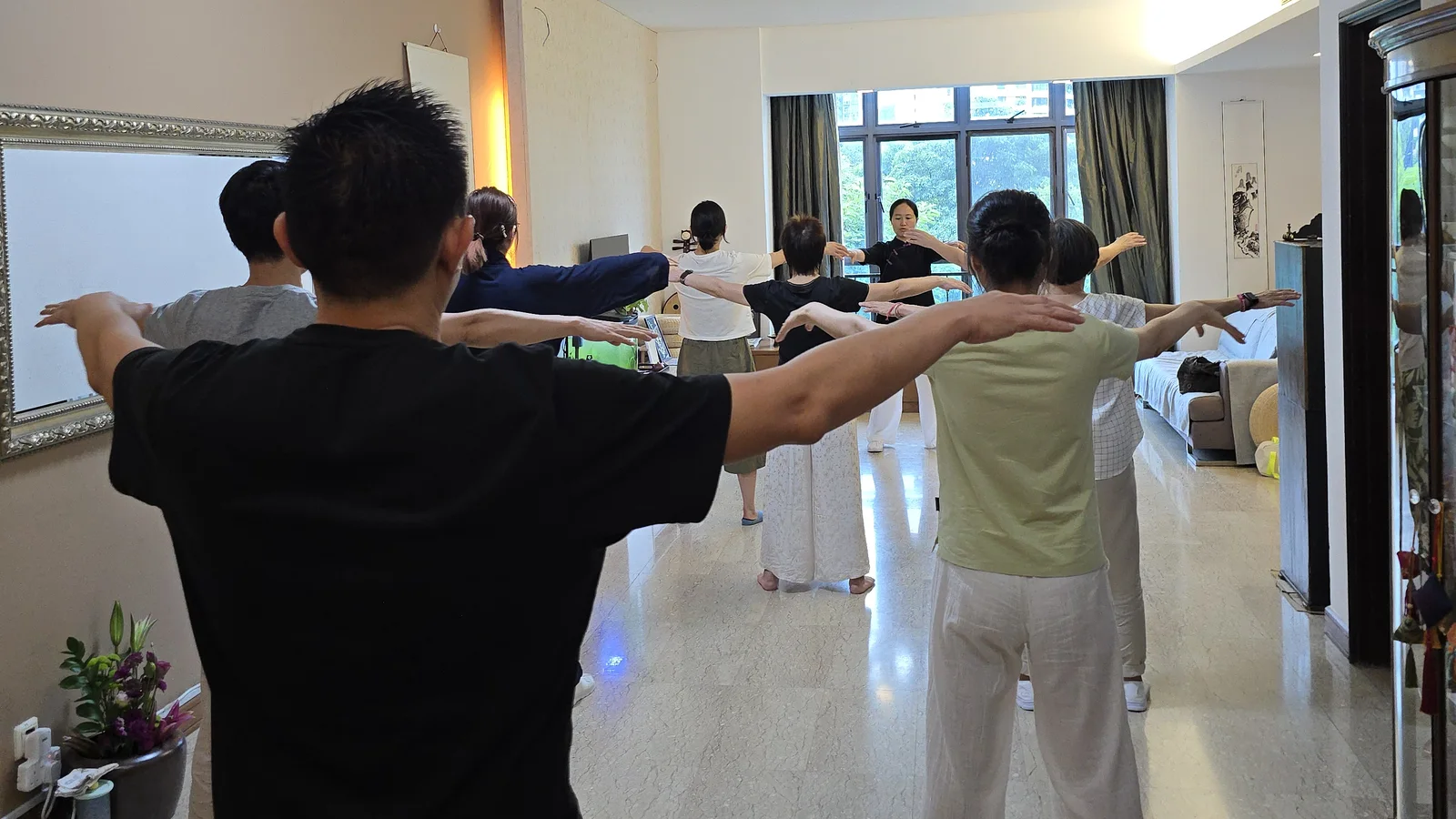
A standing qigong class in a sunlit room: students seen from behind hold both arms open at shoulder height in the same alignment, facing a teacher in dark clothing before a tall window with green trees outside.

1. Classical Sources: “Hair Should Be Combed Often” from Sun Simiao to Su Shi

In classical Taoist longevity manuals, the head is known as the “Confluence of All Yang” (Zhuyang zhi hui 诸阳之会), where the Governing Vessel (Du Mai) and the Bladder and Gallbladder meridians arch from the forehead over the crown to the nape of the neck, while the ears are regarded in the Huangting Jing (Yellow Court Classic) as the external gates corresponding to the Kidneys. Consequently, two of the most famous daily self-massage methods in the entire Daoyin tradition are Combing the Scalp with Ten Fingers (Shizhi Shufa 十指栉发, or “Hair Should Be Combed Often” Fa yi duo zhi 发宜多栉) and Warming the Ear Rims (Mo Erlun 摩耳轮).

In the Tang dynasty, Sun Simiao (孙思邈, 581–682 CE) listed “always combing the hair a hundred times at dawn” among his core longevity precepts in the Qianjin Yaofang (《备急千金要方》). In the Song dynasty, the scholar-poet Su Shi (苏轼, 1037–1101) praised combing the scalp before sleep alongside warming the soles of the feet, and the Yuan–Ming compendia Xiuzhen Shishu and Zunsheng Bajian paired scalp combing directly with rubbing the ear rims and beating the Heavenly Drum (Ming Tiangu).

2. Why Finger-Pad Scalp Combing and Ear Friction Settle Rising Tension

Modern work in Singapore and around the world concentrates hours of visual and mental strain in the forehead, temples, jaw, and suboccipital muscles at the base of the skull. Practicing five minutes of Shufa and Ca Er at dawn upon waking (right after Dry Face Washing) or in the evening before rest works through three gentle mechanisms:

  • Releasing epicranial and temporal fascia: Using the warm, soft pads of all ten fingers (never sharp fingernails) to sweep from the front hairline across the crown to the base of the skull relaxes tight scalp musculature.
  • Guiding excess upper tension downward: Each stroke travels from front to back—following the descending path from the forehead over the vertex (Baihui 百会) down to the nape hollows (Fengchi 风池)—helping settle a racing mind back toward the lower abdomen.
  • Warming the auricular cartilage: Gently massaging the outer ear rim, earlobe, and tragus brings comfortable warmth to the ears and upper neck without forceful pressure.

3. Step-by-Step 5-Minute Wudang Scalp & Ear Daoyin Routine

Sit upright on a chair or cushion with your shoulders dropped and jaw unclenched:

  1. Warm the Palms and Finger Pads (搓手生温 · 30 Seconds): Rub both hands together briskly until the palms and all ten finger pads feel warm, while taking six calm nasal breaths.
  2. Ten-Finger Scalp Combing from Forehead to Nape (十指栉发 · 2 Minutes): Slightly curve all ten fingers like a wide wooden comb. Place the soft finger pads (not the nails) at the front hairline—thumbs near the temples, index fingers near the midline—and glide slowly backward over the top of the head all the way down to the base of the skull at the hairline of the neck. Repeat 36 to 50 slow, even strokes, exhaling softly as your fingers sweep down the back of the neck.
  3. Warming the Ear Rims Up and Down (上下摩耳轮 · 1.5 Minutes): Lightly pinch the outer rim (helix) of both ears between the thumb and bent index finger, and stroke smoothly from the top of the ear down to the earlobe and back up 24 to 36 times until the ears feel gently warm. Then use the index and middle fingers set in a V-shape on either side of the ear root to rub softly up and down 18 times.
  4. Settling the Nape and Breath (抚项收功 · 1 Minute): Sweep both warm palms down the sides of the neck to the collarbones three times, rest the hands over the lower abdomen, and enjoy six quiet breaths.

4. Combining with Morning or Evening Daoyin & Safety Notes

On Wudang Mountain, practitioners naturally link Tapping the Teeth (Kouchi), Dry Face Washing (Yumian), Ten-Finger Scalp Combing (Shufa), and Ear Warming (Ca Er) into a seamless ten-minute morning or evening ritual. Always use the soft fleshy pads of your fingers or a smooth rounded wooden comb—never scratch the scalp with sharp fingernails, and never pull forcefully on the ears. Safety note: avoid massaging over open scalp abrasions, skin infections, or acute ear inflammation; this traditional self-care routine is for everyday relaxation and does not replace professional medical care.

Seeker’s Q&A · Frequently Asked Questions

Why does traditional Taoist Daoyin recommend combing the scalp with the finger pads rather than fingernails?

Using the warm, broad fleshy pads of all ten fingers glides smoothly along the scalp fascia from the forehead to the nape without scratching the skin, encouraging calm relaxation along the Governing, Bladder, and Gallbladder meridians.


