
QIGONG & DAOYIN · 气功与导引

Yijinjing (Sinew-Transforming Classic) Guide: Wei Tuo Presents the Pestle and Plucking a Star (Zhaixing Huandou) 传统易筋经导引指南:“韦驮献杵三势”与“摘星换斗势”伸筋拔骨要领

Learn the foundational opening postures of the classical Yijinjing (Sinew-Transforming Qigong) practiced in Wudang Daoyin — the three Wei Tuo Presents the Pestle postures and Plucking a Star and Exchanging a Star Cluster — to lengthen myofascial sinew channels and harmonize breath.


A standing qigong class in a sunlit room: students seen from behind hold both arms open at shoulder height in the same alignment, facing a teacher in dark clothing before a tall window with green trees outside.

1. What Yi Jin (Transforming the Sinews) Means in Traditional Daoyin

Alongside the Eight Brocades (Baduanjin) and the Five Animal Frolics (Wuqinxi Crane and Deer and Tiger, Bear, and Ape), the Yijinjing (Yi Jin Jing 易筋经, Sinew-Transforming Classic) stands as one of the great pillars of traditional Chinese Daoyin. Although popular folklore often attributes the Yijinjing to sixth-century transmissions, textual historians note that its extant illustrated twelve-posture manual was compiled and circulated in the late Ming dynasty (notably with prefaces dated to 1624) and was rapidly integrated into both Taoist and martial internal conditioning curricula.

In classical Chinese anatomy, jin (筋 — sinews, tendons, ligaments, and continuous myofascial sheets) connect the bones and govern the elastic opening and closing of the joints, while yi (易) means to change, renew, and make supple. Rather than building rigid muscular bulk, Yijinjing uses gentle spiral traction, wrist-and-ankle flexion, and calm Natural Abdominal Breathing to transform stiff, congested connective tissue into resilient, spring-like pathways that support Standing Post (Zhan Zhuang) and Silk-Reeling Force (Chansijin).

2. The Three Postures of Wei Tuo Presents the Pestle (Wei Tuo Xian Chu I, II, III)

The twelve-posture Yijinjing opens with the three progressive postures of Wei Tuo Presents the Pestle (Wei Tuo Xian Chu 韦驮献杵第一、二、三势), which awaken the twelve regular channels starting from the chest and lungs:

  • First Posture (Gathering Qi at the Chest): Stand with feet shoulder-width apart, knees softly unlocked, and spine upright. Bring both palms together in front of the sternum (Danzhong 膻中), elbows slightly rounded outward without shrugging the shoulders. Breathe quietly for three to five cycles until the mind settles.
  • Second Posture (Horizontal Wing Extension): Inhale and open the arms out to the sides at shoulder height with the palms facing downward; as you finish the extension, flex the wrists upward (liangzhang Lixian 立掌) so the fingertips point toward the sky and the heels of the palms press gently outward toward both horizons while the balls of the feet grip the floor lightly.
  • Third Posture (Supporting the Heavens and Lifting the Heels): Turn the palms upward, arc both arms overhead until the palms face the sky above the crown (as if gazing up through a skylight), and gently lift the heels (tizhong 提踵) so you balance on the balls of the feet around the Yongquan (涌泉) area, lightly clenching the teeth (kouchi 叩齿, as in Knocking the Teeth and Regulating the Ears) while lengthening the entire front and lateral torso before exhaling and lowering the heels smoothly.
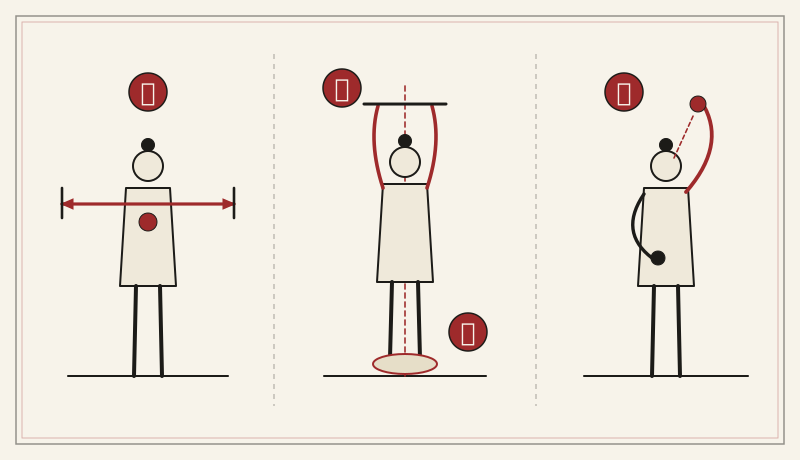
Classical ink-and-cinnabar diagram of Yijinjing Wei Tuo Presents the Pestle (I, II, III) and Plucking a Star (Zhaixing Huandou) with four numbered alignment markers (①–④).

Figure 1: Classical Yijinjing Opening Postures — ① Wei Tuo Presents the Pestle I & II (centering palms at Danzhong and extending horizontally with dorsiflexed wrists); ② Wei Tuo III overhead palm support (Tuotian) lengthening the Triple Burner and torso fascia; ③ Elevated heels rooting through the balls of the feet (Yongquan); ④ Plucking a Star and Exchanging a Star Cluster (Zhaixing Huandou) pairing overhead gaze with a lumbar Mingmen anchor.

  1. ① Centering & Horizontal Wing Extension (Wei Tuo I & II 韦驮献杵第一、二势): Palms join before the chest, then extend horizontally with vertical fingertips to lengthen the three Yin and three Yang arm sinew channels.
  2. ② Supporting the Heavens Overhead (Wei Tuo III · Tuotian 韦驮献杵第三势 · 托天): Both palms press softly upward above the crown while the ribcage and lateral fascia lengthen.
  3. ③ Lifting the Heels Over Yongquan (Tizhong 提踵): Rising onto the balls of the feet stimulates the Kidney and Foot-Yin channels and trains calm vertical equilibrium.
  4. ④ Plucking a Star and Exchanging a Star Cluster (Zhaixing Huandou 摘星换斗势): One palm reaches overhead with the gaze directed toward its center while the opposite hand rests lightly at the Mingmen lumbar region.

3. Plucking a Star and Exchanging a Star Cluster (Zhaixing Huandou)

Immediately following the three Wei Tuo postures comes the fourth movement, Plucking a Star and Exchanging a Star Cluster (Zhaixing Huandou 摘星换斗势), which bridges the upper skyward reach with the lower lumbar gate (Mingmen 命门, explored in Warming the Kidneys and Mingmen Daoyin). From a balanced shoulder-width stance, raise the right hand overhead so the palm faces downward slightly in front of the right forehead, flexing the wrist softly while turning the neck to direct a calm gaze toward the center of the upper palm (Laogong 劳宫).

Simultaneously, bring the left arm behind the lower back and rest the back of the left hand (or palm) lightly against the lumbar spine between the kidneys (Mingmen / Shenshu area). On the inhalation, gently draw the abdominal wall inward and upward while feeling a quiet diagonal traction between the overhead right palm and the anchored left hand at the lower back; on the exhalation, soften the ribs, shoulders, and hips without collapsing the posture. After three to five calm breaths, lower the right arm in a smooth arc and switch sides so the left hand plucks the star overhead while the right hand warms the lower back.

4. Daily Practice Guidelines and Gentle Safety Adjustments

In the daily wellness curriculum practiced on Wudang Mountain and shared with students in Singapore, the three Wei Tuo postures plus Zhaixing Huandou make an ideal six-to-eight-minute morning or mid-afternoon routine for counteracting rounded shoulders and prolonged sitting (complementing our Desk Neck and Shoulder Daoyin Relief). Keep three golden rules in mind: 1) Stretch the sinews to seventy percent — never lock the elbows or force the wrists into painful hyperextension; a warm, elastic lengthening sensation is far more effective than strain; 2) Never hold the breath forcefully — allow smooth nasal breathing to accompany each hold; 3) Adapt the heel lift safely — if balance is unsteady, keep the heels lightly on the ground during Wei Tuo III while still feeling the upward lengthening through the crown.

Finish your practice with two minutes of quiet standing and Closing and Self-Massage (Shougong) over the abdomen and lower back. Traditional Yijinjing Daoyin supports flexibility, posture, and stress relief and does not replace professional medical diagnosis or physical therapy.

Seeker’s Q&A · Frequently Asked Questions

What is the core takeaway of Yijinjing (Sinew-Transforming Classic) Guide?

Learn the foundational opening postures of the classical Yijinjing (Sinew-Transforming Qigong) practiced in Wudang Daoyin — the three Wei Tuo Presents the Pestle postures and Plucking a Star and Exchanging a Star Cluster — to lengthen myofascial sinew channels and harmonize breath.
