QIGONG & DAOYIN · 气功与导引

Warming Yongquan with Laogong (Ca Yongquan): Wudang Evening Foot-Sole Daoyin for Harmonizing Heart and Kidney 擦涌泉引火归元:武当晚修导引的劳宫摩足心、心肾相交与安神培本要法

A classical Wudang Daoyin guide to Ca Yongquan (擦涌泉引火归元法), detailing the anatomical location of Yongquan (KI-1), cross-lateral Laogong-to-Yongquan friction, and Heart-Kidney harmonization (Xin Shen Xiang Jiao).


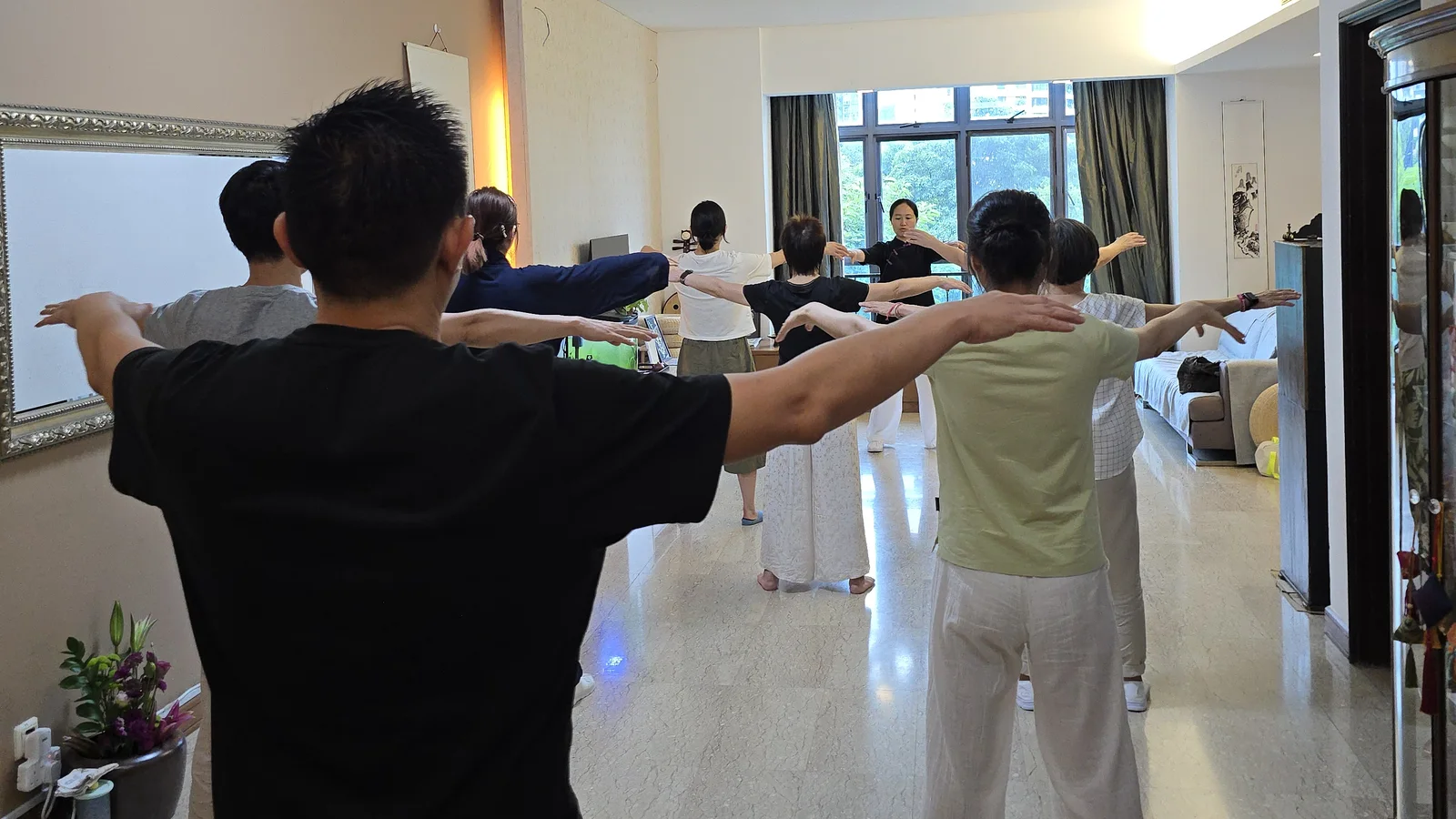
A standing qigong class in a sunlit room: students seen from behind hold both arms open at shoulder height in the same alignment, facing a teacher in dark clothing before a tall window with green trees outside.

Yongquan (KI-1) as the Earthly Wellspring of the Kidney Meridian

If morning seated Daoyin awakens the cranial apertures (Sounding the Heavenly Drum and Swallowing the Jade Fluid) and daytime lumbar friction warms the waist (Rubbing the Kidney Shu Points and Warming Mingmen), traditional Wudang evening cultivation completes the daily cycle at the soles of the feet through Ca Yongquan (擦涌泉, 'Rubbing the Bubbling Spring'). In the Huangdi Neijing (黄帝内经) and Taoist longevity manuals such as the Yangxing Yanming Lu (养性延命录) and Gao Lian's Ming-dynasty Zunsheng Bajian (遵生八笺, studied under Taoist Classics), Yongquan (涌泉, KI-1) is the Jing-Well (井穴) starting point of the Foot Shaoyin Kidney meridian: 'Kidney Qi originates beneath the soles like water bubbling up from a mountain spring.'

Locating Yongquan and the Principle of Xin Shen Xiang Jiao (Heart-Kidney Communion)

Anatomically, Yongquan lies on the sole of the foot in the natural depression formed when the toes curl inward, roughly one-third of the distance from the base of the second and third toes to the back of the heel. In classical Taoist inner landscape theory (Wudang Qigong & Daoyin), placing the center of the palm—Laogong (劳宫, PC-8, belonging to the Fire of the Heart-Pericardium)—directly against Yongquan on the sole (belonging to Kidney Water) establishes an immediate circuit between upper Fire and lower Water known as 'Heart and Kidney in Communion' (Xin Shen Xiang Jiao, 心肾相交) and 'Guiding Fire Back to the Origin' (Yin Huo Gui Yuan, 引火归元).

Cross-Lateral Friction Method: Right Palm to Left Sole, Left Palm to Right Sole

Sitting comfortably on a wooden platform or bed edge after washing and drying the feet in the evening, rest the left ankle over the right knee. First rub both palms together (Warming the Palms at Laogong Guide), then place the warm center of the right palm (Laogong) against the left sole at Yongquan. Using a steady, unhurried rhythm driven from the relaxed shoulder and elbow, rub briskly lengthwise from the base of the toes down across the arch toward the heel eighty-one or one hundred times until the sole feels thoroughly warm. Then switch legs, resting the right ankle over the left knee and rubbing the right Yongquan with the left Laogong for an equal count.

Gentle Percussion and Quiet Breath Settling Before Sleep

Upon completing the lengthwise friction on each foot, form a loose hollow fist (Kongxinquan, 空心拳) and tap gently over Yongquan and the arch nine to eighteen times, then hold the warm palm quietly over Yongquan for three slow breaths. As taught in the Wudang Mountain tradition and our Start Here guide, this simple five-minute evening practice draws restless thoughts downward from the head into the feet, preparing body and spirit for tranquil rest.

Seeker’s Q&A · Frequently Asked Questions

What is the key structural alignment in Warming Yongquan with Laogong (Ca Yongquan)?

A classical Wudang Daoyin guide to Ca Yongquan (擦涌泉引火归元法), detailing the anatomical location of Yongquan (KI-1), cross-lateral Laogong-to-Yongquan friction, and Heart-Kidney harmonization (Xin Shen Xiang Jiao).
