QIGONG & DAOYIN · 气功与导引

Kneading the Knees and Warming Zusanli (Moxi Jianbu): Wudang Lower-Limb Joint Daoyin Around Heding and Dubi 摩膝健步温养足三里:武当传统导引的“膝为筋之府”、鹤顶犊鼻环摩与阳陵泉调摄要法

A classical Wudang Daoyin guide to Moxi Jianbu (摩膝健步法), examining the knee as the 'Mansion of the Sinews' in the Huangdi Neijing, palm-warming rotations over Heding and Dubi (Xiyan), and Zusanli (ST-36) acupressure.


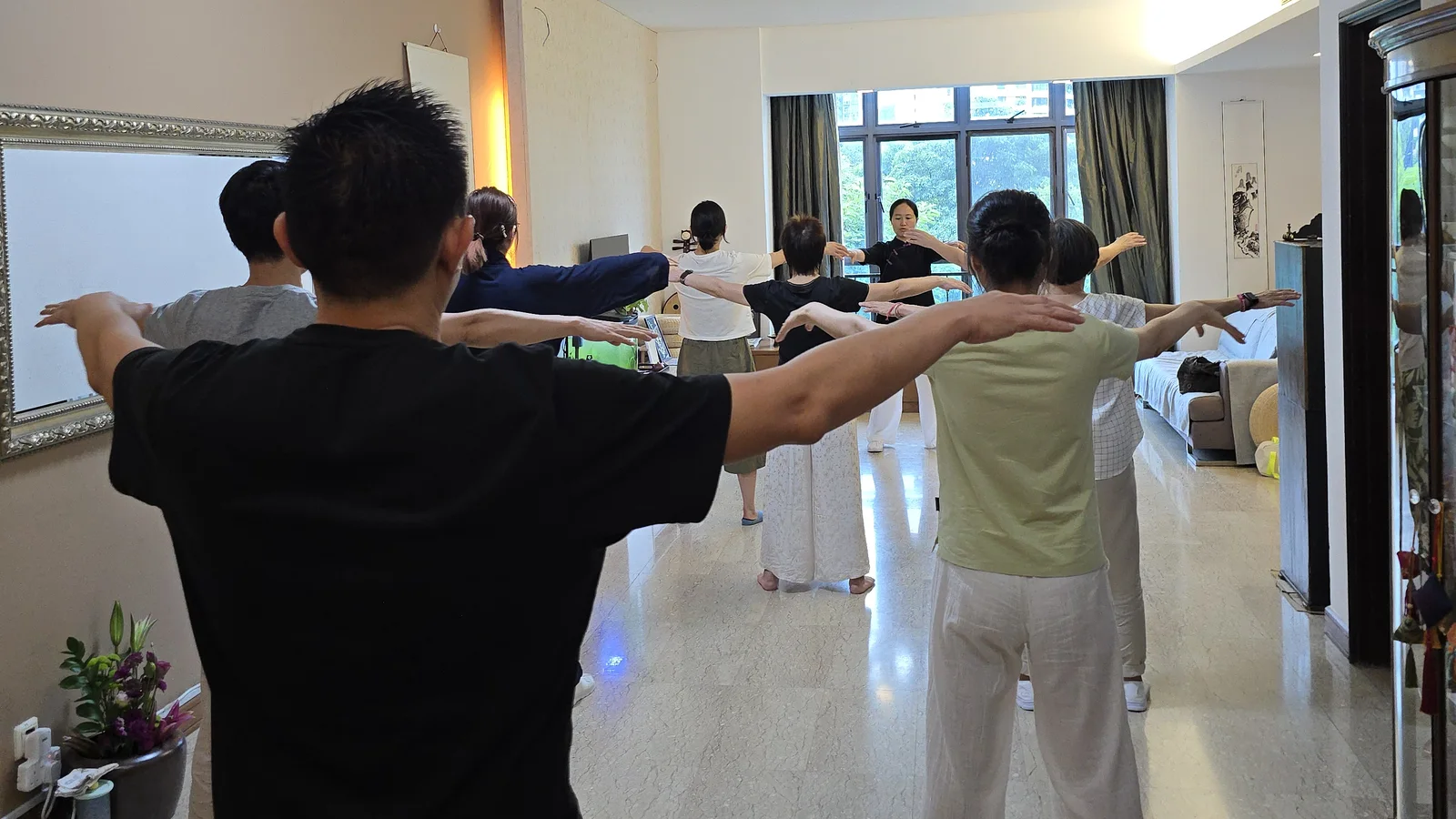
A standing qigong class in a sunlit room: students seen from behind hold both arms open at shoulder height in the same alignment, facing a teacher in dark clothing before a tall window with green trees outside.

The Knee as the Mansion of the Sinews: Xi Wei Jin Zhi Fu

In the Huangdi Neijing (Suwen, 黄帝内经·素问, studied under Taoist Classics), the knee joint is designated as the 'Mansion of the Sinews' (Xi Wei Jin Zhi Fu, 膝为筋之府): all major tendons and myofascial tracks of the three Yin and three Yang meridians of the leg converge around the patella and popliteal crease. For mountain ascents on the stone stairways of Wudang Mountain as well as low-stance transitions and single-leg kicks in Taijiquan (Standing Balance Kicks Guide), keeping the knee capsule warm and well-lubricated is essential. In the Wudang Qigong & Daoyin curriculum, Moxi Jianbu (摩膝健步, 'Warming the Knees to Fortify the Step') links lumbar care (Rubbing the Kidney Shu Points) with foot-sole care (Warming Yongquan with Laogong).

The Five Peri-Patellar Gates: Heding, Dubi (Xiyan), Yanglingquan, Yinlingquan, and Weizhong

When the warm palm cups over the knee, it encompasses five classical acupoints simultaneously: directly above the midpoint of the patella lies Heding (鹤顶, EX-LE2, 'Crane's Crown'); in the twin hollows directly below the patella on either side of the patellar ligament lie the 'Knee Eyes' (Xiyan, 膝眼 / Dubi, 犊鼻, ST-35); on the outer aspect below the fibular head lies Yanglingquan (阳陵泉, GB-34, the Confluent Point of the Sinews, Jin Hui Yanglingquan, 筋会阳陵泉); on the inner aspect below the medial condyle of the tibia lies Yinlingquan (阴陵泉, SP-9); and in the center of the back crease lies Weizhong (委中, BL-40).

Seated and Standing Palm Rotations Followed by Zusanli (ST-36) Kneading

Sitting on a wooden stool with the knees bent at ninety degrees (or standing with the feet together and knees slightly flexed), rub both palms briskly until hot, then cup the warm Laogong centers firmly over both kneecaps. Rotate the palms slowly around the patella eighteen times inward and eighteen times outward until a deep, comforting warmth permeates Heding and Dubi. Next, use the thumbs and index fingers to knead into the twin Xiyan hollows and Yanglingquan (GB-34) for nine breaths, then slide four finger-breadths (three cun) below Dubi along the outer edge of the shinbone to knead and briskly rub Zusanli (足三里, ST-36—the He-Sea point of the Stomach meridian) thirty-six times.

Pre-Practice Warm-Up and Post-Practice Recovery

As emphasized in our Start Here curriculum, practicing Moxi Jianbu for two minutes before standing post (Zhan Zhuang) or Taijiquan forms warms the synovial fluid and peri-articular tendons before weight-bearing flexion begins, leaving the legs light, resilient, and steady.

Seeker’s Q&A · Frequently Asked Questions

What is the key structural alignment in Kneading the Knees and Warming Zusanli (Moxi Jianbu)?

A classical Wudang Daoyin guide to Moxi Jianbu (摩膝健步法), examining the knee as the 'Mansion of the Sinews' in the Huangdi Neijing, palm-warming rotations over Heding and Dubi (Xiyan), and Zusanli (ST-36) acupressure.
