QIGONG & YANGSHENG · 气功与导引

Warming Yangchi (阳池 TE-4) and Daling (大陵 PC-7) at the Center of the Wrist Crease: Wudang Triple-Burner & Pericardium Source-Gate Daoyin for Warm Hands and Supple Wrist Settling (Zuowan) 武当导引“对揉阳池与大陵”精解:疏通手少阳三焦经与手厥阴心包经原穴、温煦手足寒凉与落实太极“坐腕不折腕”的养生法

How unlocking the central Yin and Yang Yuan-Source gates directly on the wrist crease warms cold fingers, protects the carpal tunnel, and perfects Wudang Taijiquan palm pushes.

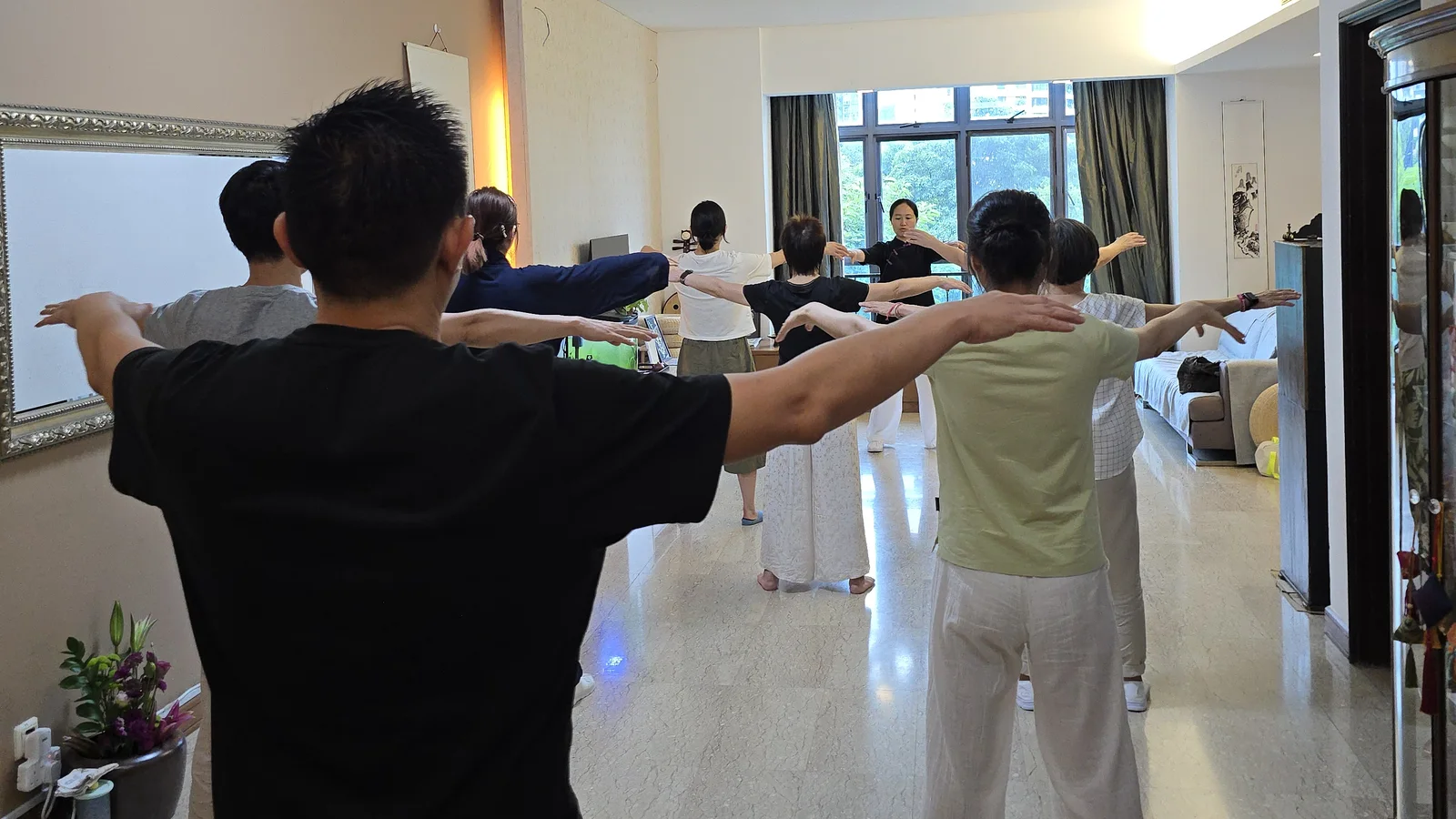
A standing qigong class in a sunlit room: students seen from behind hold both arms open at shoulder height in the same alignment, facing a teacher in dark clothing before a tall window with green trees outside.

1. Classical Meridian Architecture: The Central Yuan-Source Pair at the Wrist Crease (Yangchi TE-4 & Daling PC-7)

Across our exploration of the upper-limb gates in Wudang Daoyin, we have seen how the outer ulnar edge is governed by Houxi (SI-3) and Wangu (SI-4), the inner radial edge by Taiyuan (LU-9) and Lieque (LU-7), the forearm shaft two cun above the wrist by Neiguan (PC-6) and Waiguan (TE-5), and the palm hollow by Laogong (PC-8) and Shaofu (HT-8). Now, right at the exact geometric center of the wrist crease itself, where the hand hinges upward and downward, sit the two opposing Yuan-Source (Yuanxue 原穴) points of the Triple Burner (Sanjiao) and Pericardium (Xinbao) channels, documented in the Lingshu (Spiritual Pivot, Chapter 2 Benshu), the Nan Jing (66th Difficulty), and Huangfu Mi's Zhenjiu Jiayijing:

  1. Yangchi (阳池, TE-4 — "Yang Pool," Yuan-Source Point of the Hand-Shaoyang Triple Burner Channel): Located on the posterior (dorsal) aspect of the wrist, at the midpoint of the dorsal transverse wrist crease, in the distinct hollow between the tendon of the extensor digitorum communis (radial side) and the tendon of the extensor digiti minimi (ulnar side). When you gently lift the back of your hand toward the ceiling (wrist extension), a clear dimple opens right in the center of the back of the wrist—that hollow is Yangchi, the "Pool of Yang." According to the Nan Jing (66th Difficulty), the Triple Burner (Sanjiao 三焦) is the ambassador that circulates the body's Prenatal Source-Qi (Yuanqi 原气) from the Mingmen and lower Dantian throughout the three burners; and Yangchi is the very Yuan-Source pool where that warming vitality gathers on the back of the wrist.
  2. Daling (大陵, PC-7 — "Great Mound," Shu-Stream Earth Point & Yuan-Source Point of the Hand-Jueyin Pericardium Channel): Located on the anterior (palmar) aspect of the wrist, at the exact midpoint of the distal transverse wrist crease, squarely between the tendons of the palmaris longus and flexor carpi radialis (directly over the carpal tunnel and directly opposite dorsal Yangchi TE-4, two cun distal to Neiguan PC-6). Named "Great Mound" after the rounded heel of the palm just below it, Daling calms the Heart-Spirit, opens the chest, and relieves compression of the palmar wrist tendons caused by resting the wrist against a desk edge.
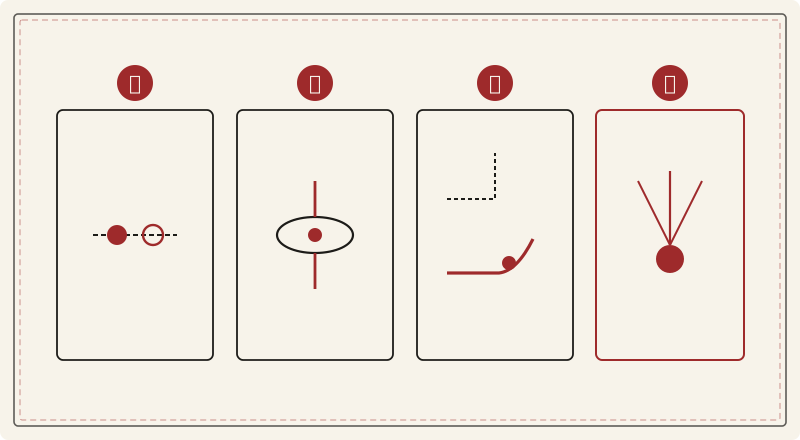
Classical four-panel Wudang Daoyin diagram illustrating dorsal Yangchi (TE-4) and palmar Daling (PC-7) at the center of the wrist crease, thumb-and-index source-gate kneading, 90-degree broken wrist error vs 45-degree supple Wudang Zuowan, and Triple-Burner warmth radiating to the fingertips
Figure 1 — Central Wrist-Crease Source Gates (Yangchi TE-4 & Daling PC-7) Wudang Daoyin: ① Anatomical midpoint of the wrist crease showing dorsal Yangchi (TE-4) in the extensor tendon dimple and palmar Daling (PC-7) between the two central flexor tendons; ② Simultaneous thumb-and-middle-finger source-gate kneading across the center of the wrist; ③ Biomechanical contrast in Taijiquan: a 90-degree bent wrist crushes Yangchi and strains Daling, whereas a 30–45 degree Zuowan keeps both gates open; ④ Triple-Burner Yuanqi warming the palms and fingertips.

2. Four-Stage Wudang Central Wrist-Crease Warming & Zuowan Protocol

Just as Wei Boyang's Cantong Qi compares internal cultivation to a skilled charioteer holding the silken reins (Zhi Xianpei 执衔辔) with supple wrists, these four stages awaken Yangchi and Daling with natural abdominal breathing:

StageExact Palpation & Hand PositionGentle Daoyin Action & RepetitionsBreath & Somatic Verification
1. Finding the Dorsal Pool (Yangchi TE-4) and Palmar Mound (Daling PC-7)Sit or stand upright in Wuji posture; lift the back of your left hand slightly to feel the central dimple on the back wrist crease (Yangchi TE-4), then turn the palm up to feel the groove between the two central tendons right on the front wrist crease (Daling PC-7)Place your right thumb pad on dorsal Yangchi (TE-4) and your right middle finger pad directly opposite on palmar Daling (PC-7)Inhale softly; notice how your two fingertips meet across the exact center of the wrist hinge
2. Paired Source-Gate Circular Kneading (Dui Rou Er Yuan 对揉二原)Keep the left wrist completely relaxed so the tendons softenGently press Yangchi and Daling toward each other and knead in 24 slow clockwise and 24 counterclockwise circles; switch hands and repeat on the right wristExhale slowly; feel a comforting warmth spreading from the wrist crease into the back of the hand and fingers
3. Transverse Wrist-Bracelet Friction (Cuo Wan Sheng Yang 搓腕生阳)Wrap your right thumb and index finger around the left wrist crease like a warm jade bracelet (covering Yangchi, Daling, Taiyuan, and Wangu)Rub briskly around the circumference of the left wrist crease 36 times until the entire joint feels warm and supple, then switch to the right wristStimulates all six hand meridians simultaneously, relieving cold hands in winter or air-conditioned rooms
4. 45-Degree "Breathing Wrist" Settling (Huxi Zuowan 呼吸坐腕)Raise both palms in front of the chest as if preparing for a Taijiquan Double Push (Shuang An 双按)On the inhale, let both wrists soften completely (Daling and Yangchi neutral); on the exhale, settle the heel of the palm (Daling) gently forward while keeping a rounded 35–45 degree hollow at Yangchi (12 slow breaths)Verify that Yangchi feels like an open pool rather than a pinched crease

3. Biomechanical Role in Wudang Taijiquan: Why "Settling the Wrist" (Zuowan 坐腕) Is Never a 90-Degree Bend

In Wudang Taijiquan, teachers constantly remind students to "settle the wrist and lengthen the fingers" (Zuowan Shuzhi 坐腕舒指) at the completion of postures such as Brush Knee, Repulse Monkey, Jade Lady Works at Shuttles, or Push (An). Yet one of the most widespread beginner errors is "Breaking the Wrist" (Zhe Wan 折腕)—Cocking the back of the hand backward at a severe 80-to-90-degree angle as if pressing flat against a brick wall.

Why does a 90-degree bent wrist block internal Jin (劲) and cause wrist pain?

  1. It Pinches Shut the "Yang Pool" (Yangchi TE-4): Cocking the hand back 90 degrees jams the dorsal carpal bones together right at Yangchi, shutting off the dorsal Shaoyang pathway to the fingers.
  2. It Over-Stretches the Carpal Tunnel at Daling (PC-7): Hyper-extending the wrist stretches the flexor tendons taut across Daling, compressing the median nerve and causing the palm to flatten into a dead board (losing the hollow Waleng Zhang arch of Laogong and Shaofu).
  3. The Wudang Correction—"Send Daling Forward While Keeping Yangchi Spacious": In authentic Wudang Zuowan, the wrist settles to a gentle 30-to-45-degree angle. Instead of pulling the fingers backward toward your face, imagine the mound of Daling (PC-7) at the base of the palm settling forward and downward while the dimple of Yangchi (TE-4) on the back of the wrist remains soft, concave, and breathable. This same unpinched Yangchi–Daling alignment allows the left Sword Finger (Jianzhi) in Wudang straight sword (Jianfa) and horsetail whisk (Fuchen) to extend with effortless poise.

4. Living Practice on Wudang Mountain and in Singapore & Safety Guidelines

Across the morning courtyards of the UNESCO World Heritage ancient Taoist temples on Wudang Mountain (No. 72 Jianhe 2nd Road, Wudangshan, Hubei, China; UNESCO World Heritage guide) and daily classes at Lee Wudang International Pte. Ltd. (58A Smith Street (2nd Floor), Singapore 058962; beginner guide), warming Yangchi and Daling is taught both as a foundational Taijiquan alignment key and as a practical self-care habit for office workers:

  • Protect the Carpal Tunnel at Daling: Use broad, gentle finger-pad circles at Daling (PC-7)—never jab sharply with a fingernail or press painfully over an inflamed carpal tunnel.
  • Non-Medical Self-Care Scope: Avoid pressing over acute wrist sprains, ganglion cysts, or fractures; this traditional Daoyin method supports joint warmth, postural ease, and movement quality and does not replace professional medical care.

Practice Reflection for Students

Test the difference between a "broken wrist" (Zhe Wan) and Wudang Zuowan right now: first, cock your right hand back 90 degrees and feel how tight the crease at Yangchi and Daling becomes; now relax the wrist halfway to 40 degrees, gently send the heel of the palm (Daling) forward while keeping a soft dimple at Yangchi, and feel how warm and connected your fingers immediately become.

Seeker’s Q&A · Frequently Asked Questions

Where are Yangchi (TE-4) and Daling (PC-7), and what is a “settled wrist” (坐腕)?

They face each other at the exact center of the wrist crease. Yangchi (TE-4) is the dimple in the middle of the back of the wrist, between the extensor tendons; Daling (PC-7) is in the middle of the palm-side crease, between the two central tendons. Both are source (Yuan) points, of the Triple Burner and Pericardium channels. Kneading the pair between thumb and middle finger warms the hands and eases a wrist compressed by resting on a desk edge. It also teaches the Taijiquan “settled wrist”: instead of cocking the hand back 90 degrees, which tightens the crease, you relax to about 40 degrees and send the heel of the palm forward. Do not press over an acute sprain, a ganglion cyst or a fracture; this does not replace professional medical care.


How can I apply this in practice?

Test the difference between a "broken wrist" (Zhe Wan) and Wudang Zuowan right now: first, cock your right hand back 90 degrees and feel how tight the crease at Yangchi and Daling becomes; now relax the wrist halfway to 40 degrees, gently send the heel of the palm (Daling) forward while keeping a soft dimple at Yangchi, and feel how warm and connected your fingers immediately become.
