QIGONG & DAOYIN · 气功与导引

Wudang Heel-Drop Vibration Daoyin (Beihou Qidian): Stimulating the Governing Vessel, Relieving Heavy Legs & Grounding Floating Qi 武当“背后七颠”与顿足导引详解:振奋督脉阳气、引气下行与久坐下肢疏通法

How the eighth movement of Baduanjin (“Bounce on the Heels Seven Times behind the Back”) uses calf-pump elevation and gentle heel resonance to wake up the spine and settle top-heavy tension.

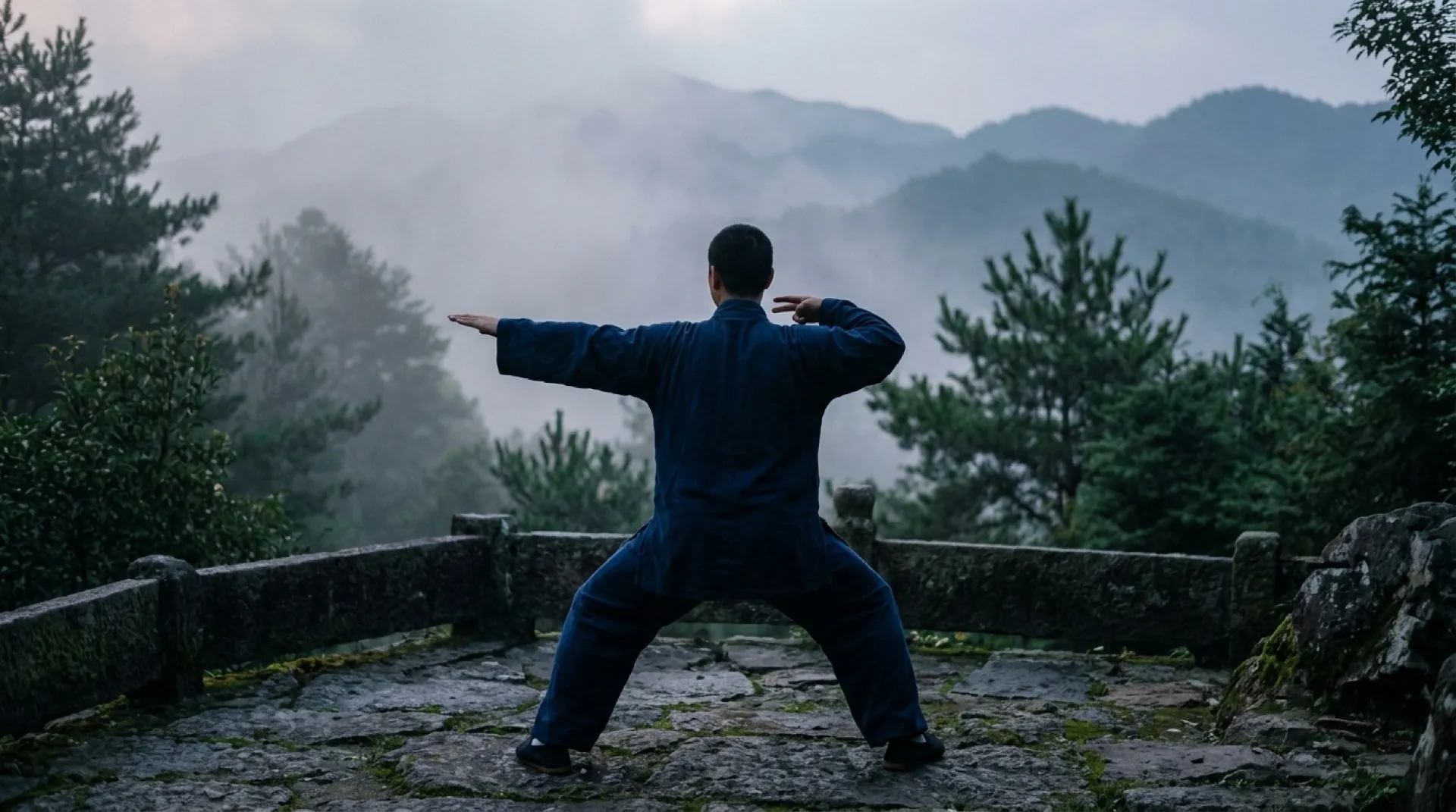
A practitioner in indigo training clothes, seen from behind, in a wide horse stance with one arm extended to the side and the other drawn back as if drawing a bow, on a stone terrace facing misty mountains.

At the very end of the traditional Eight Pieces of Brocade (Baduanjin) comes a deceptively simple movement: Beihou Qidian (背后七颠, “Rising and Gently Jolting the Heels Seven Times Behind the Back”). After seven movements of stretching the torso, turning the neck, and drawing the bow, you bring your feet parallel, rise high onto the balls of your feet as if drawn upward by a silk thread at the crown, pause for a calm breath, and let your heels drop back to the floorboards with a gentle, elastic vibration.

Why did classical Taoist Qigong and Daoyin masters choose this rhythmic heel-drop to seal the entire routine—and why is it one of the most effective 3-minute desk breaks for modern people with cold feet, heavy legs, and a top-heavy, overthinking head?

1. Three Classical Principles Behind Rising on the Toes and Dropping the Heels

  • Waking the Six Foot Meridians at the Toes: In classical meridian theory, the Three Yin and Three Yang channels of the legs (Liver, Spleen, Kidney, Stomach, Gallbladder, and Bladder) all begin or terminate at the toes and soles (Yongquan). Rising onto the balls of the feet while gripping lightly with the big and second toes activates the muscular pump of the calves (“the body’s second heart”) to return venous blood from the lower legs.
  • Vibrating the Governing Vessel (督脉) Without Straining the Brain: When your heels kiss the floor with controlled elasticity, a subtle longitudinal wave travels up through the ankles, knees, sacrum, and spine to the crown (Baihui 百会), shaking loose residual tension along the back before your final Shougong closing.
  • Grounding Floating Qi (引气下行 · 上虚下实): Echoing Chapter 26 of the Tao Te Ching (Dao De Jing)—“The heavy is the root of the light; stillness is the master of restlessness” (重为轻根,静为躁君)—bringing attention down into the heels draws excess heat and mental agitation away from the temples into the soles of the feet.

2. Step-by-Step Guide: How to Perform “Beihou Qidian” Safely in 3 Minutes

The secret to Beihou Qidian lies in the three phases—Rising, Pausing, and Cushioning the Drop:

  1. Starting Posture: Stand with feet parallel, either heels together or a fist-width apart for easier balance. Rest the backs of your hands lightly against your lower back over the kidneys, or let both palms press softly downward beside the hips (shoulders relaxed). Fix your gaze calmly on a single point straight ahead (Baduanjin Breathing & Gaze Guide).
  2. Phase 1 — Inhale & Rise Smoothly (吸气提踵 · 百会悬顶): Inhale through the nose as you press into the balls of both feet (especially the base of the big toes, so your ankles do not roll outward) and rise smoothly over three seconds. Feel the crown of your head lift toward the sky and the spine lengthen.
  3. Phase 2 — Brief Poised Pause at the Peak (极点微停 · 如立云端): Hold the elevated posture for one to two seconds without holding your breath tightly in the throat; keep the knees supple rather than hyper-extended.
  4. Phase 3 — Exhale & Cushion the Heel Drop (呼气落跟 · 轻震莫砸): Begin to exhale, lower the heels halfway with control, and let the final inch drop onto the floor with a crisp yet cushioned spring—Keep your teeth lightly closed (Kouchi 叩齿) and knees micro-soft so the vibration feels warm and refreshing through the spine, never jarring the skull. Repeat seven times count-by-count.

3. The #1 Mistake to Avoid: Never Slam Your Heels Like Iron Hammers

Some people mistakenly believe that “the harder you slam your heels onto concrete, the stronger the effect.” In Wudang practice, slamming stiff heels with locked knees sends a harsh shockwave into the menisci, lumbar discs, and inner ear. Always wear flat, cushioned cloth shoes or stand on a wooden floor or mat, keep a hair’s breadth of spring in the knees and ankles, and let the vibration resemble a gentle temple bell rather than a sledgehammer.

4. Practising Complete Daoyin Between Wudang Mountain and Singapore

Connecting the living cultivation heritage near Wudang Mountain’s UNESCO World Heritage ancient Taoist temples with our regular classes in Singapore, Wudang.Org guides students through every detail of classical Qigong. Compare our foundational sets in Choosing Your First Qigong Set, visit Start Here, or join our Singapore Baduanjin workshop.

Safety note: If you have acute plantar fasciitis, Achilles tendonitis, severe osteoporosis, or vertigo, perform the heel raise and lowering smoothly with zero drop impact while keeping one hand near a wall or chair back; traditional Qigong is a cultural wellness practice and does not replace medical care.

Seeker’s Q&A · Frequently Asked Questions

How hard should my heels drop onto the floor in “Beihou Qidian” (背后七颠)?

Lower your heels halfway under calf control first, then let only the final inch drop with soft, cushioned elasticity while keeping your knees micro-bent and teeth lightly closed—creating a warm, gentle resonance rather than a harsh impact.


How do I keep my ankles from rolling outward when rising onto my toes?

Press evenly through the balls of the big toes and second toes while keeping your inner ankles gently aligned toward the midline and your gaze fixed on a single horizontal point ahead.

Can I still practise Beihou Qidian if I have sensitive knees or plantar heel pain?

Yes—simply modify it into a smooth, zero-impact calf raise and slow lowering on a soft mat while lightly touching a chair back or wall for balance.
