QIGONG & DAOYIN · 气功与导引

“Regulating the Spleen and Stomach Requires a Single-Arm Raise” (Tiaoli Piwei Xu Danju): Wudang Baduanjin Third-Brocade Counter-Traction Guide 武当八段锦「调理脾胃须单举」单式深修:脾升胃降、上下对拔与中焦舒展导引指南

A complete practitioner's guide to the Third Brocade of Baduanjin (Tiaoli Piwei Xu Danju)—exploring the classical Spleen-ascending and Stomach-descending pivot (Pi Sheng Wei Jiang), asymmetric palm-to-heaven and palm-to-earth counter-traction, and gentle Middle-Burner Daoyin.


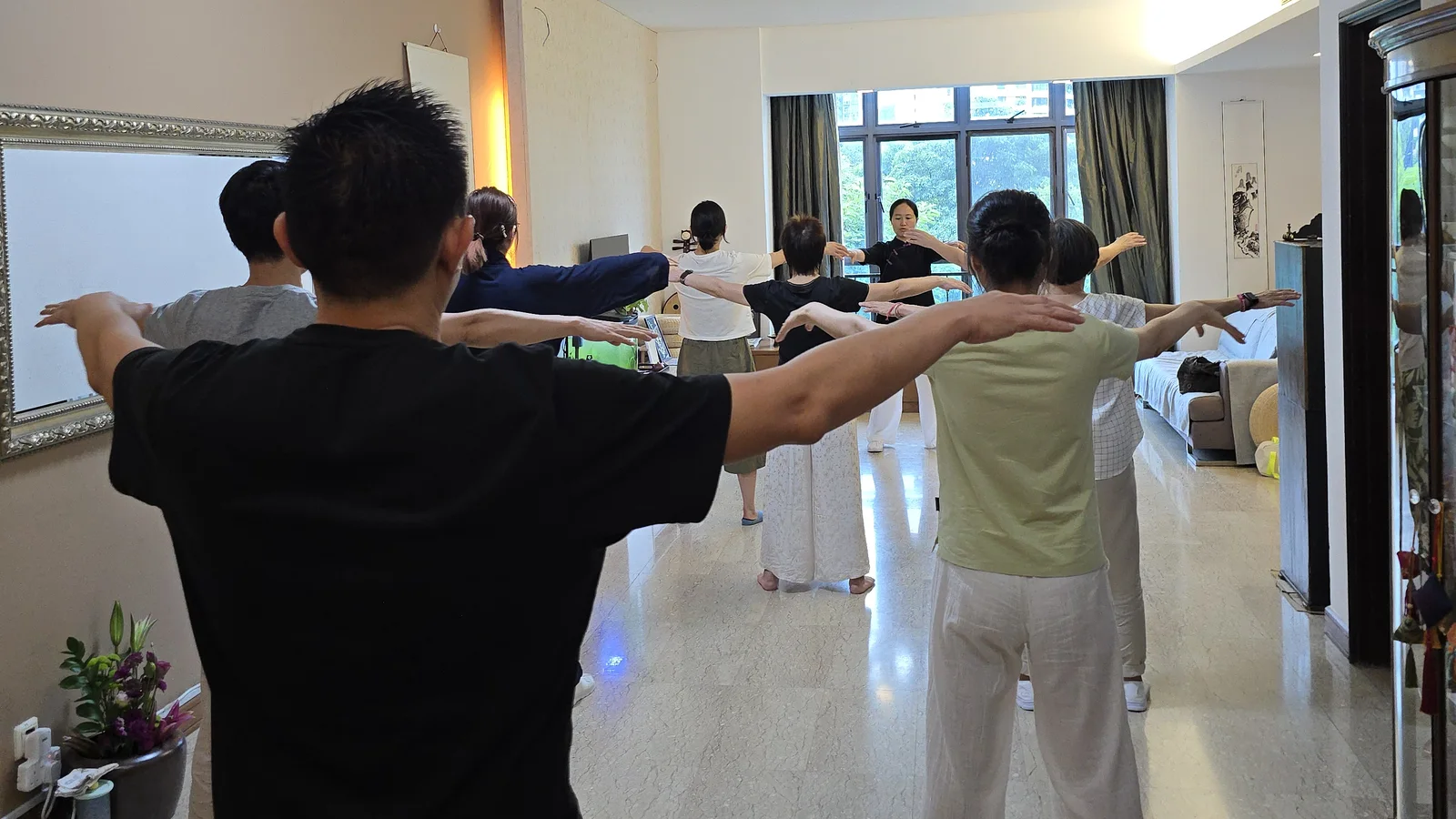
A standing qigong class in a sunlit room: students seen from behind hold both arms open at shoulder height in the same alignment, facing a teacher in dark clothing before a tall window with green trees outside.

Why a Single-Arm Raise? The Earth Pivot of Ascending and Descending (Pi Sheng Wei Jiang)

In the first movement of the Eight Brocades (Baduanjin 八段锦), both hands press upward together to stretch the Triple Burner (Liangshou Tuotian Li Sanjiao 两手托天理三焦). Why, then, does the third movement—'Regulating the Spleen and Stomach Requires a Single-Arm Raise' (Tiaoli Piwei Xu Danju 调理脾胃须单举)—insist on raising only one palm toward the sky while pressing the other palm down toward the earth? In classical Chinese physiology rooted in the Huangdi Neijing Suwen (黄帝内经·素问·太阴阳明论), the Spleen and Stomach occupy the Middle Burner (Zhongjiao 中焦) as the central Earth pivot of digestion and transformation, yet their directional tendencies are opposite and complementary: the Spleen governs the ascending of clear qi (脾主升清), while the Stomach governs the descending of received food and turbid qi (胃主降浊). Pressing one palm upward while the other presses downward mirrors this exact up-and-down counter-flow across the left and right halves of the abdominal cavity.

Biomechanics of Asymmetric Counter-Traction: Supporting Heaven and Pressing Earth

When you sit for long hours after meals or hunched over a desk, the ribcage settles heavily onto the upper abdomen, compressing the epigastrium and lateral flanks. In Tiaoli Piwei Xu Danju, the two palms create a gentle diagonal stretch through the myofascial lines of the trunk without leaning the spine to either side. The upper hand rises along the centerline past the chest and face, rotates inward so the palm faces the sky above the crown with the fingers pointing toward the opposite shoulder, and pushes gently upward from the heel of the palm (掌根上托). Simultaneously, the lower hand presses downward beside the outer thigh with the palm facing the ground and the fingers pointing forward (掌根下按). Keeping both elbows slightly curved (撑圆如环) ensures the stretch lengthening occurs through the ribs, waist, and abdomen rather than locking the shoulder joints.

Step-by-Step Breathing and Movement Coordination

Stand in a relaxed shoulder-width Wuji stance with your knees soft and both palms resting lightly in front of the lower abdomen, palms facing up as if holding a bowl of water. Inhale & Lengthen (Left Hand Up, Right Hand Down): As you breathe in slowly through the nose, draw your left hand upward along the front of your torso while your right hand turns palm-down beside your right hip. As the left hand passes forehead height, rotate the left forearm so the palm faces the sky and the fingers point right; press the left palm-heel gently upward while the right palm-heel presses downward beside the right thigh, feeling the left and right flanks lengthen evenly around a vertical spine. Pause for one calm beat without holding the breath tight. Exhale & Return: On a slow nasal exhale, turn the left palm inward and let it float down along the centerline back to the lower abdomen while the right hand softens, returning to the starting bowl posture. Repeat on the opposite side (right hand up, left hand down) for 6 to 8 alternating rounds.

Three Common Mistakes and When to Practice

To get the most comfort from Tiaoli Piwei Xu Danju, watch for three common habits. 1. Leaning the Torso Sideways: When pressing the upper palm toward the sky, keep both feet weighted 50/50 and the spine vertical; do not tilt your ribs toward the lower hand. 2. Locking the Elbows Straight: Keep a soft 10-degree curve in both the upper and lower elbows so the shoulders stay dropped away from the ears. 3. Practicing Immediately After a Heavy Meal: Wait at least 30 to 45 minutes after eating before doing full overhead stretches. Safety note: If you have a shoulder impingement or recovering abdominal surgery, reduce the upper hand height to forehead level and press with only 30 percent effort; remember that classical Daoyin is gentle daily self-care rather than a substitute for medical care.

Seeker’s Q&A · Frequently Asked Questions

What is the key structural alignment in “Regulating the Spleen and Stomach Requires a Single-Arm Raise” (Tiaoli Piwei Xu Danju)?

A complete practitioner's guide to the Third Brocade of Baduanjin (Tiaoli Piwei Xu Danju)—exploring the classical Spleen-ascending and Stomach-descending pivot (Pi Sheng Wei Jiang), asymmetric palm-to-heaven and palm-to-earth counter-traction, and gentle Middle-Burner Daoyin.
